

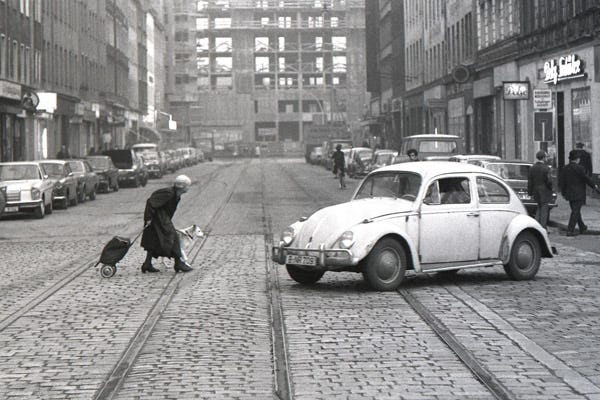
One of my favourite things as a child in 1990s Germany was visiting my cousin in Berlin. I’d hop on the train in rural, small-town Brandenburg, and within an hour, green would give way to grey, and I’d step out into the bustling metropolis.
My cousin lived in Treptow, not far from where the Berlin Wall was still standing but no longer preventing people from moving across the city. Only a few years earlier, the row of houses across the street had actually been part of the Berlin Wall. You needed special permission papers to visit people who lived there.
Unlike our parents a few years earlier, we were free to roam the city now. We would often cycle over bridges and along busy roads to visit my cousin’s grandmother. I loved doing that. Berlin appeared to be full of eccentric people. I heard there was a posh old lady walking a pet monkey. As a provincial kid, I found all this endlessly fascinating. My cousin’s granny didn’t have a monkey, but she lived with a cat, a canary and a tortoise. And she was a great storyteller.
During those visits, an image of “old Berlin” emerged in my head, a cool and evocative place full of larger-than-life characters, a place where anyone could be anything. I found out much later that this is how many people — East and West, in Germany and beyond — imagined West Berlin during the Cold War. As a Cold War island, it attracted countless creatives and hedonists. It inspired spy novels. Its draw was enough for many East Germans to risk their lives to try to get there.
But what was West Berlin really like? I asked historian David E. Barclay that question. Not only did he live in West Berlin himself, but he’s also just published a brand new book about it called Cold War City: A History of West Berlin, available from Princeton University Press in the US and the UK. He has kindly agreed to write an exclusive guest piece for us here at ZEITGEIST. Enjoy!
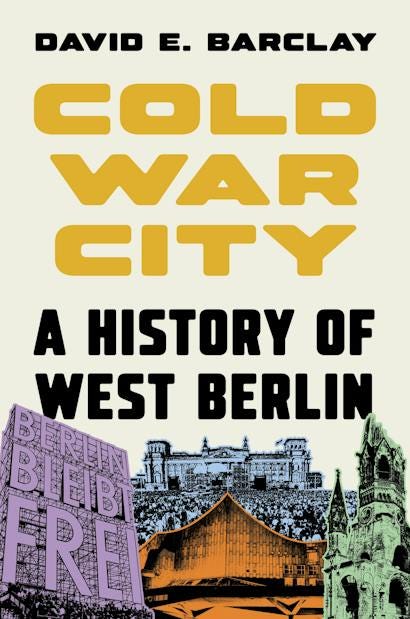
How “cool” was West Berlin?
By
David E. Barclay
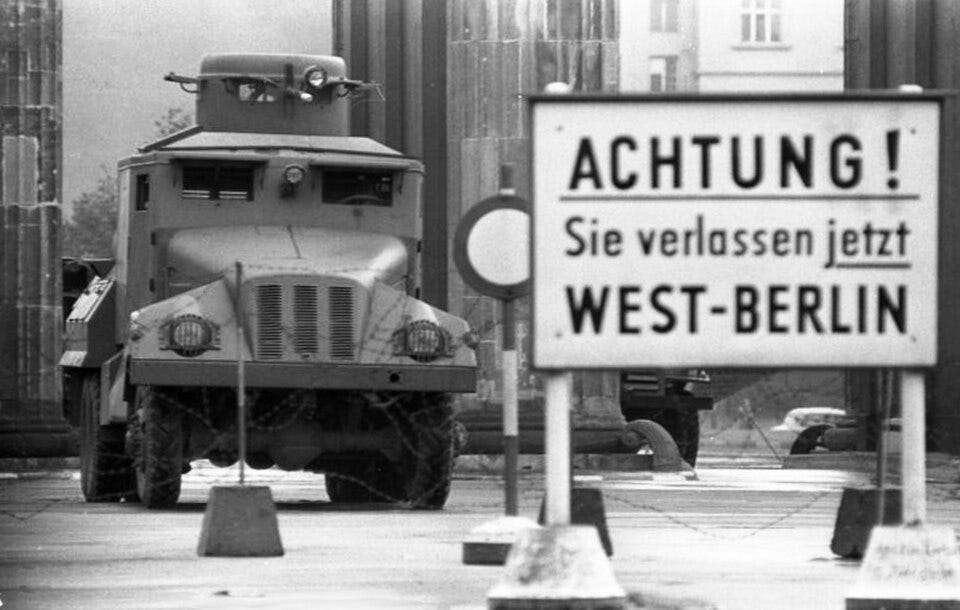
During the earliest phases of the Cold War, West Berlin, that strange “island city”, located 110 miles inside East Germany, gained a reputation as an “outpost of democracy”, a showcase of Western values inside the Iron Curtain, a beacon of freedom in a communist sea. West Berlin was also widely regarded as the flashpoint of superpower confrontation where World War III was most likely to happen.
Ironically, perhaps, things began to change after the building of the monstrous Berlin Wall in 1961. It completely enclosed West Berlin and largely stopped the flow of refugees from East to West. A decade later, the 1971 Quadripartite Agreement between the wartime victors France, the Soviet Union, the United Kingdom and the United States cemented the status of West Berlin and sent a clear signal that it was now on the back burner of global politics. This odd status quo persisted until the fall of the Wall in 1989.
But if West Berlin was no longer a source of global political tension, a new kind of reputation seemed to replace older spy-thriller tropes. Indeed, since the student revolts of the mid- to late 1960s, West Berlin was increasingly perceived as a “cool” city, a congenial home for what the musician and writer Wolfgang Müller called “squatters, anarchists, ecos, freaks, punks, lesbians, gays, queers, trans people, conscientious objectors, all the members of the subcultures who fled to Berlin from the stuffiness and narrowness of a reactionary bourgeoisie, the capitalist sausage-making machinery, or the constraints of real existing socialism”. In short, he suggests, for many people West Berlin became a refuge from both postwar German states.
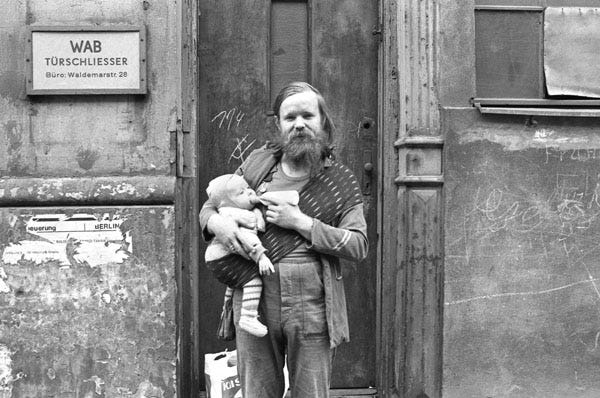
But how “cool” was West Berlin really? To some critics, West Berlin after the Quadripartite Agreement was sinking into what one British diplomat called “staid and dull provincialism”. It was a place full of both pensioners and students, economically and financially dependent on outside subsidies, while its traditional industrial base was departing.
Many West German university students chose West Berlin because they could avoid military conscription by living there. It had become the plaything of corrupt and mediocre politicians, the critics continued. It was certainly no longer a “showcase”, they asserted.
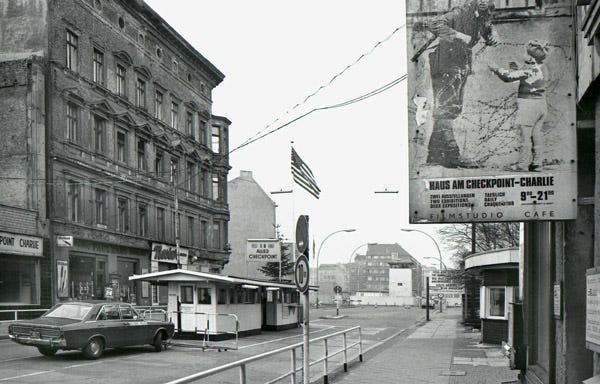
Some observers, like the British diplomat Sir Oliver Wright, described West Berlin in 1975 as “an agreeable backwater” with “the tranquillity of a cul-de-sac”. German observers could sometimes be even harsher. The acerbic critic Henryk Broder was unsparing in his assessment of the walled-in half-city in the 1980s: “West Berlin was hysterical, petty, shitty, full of dog crap — a city where you were constantly running your nose into something, because it really was a totally enclosed little enclave. With hysterical people and such a demonstrative survival symbolism.”
Despite his own complex attachment to West Berlin, writer Peter Schneider described it as a “society without a future”, while the journalist Paul Hockenos has suggested that, for many people, its “decrepit cityscape” held a kind of “morbid charm”.
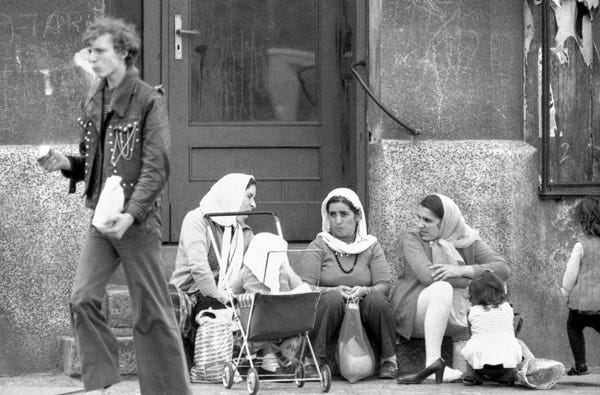
The West Berlin politics of the 1970s and early 1980s hardly seemed conducive to “coolness”. The island city endured a series of sensational financial scandals in those years, three of them involving corruption in the building trades, while speculation in the city’s housing stock led to a wave of squatting and confrontations with the West Berlin police. Little wonder, then, that West Germans and others came to deplore what they called the “Berlin swamp”.
Given the easing of Cold War tensions after the early 1970s, did West Berlin even still serve a purpose? Or was it simply a bizarre anachronism, a leftover from the early years of the Cold War?
The answer is obvious if trite: It all depended on whom you talked to, and where, and about what. All of Berlin — West and East — had long been a city of neighbourhoods, or Kieze as they are called in Berlin, intimate spaces where one could socialise or be left alone, as one wished.
The united city of Berlin now contains 542 Kieze, which are recognised as “official planning spaces”. By the 1970s more and more Kieze, especially in the boroughs of Kreuzberg and Schöneberg, were becoming distinctive cultural, political, social and economic niches, separated in many important respects from the rest of the island city.
As Wolfgang Müller also pointed out, Berlin’s Kieze became refuges for people who were trying to get away from somewhere else. To David Bowie and Iggy Pop, two bona fide rock legends, West Berlin became a place of personal and artistic rejuvenation in the 1970s. Some of their most memorable compositions date from their time in West Berlin between 1976 and 1978, including Bowie’s great song “Heroes,” recorded at the celebrated Hansa-Studio in the shadow of the Wall.
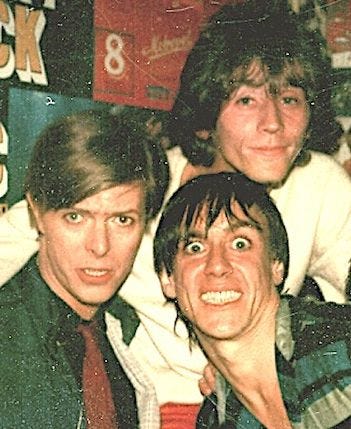
In West Berlin, just about anyone could be invented or reinvented. Bowie and Iggy Pop were two particularly famous examples. So too were celebrated individuals like Romy Haag, born in the Netherlands as Edouard Frans Verba, whose famous club “Chez Romy Haag” attracted stars from around the world.
With all its diversity and contradictions, West Berlin had become what Germans call an experimental Biotop, where practitioners of alternative politics and lifestyles coexisted, sometimes uncomfortably, with more traditional Berliners and with representatives of the occupying Western powers.
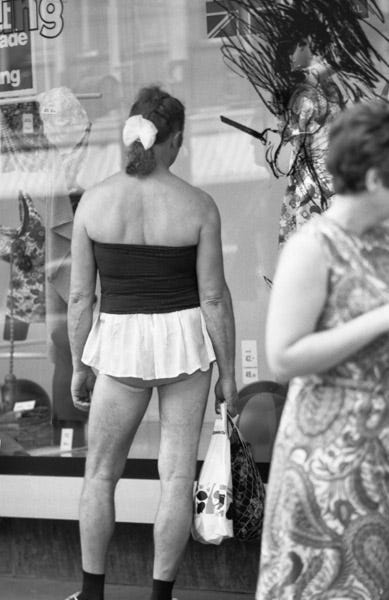
Until 1990, the Allied powers remained the ultimate source of authority in the Biotop, and not the Federal Republic of Germany. Those Allies and the “alternative” residents of West Berlin lived in a strangely symbiotic relationship, as the things that made West Berlin “cool” were only possible thanks to the Allied presence.
That coexistence was on display in 1973 at a Rolling Stones concert I attended as a student in West Berlin. About half the attendees seemed to be American and British soldiers, with a few French soldiers as well. The other half seemed to come from the alternative communities in Kreuzberg, all united by the Stones’ music and rocking together under a vast cloud of cannabis smoke.
The alternative niche communities didn’t always get along with the authorities or with older Berliners. More than a few times, especially during the heyday of squatting in the 1980s, violent confrontations resulted. This all led Eberhard Diepgen, the governing mayor of West Berlin between 1984 and 1989 (and of united Berlin from 1991 to 2001), to describe members of the alternative communities as “anti-Berliners”.
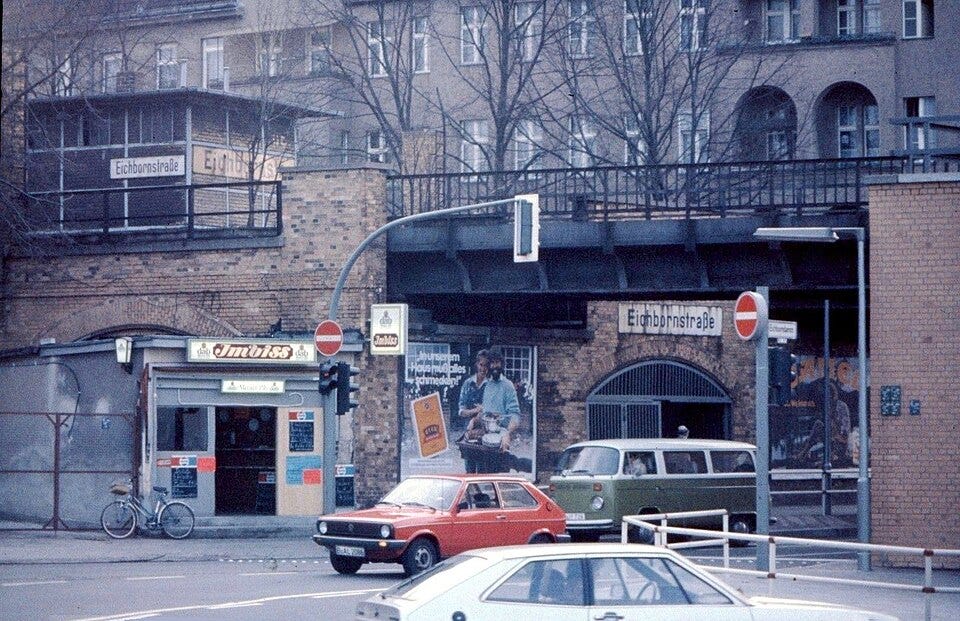
Yet it was precisely those so-called “anti-Berliners” who helped make West Berlin a “cool” city, with their bars, clubs, cafes, music, galleries, studios, festivals, bookstores, communes, left-wing daycare centres, alternative politics and other expressions of an experimental lifestyle that were among the most dynamic and creative in the world.
To this must be added what I suppose might be called the world of the “traditional” arts, from an edgy theatre like the Schaubühne under the always innovative Peter Stein to the opera and classical music scenes, such as the Deutsche Oper under the legendary Götz Friedrich and the Berlin Philharmonic Orchestra under the baton of Herbert von Karajan.
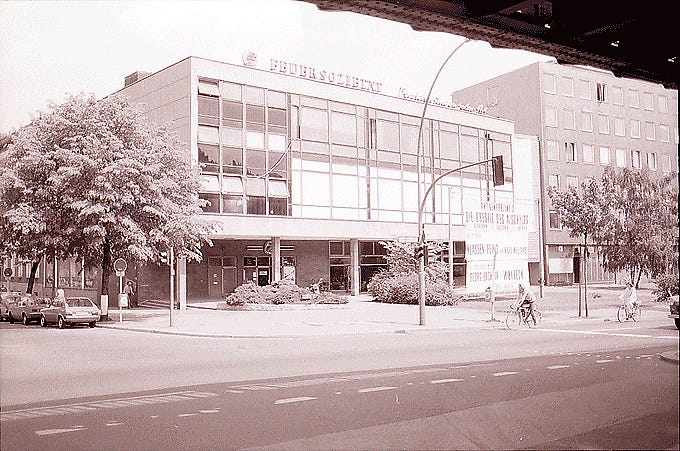
Looking back years later, one prominent American diplomat, Harry Gilmore, reflected, “West Berlin was a mecca, particularly for opera and classical music. . . . In fact, I would argue that the cultural power of Berlin, the two parts together, during the 1970s and 1980s was unsurpassed by any of the other great cultural cities, New York, Paris, Rome.”
So was West Berlin an “agreeable backwater” or a “cool city”? Perhaps it was both at the same time, depending on where in West Berlin one lived and with whom one associated. Of course, living within the confines of a walled-in half-city complicated things, though most West Berliners had come to terms with that strange status, and the half-city was large enough to allow people to live their own lives.
Certainly there can be little doubt that the post-1990 “New Berlin” continues to be one of the “coolest”, most exciting places on earth. And I would contend that the seeds of that “coolness” were planted in the West Berlin of the 1970s and 1980s. A “cool” city? Yes, it was. Provincial and politically second-rate? That too. West Berlin was a strange and unique place like no other.
I had a German girlfriend who was a student in the late 70s and early 80s. For her and her friends WB was the place to be, as there was no conscription and freedom from the dull conformity of West Germany.
West Berlin was the coolest place in the German speaking world when you were a student. Yes it was not glamorous or esp. pretty