

I must admit that after months of talking and writing about Weimar and the state of German politics today, I’m feeling a little washed out. I’ve found myself enviously watching fellow passengers on trains and planes reading novels or watching TV shows on their devices while I listened to yet another German news podcast or furiously typed on my laptop to meet deadlines or schedule interviews.
I’m not complaining – being a travelling historian is a dream job many people would give their right arm for – but I appear to have reached a saturation point where every spare moment is taken up by German thoughts. You know you’ve overdone it when you sink into the dentist’s chair as if you were at a spa.
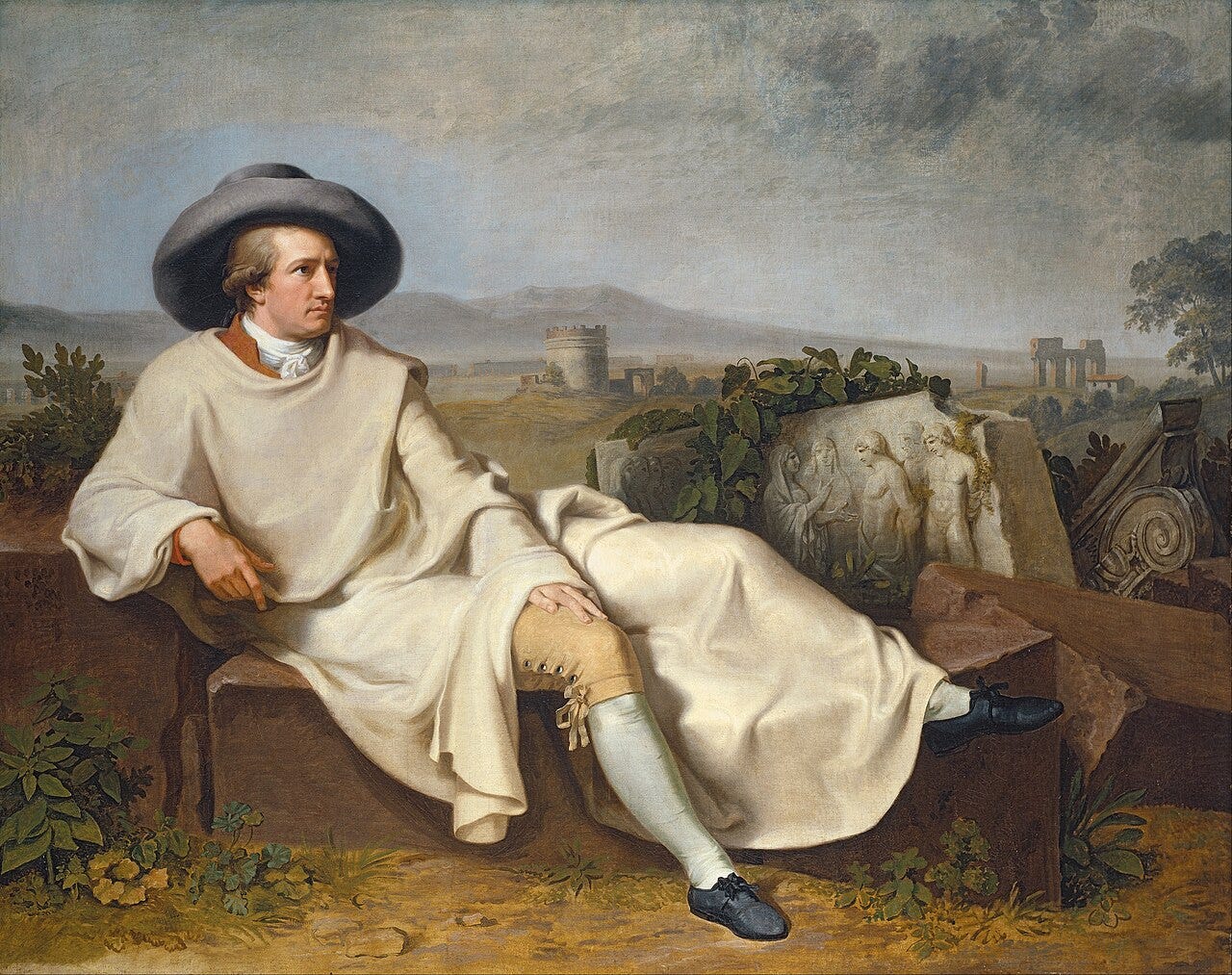
So I’m taking some inspiration from the famous German poet Johann Wolfgang von Goethe. I’m off on an Italian Journey.
If you’ve read my Weimar book, you may recall that Goethe’s presence in the town still hung over everything in the 20th century. Today, he is still widely regarded as Germany’s national poet. I had to recite many of his writings at school, and we read and watched plays like Faust. Despite the fact that he died in Weimar in 1832 – now nearly 200 years ago – his kudos there never diminished, and tourists still flock to the town to bask in his legacy.
Born in Frankfurt in 1749, Goethe moved to Weimar in 1775 following the success of his first novel, The Sorrows of Young Werther, which had become a veritable cult read, especially for young people across the German lands. At 26, he was himself still rather young but already famous across Europe. During his years in Weimar, Goethe had to be much more than a writer, though. He became closely involved in the government of the Duchy of Saxe-Weimar and served Duke Carl August, who ennobled him in 1782.
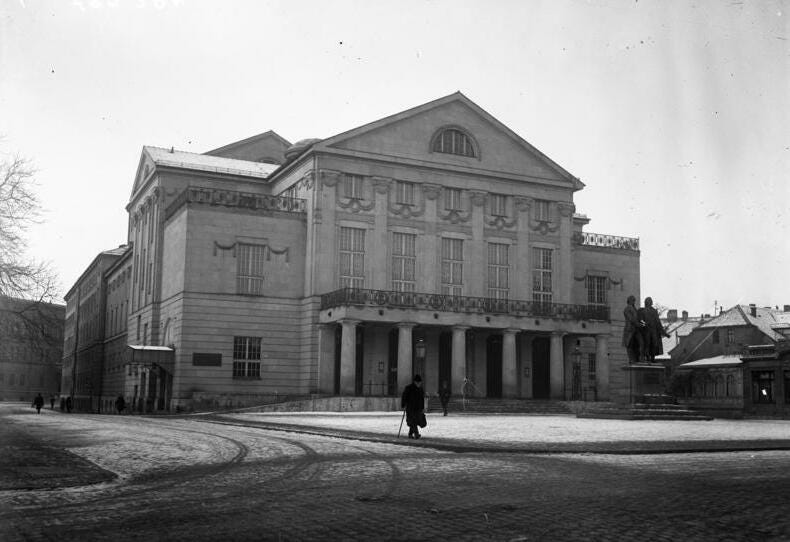
This was hard work. Goethe dealt with stuff like finance, mining, roads and military affairs while also pursuing his wide range of interests in all sorts of things from science and literature to the arts. Weimar itself was a relatively small court, but under Carl August it was becoming a lively centre of German intellectual life. Goethe was at the heart of it, enjoying a fruitful working relationship with his pal and fellow writer Friedrich Schiller. There’s a memorial to the pair of them in front of the Weimar theatre (which Goethe was the managing director of) to this day.
By the mid-1780s, though, the workload was beginning to wear him down. He had been in Weimar for more than a decade and had accumulated a formidable load of responsibilities. He was also so famous that it became difficult to be Goethe, the curious young man, rather than Goethe the court official or the celebrated author. Everyone wanted something from him. The pressure to produce the next successful thing was enormous. He began to develop a classic writer’s malaise, sapping the energy and inspiration to be who everyone wanted him to be.
So, in September 1786, he just left. He made no great public announcement. Nor did he tell his friends what he was up to. He just negotiated with the Duke that he’d be suspended from his duties while still being paid for them. On 3 September, he set off southwards, initially incognito, using the name Johann Philipp Möller. His destination was Italy, a place he had wanted to see for years but never quite got round to.
For an eighteenth-century German intellectual, Italy was practically a must-see. It was the land of ancient Rome, Renaissance art and classical architecture. Due to the way the Holy Roman Empire worked, with emperors traditionally anointed and crowned by the Pope in Rome, Italy had loomed large in the German imagination for centuries. The very founding concept of the Holy Roman Empire involved translatio imperii – the “transfer of rule” – from Rome to Germany-speaking Europe. Like many Germans, Goethe had spent years picturing Italy. Now he could finally see it for himself.
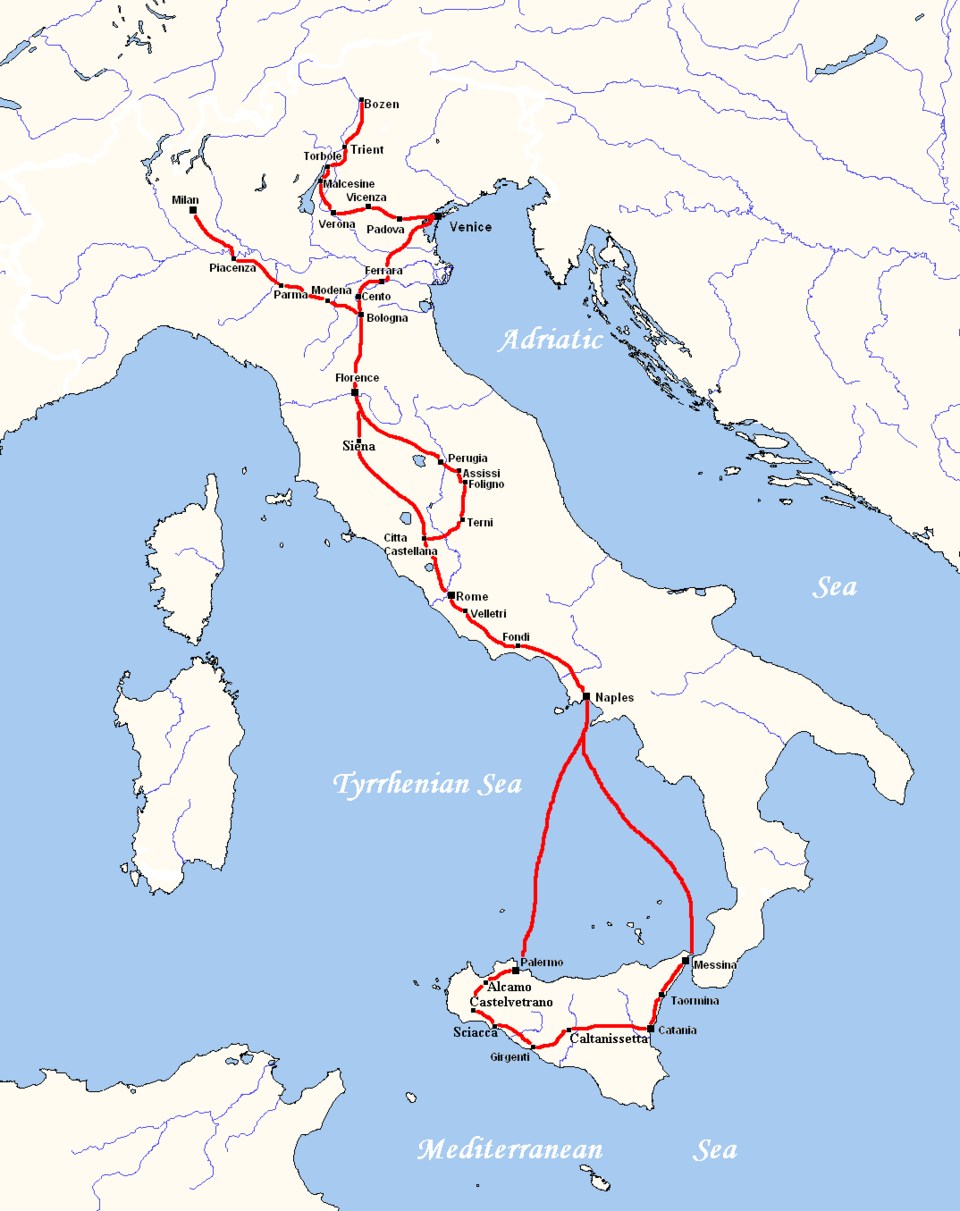
He travelled across the Alps, passing through Innsbruck and the Brenner Pass before reaching Verona. From there, he went on to Vicenza and Venice and then south towards Rome. Travelling under an assumed name gave him at least some freedom to move around without being recognised – much easier done in an age before photography and mass media.
He arrived in Rome, his main destination, on 29 October 1786. There is genuine excitement about this in his letters. For years, Rome had existed in his imagination, and here it was. Suddenly he could walk through its streets, see its ancient buildings and visit sculptures he had previously mostly encountered as reproductions. He spent some time with artists and practised drawing himself.
Goethe’s Italian journey was also a way of reviving his curiosity in all sorts of other things, including the natural world. He was interested in almost everything he saw, collecting plants, observing geological formations and studying ancient monuments. I thought about making a bad joke about him being a Renaissance man but thought better of it. I think you get the picture.
In early 1787, he travelled further south to Naples, which gave him access to the archaeological sites of Pompeii and Herculaneum, while Paestum offered its well-preserved Greek temples. He then travelled on to Sicily, which fascinated him partly because of its connection with Ancient Greece. Goethe was deeply interested in that, but an 18th-century journey to Greece itself was considerably less well-trodden than Italy.
The Italienische Reise had the intended effect on his work. Goethe worked on Iphigenia in Tauris (another classic I was made to read at school), finished various other works he’d started in earlier years and produced material that would contribute to his later cycle of twenty-four poems called Roman Elegies.
More broadly, his experiences helped shape the style of the later Goethe. He eventually returned to Weimar in June 1788, after nearly two years away. He had left as a burnt-out court official and returned as a re-energised writer. He told the Duke that he had found “new youth” in Italy and even experienced a “rebirth” of sorts there as an artist.
Well, I have high hopes then for my own Italian Journey this week. While Rome is one of my personal happy places and I have been there many times to soak strength and energy from its ancient soil, I’m off to northern Italy this time. I won’t be away for two years – unlike Goethe, I can’t suspend my duties and expect to get paid anyway – but hopefully I’ll return to all things Weimar just reenergised, as that great German poet once did.
Gute Reise!
Have a well relaxing trip ,personally I would be off exploring the Gothic line with Mrs Adie saying what is it with you and bunkers .