Death Strip to Green Belt: Walking the Berlin Wall
On Moving on without Forgetting

I was in Berlin yesterday and on my way to a recording studio to give a long-form interview about my new book Weimar. My head was full of thoughts about how I might answer the questions, and it was also busy re-adjusting to the German language. So I wasn’t paying much attention to my surroundings until I literally stumbled upon some history.
There, in the ground in front of my feet, was a narrow line of cobblestones and a plaque that read “Berliner Mauer 1961-1989”. Isn’t that remarkable? Here was a line that had once divided people, ideologies, a country, worldviews, families and the city itself. And I had very nearly crossed that line without giving it so much as a thought. That didn’t seem right. After all, here, where I was standing now in the spring sunshine, a cup of takeaway coffee in my hand and a pair of subglasses on my nose, had once been a heavily fortified border where people were killed if they tried to cross.
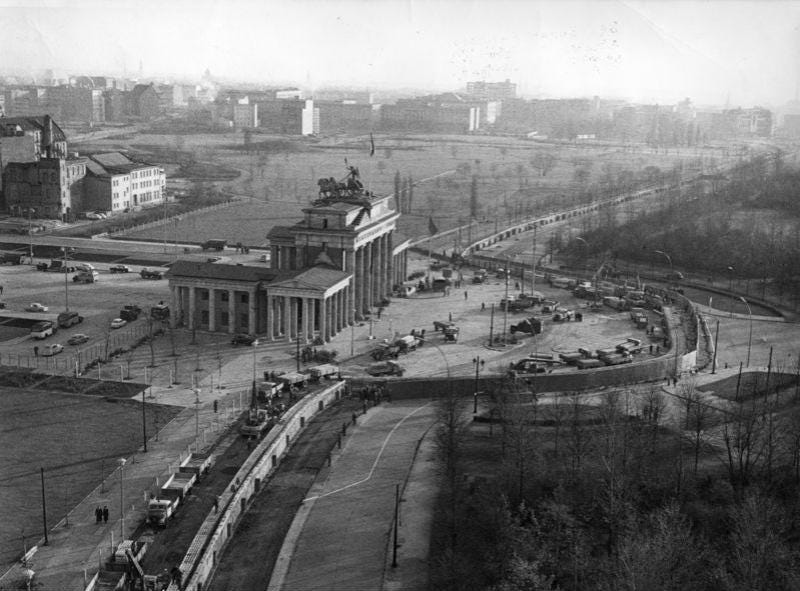
Between 1961 and 1989, the Berlin Wall encircled West Berlin, cutting it off from East Berlin and from East Germany itself. What had begun as a ramshackle collection of barriers consisting of bricks, barbed wire, bodies of water and soldiers with weapons developed into a vast, deadly and near-impregnable fortification over the years.
Berlin learned to live with it. I have vague memories of visiting my uncle in East Berlin as a small child in the late 1980s and being told that there were certain routes we couldn’t take on afternoon strolls because “we just can’t go there”. Close to four decades later, here I was walking from East Berlin into West Berlin without a second thought.
In many ways, that’s a very good thing, of course. The Berlin Wall kept people apart who never asked to be kept apart. It curtailed the freedom of movement of East Germans on pain of death. It brutally cut a city in two that had never been designed that way. The fact that Berlin is overcoming this trauma so successfully that people walk across the former border every day without realising it is remarkable in itself.
But there is a fine line between overcoming an aspect of the past and forgetting it. Berlin is very keen to ensure that it marks and remembers its history, and the Wall is no exception. Of the once-155 km-long installations, only around 2km remain today. It would simply have been neither practical nor desirable to retain the entire thing, since this would have kept the city physically divided. The Wall cut through existing infrastructure like roads and houses, over bridges and along the Brandenburg Gate. It had to go.
So today, only individual segments remain. The longest and most famous is the East Side Gallery, a 1.3km stretch on which artists have painted a series of murals. This is the bit tourists usually ask for and photograph a lot. There is also a smaller remnant at Bernauer Strasse and a 200-metre-long original piece on the grounds of the “Topography of Terror” exhibition. But that’s pretty much it. Otherwise, Berliners and visitors can walk freely and unimpeded from one part of the city to the other. As well they should.
To allow people to move freely without forgetting that they once could not, 5.7km of the former Berlin Wall are now marked with cobblestones and plaques like the one I stumbled upon. What happened to me yesterday is exactly the desired effect. You’re walking from A to B, not consciously looking around or thinking of history, and then you stop and look down. I think it works well. I certainly get a strange feeling each time I cross these markers so easily today, markers that once denoted the fault line between two worlds.
It’s a small thing, but it reminds me of the huge impact history has on our lives. I was born to the east of that line, born on the side that that line kept cut off from the other. Where those cobblestones act as a memorial today, once stood a structure that would have prevented me from travelling to England, never mind setting up a life for myself there. Today, it’s a line I cross easily and regularly, several times a year. That would have been unthinkable when I first stood there as a small child, wondering why we couldn’t walk down a certain road after having coffee at my uncle’s flat.
The rest of the former Berlin Wall is marked in other ways. There is a Berlin Wall Trail that traces the entire 160km of the Wall around West Berlin. Some sections have information plaques. Others display remnants of the military installations that were once used. Yet others have crosses or memorial plaques dedicated to the victims, people who were killed or died trying to cross the Wall. Another stretch is lined by cherry trees, which were donated by Japanese citizens. They are now a tourist attraction in their own right when they bloom.
If it seems odd that people are walking the Wall today amid the splendour of parks and cherry blossoms, the same idea was applied on a much greater scale along the long inner-German land border separating East and West Germany. Since setting up the border involved leaving a broad belt of “no-mansland” between the fortifications during the Cold War, wildlife flourished there undisturbed. It was a strange side effect of the deadly installations and the brutal shooting orders: nature was left to its own devices, and a unique biotope emerged.
The former border was nearly 1,400km long and stretched all the way from the Baltic Coast through the centre of Germany and to the border with Czechoslovakia. From 1989 onwards, groups campaigned to protect this unique area as a nature reserve, Germany’s largest connected group of protected environmental spaces.
So I will leave you on this Thursday morning with the beautiful thought that the old Death Strip is now a Green Belt — a great symbol for our ability as humans to move on without forgetting.


It is to great credit to the city of Berlin how the wall has been allowed to melt away but not forgotten, to be a memorial and a tourist attraction, of course thousands of tonnes of concrete have appeared since pertaining to once being part of the wall.
Berlin one of the worlds great cities, feel I need to visit again it’s been a few years , it’s an historians love affair 😃