Did Dadaists invent Brainrot?
On the art of nonsense a century before TikTok

I’m getting old. No, seriously. The Telegraph and Peter Hitchens may still describe me as a “young” historian — and don’t get me wrong, I will gladly accept that description for as long as it’s given — but I’ve begun to shake my head at “young people”, and that’s got to be a surefire sign that I’m not one of them anymore.
To put that into a bit of context: I’m at the oldschool-childhood end of the “Millennial” generation. I technically belong to the early “digital natives”, but I can still hum the dial-up sound of modems, and that comes from a very different world compared to the one Gen Z and Gen Alpha have grown up in. Theirs involved constant exposure to the internet, smartphones and social media. Their in-jokes and behaviours are influenced by the logic of the internet and are therefore difficult to comprehend for those of us who grew up in a largely analogue world.
I remember being very confused a few years ago when someone randomly shouted “Can I get a Hoya?” at Embankment Tube station in London. It’s so close to my last name that you can imagine how my head snapped up as I wondered what was going on. Even more confusingly, this was met with a small chorus of “hoya” shouted back by random strangers. I had to Google that later to find out that it was a TikTok trend. Apparantly, it goes back to influencers asking for a “hell yeah” in response to their content, and then it took on a life of its own with people beginning to do this all over the world.
At its root, this is a kind of call-and-response thing — a communal activity presumably as old as humanity itself. In music, many compositions use it as a technique. It’s used in prayer (Amen!), games (Marco!) and by rock stars (Give me a “yeah-yeah”!). So there are ways in which internet culture echoes older, analogue behaviours. But one internet-culture phenomenon I hadn’t found an analogue equivalent for until recently is brainrot.
In case you’re not familiar with the concept, brainrot is internet content deemed so pointless and inane that it’s said to erode your mental faculties if you overconsume it. Take the subcategory of Italian brainrot, which involves internet memes depicting absurd, AI-generated characters with Italian-sounding names and synthetic voiceovers. They are deliberately nonsensical and draw their humour from bizarre characters and random stories.

A well-known example is Bombardiro Crocodilo, a crocodile fused with a military bomber, introduced with dramatic faux-Italian narration. Anyone not immersed in brainrot culture or regularly exposed to TikTok and Instagram algorithms will wonder what the point is. Don’t bother. The point is that there is no point.
The reason I think I can get away with discussing this issue on a German history blog is that brainrot culture has been compared to the art movement Dadaism, which took off during and after the First World War and gained many followers in Weimar Germany, particularly in Berlin.
Having pondered the matter a little this week, I think I buy many of the arguments that have been made comparing Dadaism and Brainrot. Only last week, an article in the German newspaper Die Welt linked the two. “Brainrot,” culture editor Julian Theilen wrote, “is the new avant-garde because it borrows from Dadaism.” In the London art magazine Plaster, the writer Günseli Yalcinkaya, too, argued that “as a medium, brainrot is intentionally absurd, context-less and fast-paced, a total parody of internet culture itself, drawing comparisons to another 20th- century art movement: Dadaism.”

I can see why the comparison is made. Both movements are gleefully absurd and can leave outsiders wondering whether they’re missing some profound artistic statement. Both toy with nonsensical language, and there’s a surprising penchant for crocodiles in both cultures, too. More on that in a moment, but let’s have a quick look at Dadaism first.
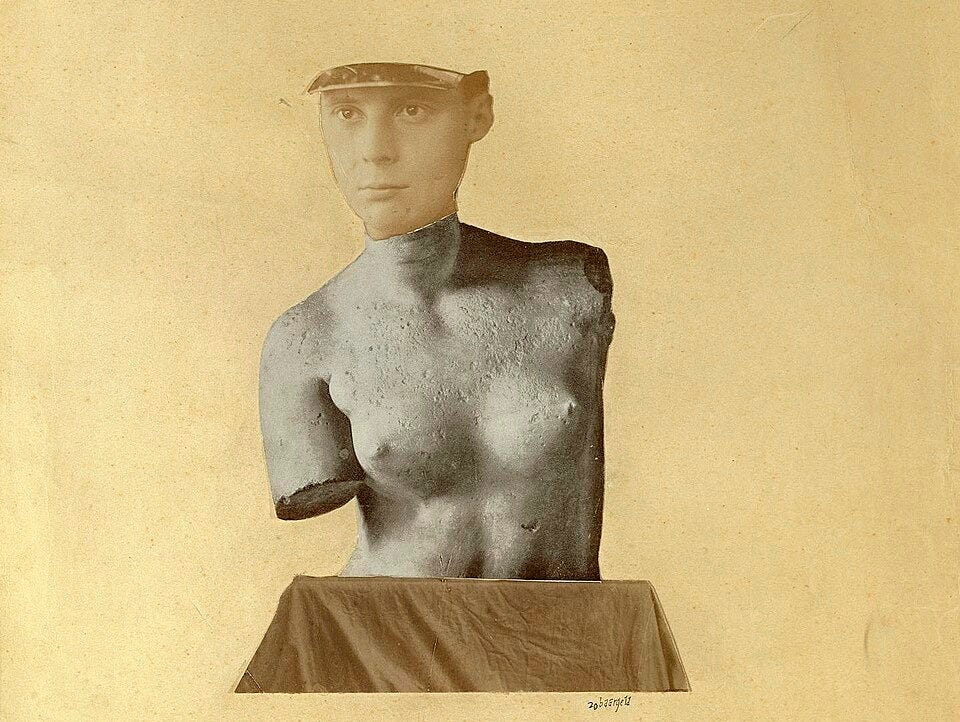
It was an artistic response to the horrors of the First World War. As millions died in a conflict fuelled by industrialisation and supposedly rational political systems, many artists concluded that the world itself had stopped making sense. There was a strong political dimension to their work, too, in that Dada explicitly rejected the cold logic of reason and capitalism that in its adherents’ eyes had led to the war.
The artists’ response to the trauma of industrialised warfare was to reject conventional ideas about art and culture. Instead of carefully crafting paintings or poetry with thoughtfully arranged compositions, Dadaists produced nonsense verse, bizarre performances, collages made from found objects and works designed to ridicule the very idea that art had to follow rules. Dada embraced absurdity as a serious statement of intent.
This seriousness was what struck me most when I stumbled across the movement in my research on the town of Weimar. The Dutch artist Theo van Doesburg spent time in Weimar, teaching courses at the Bauhaus school of art and architecture in 1921 and 1922. Being the main proponent of Dadaism in the Netherlands, he convened a congress of Dadaists and Constructivists in the town in September 1922. Constructivism and Dadaism had almost opposite attitudes toward art and society. Dadaism embraced nonsense while Constructivism believed art should be rational, functional and help build a better society.
Doesburg wanted to see sparks fly and invited prominent people from both sides to Weimar. Against the odds, Constructivist and Dadaist delegates got through a full programme together. They enjoyed a Dada soirée at the Hotel Russischer Hof for which Doesburg had designed the tickets.
They listened to “Wedding March for a Crocodile” (Marcia nuziale per un coccodrillo) by the young Italian composer Vittorio Rieti and to the recital of a poem by the influential German artist Kurt Schwitters about the letter W, “a symphony of sounds, which took our breath away”, one of the attendees remembered.
Both Dada and Brainrot are challenging the boundaries of what counts as art and entertainment. Even the experience of trying to explain them is remarkably similar in its futility. When I ask young people why Brainrot is funny, I usually get a shrug. You have no idea how much time I spent trying to understand Dada when researching for Weimar. I’m not a particularly arty person and for a long time I thought I wasn’t getting it. Then I finally realised there was nothing to get.
But there is a significant difference in the intent and origins of the two cultures. For Dadaists, absurdity was a means of attacking a society they believed had failed catastrophically. The movement was also deeply political and serious even when its artworks looked deliberately ridiculous. By mocking reason, order and artistic convention, Dada was making an argument about a world that had descended into violence. It often contained sharp criticism of the class system and bourgeois conventions.
Brainrot, by contrast, doesn’t appear to be protesting anything, or at least none of the young people I asked about it could tell me why they engage with it. It seems to be internet culture entertaining and mocking itself. It certainly doesn’t seem to be an explicit political response to war, crisis or social breakdown. But that’s not to be dismissive. I rather think there’s something quite endearing about the inclusivity of brainrot while Dada remained niche and pretty exclusive.
Brainrot captures the strange logic of the internet rather well, perhaps better than many more self-conscious forms of art. It’s collaborative, endlessly variable and powered by algorithms that reward surprise and novelty. Characters evolve because thousands of people collectively add to the joke, each trying to make it stranger than the last.
What starts life as a pretty budget-looking AI image can become an elaborate shared universe with its own lore. It often spills over into the real world, too, in new words, phrases or references, like the annoying “six-seven” thing, which doesn’t appear to mean anything. Kids just shout it, and when you ask them why, they tell you that “it’s a thing”. Type it into Google and see what happens.
So is Brainrot digital Dadaism? Maybe. I think they have different purposes and contexts, with one arising from the trauma of war and the other from the logic of internet algorithms. But they arrive at similar aesthetics. They may not be exactly the same movement, separated by a century, but they do seem to share a belief that the most effective way to capture a chaotic world is to stop pretending it makes any sense.


