Dispatch from Berlin
How will Weimar land in Germany?
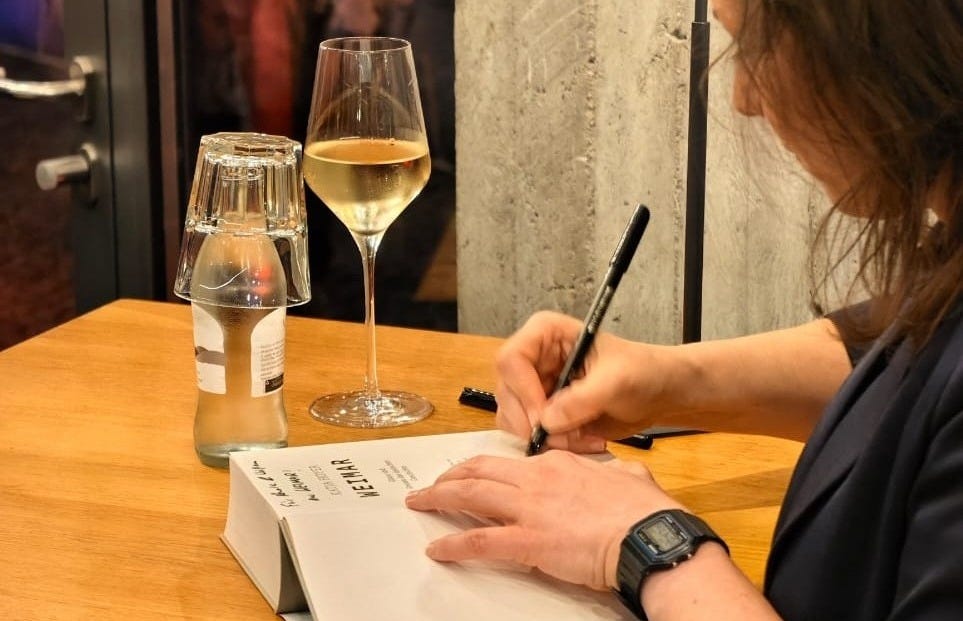
When this article lands in your inbox, I will be fast asleep in a hotel room in central Berlin. My head will be filled with German thoughts and perhaps the lingering fumes of a beer or two… My German book launch will be behind me.
I was genuinely curious to see how the German public would respond to Weimar. It came out alongside the English and Dutch versions on 7 May, and there was no way of telling how it would go down in the country it is about.
My last book, Beyond the Wall, contributed to a big and acrimonious debate about East-West relations in post-unification Germany and how the GDR should be remembered. There was sharp, often rather personal, criticism, as well as praise and passionate defence of my book. It was an intense time for me, but in the end, Beyond the Wall became a bestseller in Germany, and I was grateful for the opportunity to contribute something meaningful to my birth country’s discourse with itself.
So what would Germans make of Weimar? It’s a book that once again aims to explore history through the eyes of the people who were there. Only this time, it’s about the darkest chapter of German history.
When I gave a talk at a conference for German academics a couple of years ago and explained my general method of exploring big history through smaller, human stories, one of the delegates asked aghast: “Surely you can’t use this kind of approach to explore the rise and reign of the Nazi dictatorship?! What if readers feel empathy for people who enabled the regime or who voted for Hitler?”
It’s true that I’m treading a fine line here. I want readers to be able to understand why people did what they did, not endorse or justify their behaviour. I trust readers to make their own judgements — indeed, I want them to think rather than merely absorb — but I can see that this may make some people uncomfortable, especially with this topic.
Some of the reviews in the UK (which have been great so far) hint at this unease. Take the Guardian one, which came out last week and made a point of clarifying this: “Though she eschews judgment on individuals, Hoyer nevertheless writes with moral purpose.” The New Statesman seemed to feel a bit more at ease with the idea, with author Ian Buruma writing: “Entirely to her credit, Hoyer describes the vices, vanities, fears, cowardice, heroism, naivety, cynicism, opportunism and the very human instinct to protect one’s loved ones without indulging in self-righteous moralising.”
But the perspective I’ve adopted is rather unusual from a German point of view. A few German books have gone there in recent years, such as the excellent Berlin 1936 by Oliver Hilmes. On the whole, however, German history remains more formal and distinct in style. For understandable reasons, German memory culture views history as something to be learnt from, an approach that favours clear moral and political lessons.
This manifests in many different ways. Often, public memorials in Germany aren’t traditional memorials but “Mahnmale”, which loosely translates as “Warning Memorial”. They don’t intend to stir feelings of pride and admiration but of sombre remembrance. The Holocaust-Mahnmal in central Berlin is a famous example.
Weimar diverges a bit from this tradition. It doesn’t really deliver big lessons. It’s granular and features many complex people who don’t neatly fit the categories of perpetrator, victim and bystander that we often use in the context of the German interwar period. A stark example is hotelier Rosa Schmidt, a Jewish woman married to a protestant Weimarer, Arthur Schmidt. Adolf Hitler stayed under their roof repeatedly in the mid-1920s and gave at least one talk there as well.
At this point, he was nowhere near power, and the Schmidts could have chosen not to host him and his band of extremists, but they did. Again and again. Under other circumstances, it would be easy to declare the Schmidts at the very least bystanders to the rise of the Nazi Party. But Rosa’s Jewish background would soon cast her and her family as victims. There’s very little overt commentary from me in the book on what we should make of that today because I don’t want to get in the way of readers’ thinking about this for themselves.
I recently saw an interesting comment on social media where one user posted something about two of the men in my book: Carl Weirich, a bookbinder who finds a way to live with all the political systems he finds himself in, and Kurt Nehrling, a Social Democrat whose heart burns for his political convictions and who will risk everything to stand up for them.
The guy’s comment on social media was that he’d discussed with a friend whether they are more Carl or more Kurt. They appear to have concluded that they’d like to be like Kurt but are probably more Carl. These are incredibly valuable thoughts and discussions, I think. If the book triggers personal responses to the big and small questions and decisions it outlines, I feel it’s achieved what I’d hoped for and more.
So far, it seems to have done that for German readers, too. Pleasingly, WEIMAR entered the German bestseller charts (the Spiegel list) this week, which suggests it’s found an audience. I also appeared on the Ronzheimer and Apokalypse & Filterkaffee outlets, two of the country's biggest podcasts. There was a feature with me on the TV programme artour and positive reviews, in various places, notably Die Welt, which concluded as follows:
“Hoyer’s book is a success because it reveals how entanglements are a part of everyday life across society. More than 80 years on, when it increasingly seems as though there are only perpetrators or victims, resistance fighters or Nazis, the grey mass in between risks being lost. Their story must continue to be told.”
So far so good. A trace of unease remains evident in the way that some interviewers ask their questions. One for the Berlin-based newspaper Der Freitag asked, for instance: “You have developed a form of microhistory that has to manage without any theoretical framework. Why have you left that out?” I gave a similar answer to my explanations above and added that I see my book as a contribution to existing scholarship rather than a replacement.
I feel this is a good and constructive debate to have: What is the role of the historian in memory culture? Should we take an active role in shaping it, in formulating lessons, or do we simply offer observations and analysis? I think probably all of the above in different books and by different people. My book serves a different purpose than, say, a general history of the rise of the Nazi regime or of the Weimar Republic. I chose a particular approach for my Weimar because I felt it offered a fresh perspective on this field.
I’m immensely looking forward to talking to German live audiences. Tonight, I will be speaking in Weimar itself, or rather nearby at the Etterburg Castle, which occasionally features in the book (among other things, it was a favourite haunt of Carl’s for his weekend outings). Tomorrow, I am in Erfurt, the present-day capital of Thuringia. There are still tickets if you happen to be in the area and want to come along. You can find them here and here.
For now, I shall turn one more time and dream another German dream before it’s time to get up and enjoy some cold sliced sausage, boiled eggs and meat salad for breakfast…


I’m looking forward to this book , currently wading through stalins “ court of the red tsar “ then it’s onto yours , just a point on what you raise , nobody knows how they would react in certain eras of history, everyone hopes they would be the goodie not the baddie ,it’s an unanswerable question in my opinion, it’s extremely important to understand how we get to such points.
As your loyal followers we have followed your ideas, process and final book release ,many visits to the archives reading diaries and letters to form a comprehensive narrative. I wonder how a Katja Hoyer of 2126 will research us .