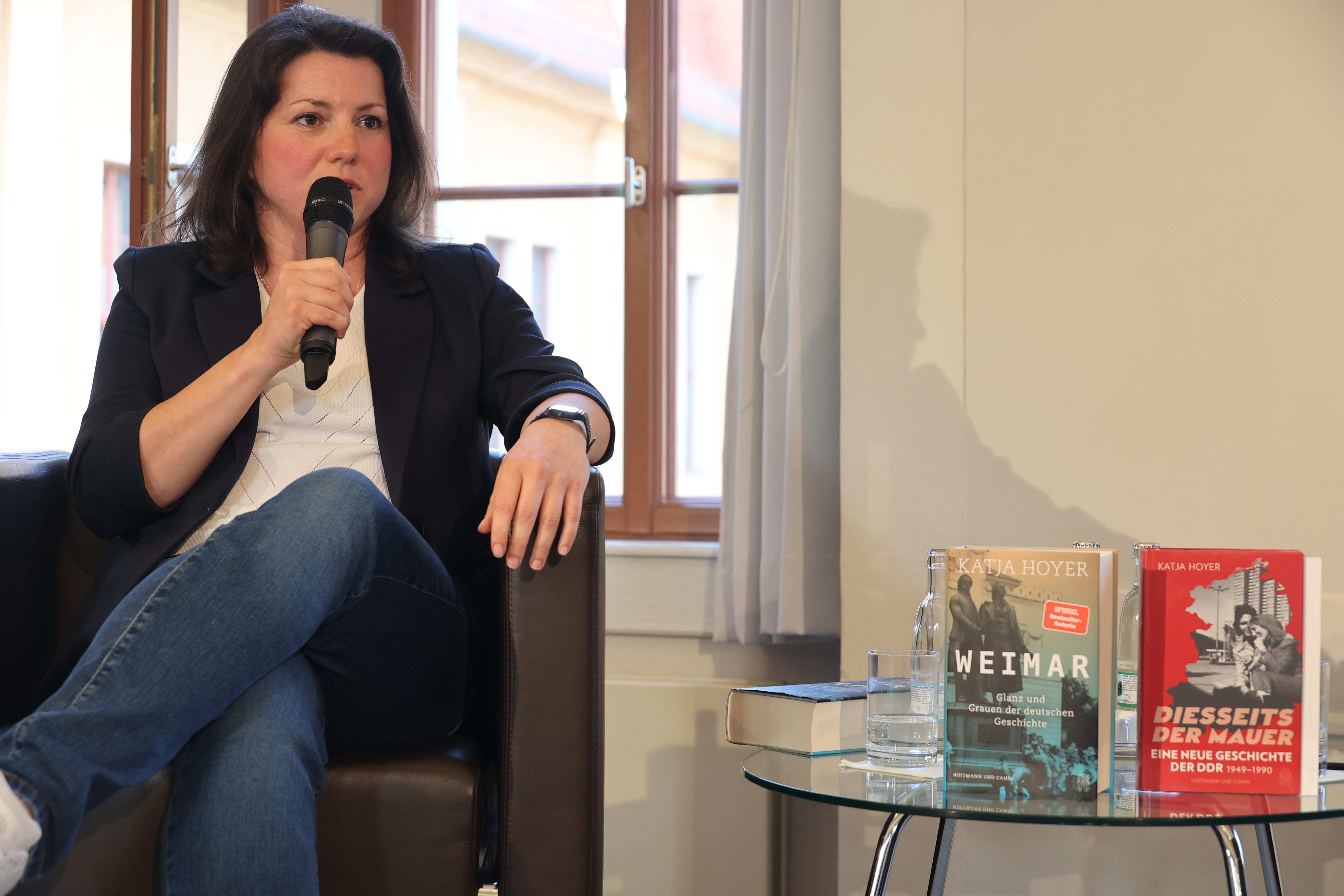
Dispatch from Weimar
Or: How I met Carl Weirich's niece
I’m not usually a snob when it comes to travelling, but when Germany’s national railway company Deutsche Bahn offered me a reasonably-priced upgrade to First Class for my train journey from Berlin to Weimar on Thursday, I snapped it up gladly. Relieved, I walked into the quiet, dark compartment with its wide aisle flanked by laptopping passengers, slumped into my comfortable seat and stretched out my legs.
As predicted, I had woken up with a slightly fuzzy head in my hotel room that morning. In search of a “quick nightcap” after my German book launch, our small group ended up in a bar in the Prenzlauer Berg area of Berlin that was just about to close.
The owner, a Russian-speaker who introduced himself as Dimitri in heavily accented German, smiled a happy, drunken smile, invited us in and poured generous glasses of Gin and Tonic for everyone before hastily answering a question nobody had asked: yes, he was Russian, but he had lived in Berlin for over thirty years and had nothing to do with Putin. Well, that was a conversation starter if ever there was one…
Unsurprisingly, the next morning I woke up later than I had intended. I hastily packed my things and rushed off to my morning appointments. By the time I fell into my generously proportioned armchair on the train around noon, my head was clear of Dimitri’s drinks but swirling with thoughts about Part 2 of my German book launch that night. It was time to present WEIMAR to Weimar.
As my train sped south and Berlin’s shades of grey gave way to the wide greens of Brandenburg and Saxony-Anhalt, my thoughts turned to the evening. There couldn’t be a more fitting place to present the book than where I was headed: Ettersburg Castle, on the Ettersberg hill just outside of Weimar.
The castle itself is beautiful. It’s an 18th-century hunting palace set in sprawling, landscaped gardens with breathtaking views over the surrounding countryside. Goethe, Schiller and other figures of the German literary canon once met and wrote here.
Yet Ettersburg is located just a walk away from the former concentration camp of Buchenwald. That unsettling proximity of culture and barbarity encapsulates the tension at the heart of my book. I was grateful to have been given the opportunity to talk about WEIMAR here, of all places.
But I was nervous about the audience. Would Weimarers be interested in the book? If they were, what would they make of the fact that I’m talking about the interwar history of their town to people in Germany, Britain and other countries? What if relatives of the people in my book turned up that night? Would they approve or worry about my dragging their ancestors into the historical limelight? I’ve done a book event almost every day since launch day. None made me as nervous as this one.
As it turned out, I needn’t have worried. The event was sold out. I was still giving an interview to a TV team outside when I saw the organisers dragging extra chairs into the event room.
Reassuringly, the audience also contained many people I knew. There was the director of the Weimar Town Archive, Jens Riederer, whom I can’t thank enough for his vital help with finding suitable sources for the book. Weimar’s Town Chronicler (yes, that is a real job), Axel Stefek, had come – without him, the sections on Marlene Dietrich would have been a whole lot less colourful.
Then there was Peter Krause, who had invited me to speak at Ettersburg Castle and who had proved excellent coffee company during previous Weimar visits, something I always find helpful in keeping me sane and tethered while travelling for research. The Lord Mayor of Weimar, Peter Kleine, gave a brief introductory speech. And there were scores of other interested Weimarers who asked great questions and were an attentive and generous audience.
What will stick with me the most is that there were indeed men and women in the audience who knew people in my book or were even related to them. When the host asked if anyone knew Carl Weirich, the bookbinder whose story ties my WEIMAR together, a few hands went up.
Most movingly of all, there was a descendant of Arthur Schmidt, the man who ran the Hotel Hohenzollern with his Jewish wife Rosa from the end of the First World War to the end of the Second. This was Adolf Hitler’s regular hotel in Weimar for his first few visits before he moved to the more upmarket Hotel Elephant in the town centre. The Schmidts’ story is accordingly dark, complex and tragic.
The lady at the event told me that her grandad had been married to Arthur Schmidt’s sister Ida. The stories of what happened to Rosa and Arthur were still talked about at family events when she was a child. She’d come to my talk because she was interested in the subject matter, but had no idea that the Schmidts featured in my book. When I mentioned them and read passages in which they featured, she was shocked. It was a poignant reminder of how big history affects ordinary people and how the repercussions of this run through generations. It was a relief to find that she was moved by my telling of her family’s story.
I was still thinking about that the next day, when I boarded a train for the short journey to nearby Erfurt, which has replaced Weimar as the capital of the German state of Thuringia. I was to give another talk there that night at the famous bookshop Peterknecht in the old town. This time, I didn’t really expect any surprises and settled in for an ordinary book event, relieved that Weimar had gone so well the previous night.
I couldn’t have been more wrong. I was in for a huge surprise. When I had finished my talk, and it was time for questions from the audience, an elderly lady put up her hand. She thanked me for my presentation and for writing the book, and then explained that she was Carl Weirich’s niece!
I couldn’t believe it. I’d been worried about whether I had done the right thing in not only studying Carl’s diary but also making his story public. At the end of the day, I had no way of asking him for his consent.
I stared at the lady in the audience as she explained in an emotional voice that Carl had always been keen to record his story for his family. Besides the diaries I had studied, she said, there were other bound volumes of his notes as well as photographs, newspaper clippings, postcards and other bits he had collated over the years.
She said she wanted to lend me some of those for a while. With shaking hands, I stood on the stage and took the tiny book she offered me. It was beautifully bound like all of Carl’s things. On top of it lay a photograph of Carl and a short obituary for his first wife Friedel who died in 1920.
The book was a collection of love letters the pair had exchanged during the courtship before the First World War and after their wedding in 1914. Lines of Carl’s tiny, neat handwriting were adorned with pressed flowers. In between there were postcards. Some were hilarious, such as this one captioned “How Friedel pictured her beautiful future in 1913!”
But history denied the newlyweds a beautiful and even an ordinary future. The First World War set in and brought misery to their young family. Later postcards were hauntingly sad, especially one captioned “Her Last Wedding”, which showed a lifeless young woman being carried away by Death.
I was speechless. I looked at Carl’s niece, studying the lines of her face for a physical resemblance to the man whose name has been in every review of my book over the last couple of weeks. She thanked me again and added that her maiden name had been Weirich. She said she was sure Carl would have loved the idea of the “literary memorial” I had set him and his family.
I felt touched and relieved by this unexpected human link to a past I had been studying so intensely. Even now, a day later, I still can’t quite believe that I’m sitting at Berlin airport with Carl Weirich’s bound love letters to his wife in my bag. Neither person is here anymore, yet their words and expressions of emotion remain.
And so, as my short but very memorable German book tour comes to an end, I am once again reminded how important history and the telling of it are. My encounters in Berlin, Weimar and Erfurt were a reminder that history is nothing more and nothing less than the study of human behaviour. It shows us that our actions matter, that all the great and small things we do and don’t do can have consequences for generations to come.


What a beautiful and very emotional moment along with such a treasure of a possession.
Just a few days ago I finished Weimar, which I thought was brilliant. Excellent at conveying broad political and economic trends of the era while also showing what it meant to be alive in Weimar at that time.
A superb eye-level view of history and very emotionally engaging. Poor Wilhelm!
And, speaking as a history graduate, I think at least every decent-sized settlement should employ a town chronicler.