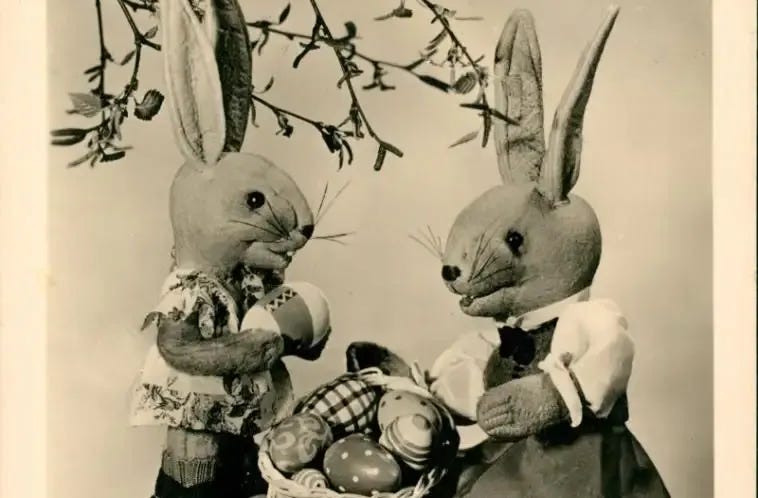
Easter among East Germans
What the GDR did to Christian holidays
I have visitors over from Germany this Easter, and it’s been great fun to show them around. We travelled the length and breadth of East Anglia, and I found myself talking about things that were way out of my usual comfort zone.
At the Lord Nelson Pub in Southwold, I scraped together what little knowledge I have of the Battle of Trafalgar, the HMS Victory and Nelson’s death. Driving around, we spotted some muntjacs, also known as barking deer, which are ubiquitous in Norfolk and Suffolk but are not native to Britain. So I tried explaining how they were brought to the UK, and that they escaped from an estate, clearly adapting well to the climate and environment.
It’s also always amusing to try to explain the many eccentricities of the British Isles to people who aren’t from here. Sooner or later, you get asked questions like: Why are many seaside towns full of slot machines and amusement arcades? How do you wash your hands properly when one tap releases scalding-hot water at one end of the sink and another ice-cold water at the other? Why do people apologise profusely when you accidentally step on their foot?
I can offer theories and improvised answers to many of these questions, but I really began to struggle this time when trying to explain what happens in local churches this weekend.
As one does on holidays, we wandered into different churches over the last few days. Unsurprisingly, they all displayed varying responses to Easter. One had been stripped back with no decorations on the altar. Another was closed altogether on Good Friday. I’ve had to Google this to find out that both are indeed Good Friday traditions that symbolise the suffering of Jesus Christ. I was also told off on social media for wishing everyone a happy Easter on Good Friday – perhaps not my most tactful moment.
I’m not proud of my embarrassing lack of Easter knowledge. But it made me reflect on where I’m from and what impact this had on my upbringing and outlook. I was born in the GDR, i.e. in a culturally Christian country that was by then largely devoid of religious life in its mainstream culture. I’ve written before about the aggressive secularisation measures the East German authorities undertook and how this created the only majority atheist society in the world. But occasions like Easter really highlight the point.
Perhaps counterintuitively, Easter was big in East Germany. It was never abandoned or eradicated as a significant fixture in society’s collective calendar. But for the vast majority of people, certainly towards the end of the state’s existence, it was more of a family occasion, full of cultural rites and traditions, rather than a religious thing.
When people talk or write about Easter in the GDR, they often note that Easter Monday was abolished as a public holiday in 1967. However, this was less an attempt to abolish Easter and more an effort to reduce working hours without tanking the fragile economy. That year, the GDR abolished Saturday work and introduced the 5-day work week, which it couldn’t really afford. So a few public holidays were cut to make up for the labour shortfall.
People often point out that most of the vanished public holidays were religious, but so are most public holidays to start with, and the GDR also abolished the “Day of Liberation” on 8 May as a day off, which highlighted the role of the Soviet Union in the defeat of Nazi Germany and was therefore a political occasion.
What is certainly true, however, is that Easter became very secularised for the majority of people, a family occasion that was more of a themed celebration of spring than a way of remembering and reflecting on what happened to Jesus.
There was a huge focus on crafts in the build-up to Easter, particularly for children. Typical preparations included carefully dyeing eggs with onion skins, which produced a deep brown, almost orange tone that could be polished to a shine, or using shop-bought colouring tablets, which were dissolved in water. There were also little decals to stick on the egg shells.
Sweets were often put into colourful cardboard eggs produced in Saxony that opened down the middle. They usually contained fake green grass made from paper, within which small chocolate eggs or other treats would be nestled. Those cardboard eggs were often treasured for a long time, reused year after year, sometimes for generations. The ones my mutti hid my Easter treats in were the very same ones she’d once received from her parents as a child. She still has them today, and they come out every Easter.
Other traditions included Easter walks, Easter bonfires or rolling hard-boiled, dyed eggs down small hills to see who could roll theirs the farthest without breaking them. These little rituals may not seem significant in their own right, but they accumulated into a much-cherished annual tradition. Easter was never as big as Christmas, but many families made a point of having a nice time together.
In the end, Easter in the GDR shows how a tradition can change without disappearing. While its religious meaning faded for many, the occasion itself didn’t lose its importance. I’m a living example of how the story behind the holiday has faded into the background for many East Germans. But the feeling of Easter, the time spent together, the small rituals and the effort people put into making it special with what they had don’t become less important.
That’s why, for many who grew up in the GDR or in its aftermath, Easter is still remembered so fondly. It wasn’t about religious belief anymore, but about simple, shared moments like dyeing eggs at the kitchen table, searching for treats and enjoying a break from routine. In that sense, it may have moved far from being a Christian occasion, but it remained a deeply valued family tradition all the same.
On that note, eggscuse me please while I’m off to spend a relaxed Easter Sunday with my German visitors. No cardboard eggs from Saxony this year, but still plenty of chocolate, spring flowers and good cheer. Frohe Ostern, dear ZEITGEISTERS!


Nice one Katja, sounds like your guests have a wonderful time both culturally and historically, the Easter traditions in the DDR sound free and full of colour not something one associates with East Germany, i like these nuggets of everyday life and traditions of the average citizen.
Nice, gentle read reminding me of great Easter experiences as an austauschschüler in Solingen, NRW. Hunting small Easter eggs - some chocolate, some dyed and painted. Families also had an ‘Easter tree’ which, from memory, seemed to be willow sprigs in a big vase with egg shells painted and decorated by us children.
I remember thinking it was as good as Christmas. Happy days in, in my mind, a better culture.