

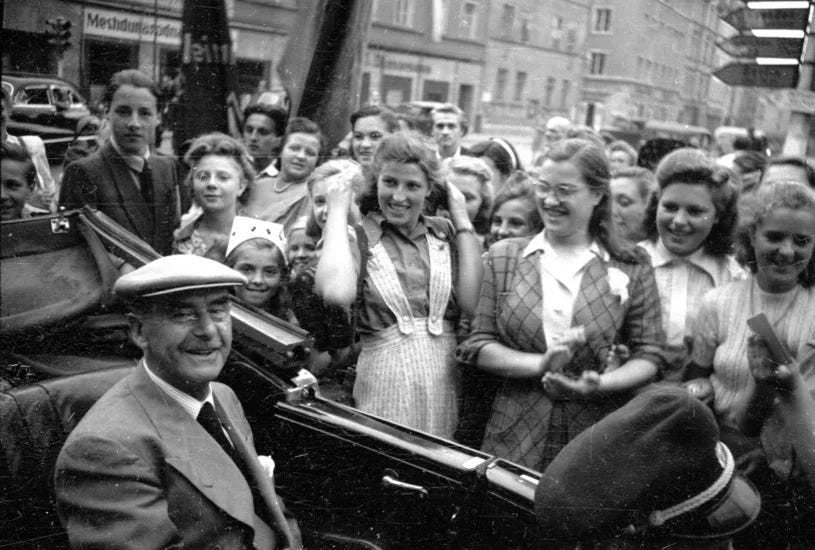
“Was this the movie you had expected to see?” was the first question I faced on Tuesday, as the curtain fell in one of Britain’s oldest cinemas. From my seat in the third row of the Regent Street Cinema in central London, I had just watched the new film Fatherland and felt I needed a few days to digest it. It had somehow squeezed the enormity of Germany’s postwar identity crisis into 82 minutes. Now my brain seemed to buzz with thoughts and questions.
But there was no time to digest. Not yet. I wasn’t just there to watch the movie. I was part of the programme. The London Review of Books staged this preview screening ahead of the British cinema release on 23 October, and I was supposed to introduce the film and discuss it and its contents on stage afterwards. So I frantically tried to reassemble my thoughts as I got up and took my seat on stage.
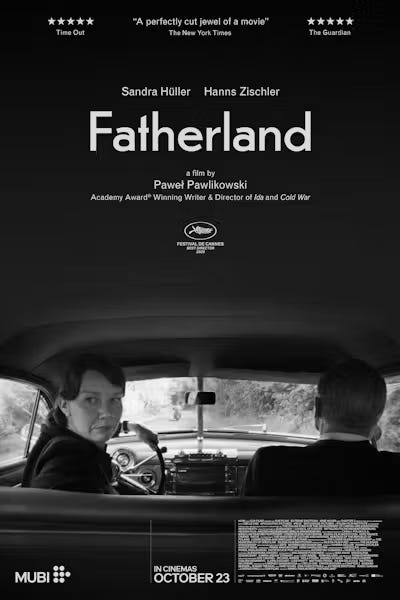
Was this the film I had expected to see? I’m not sure what I had expected. Fatherland is set in post-war Germany in the summer of 1949. The West German state has just been created. In the Soviet Zone of occupation, they prepare for the official founding of an East German one. And we follow the famous German writer Thomas Mann crossing from one to the other in a shiny Buick cruiser.
While the film takes some artistic liberties, this really happened. Mann had spent the Nazi era and the war in exile. He and his family had left Germany in 1933. Eventually, his German citizenship was revoked by the Nazi regime. In 1938, he moved to the United States. Asked how he felt as a German writer who had lost his German homeland, he said: “It is hard to bear. But what makes it easier is the realisation of the poisoned atmosphere in Germany. That makes it easier because it’s actually no loss. Where I am, there is Germany. I carry my German culture in me. I have contact with the world and I do not consider myself fallen.”
But like many German intellectuals in exile, he struggled to come to terms with the involuntary nature of having been uprooted. For writers, the difficulty of adapting to somewhere that doesn’t speak your mother tongue can be a particularly jarring and painful experience. Mann always wanted to believe that a “good Germany” still lay dormant in his fatherland and might be resurrected one day. He also believed he would have a role to play in this.
Meanwhile, his fame and reputation grew further. He was already a Nobel Prize laureate, having received the prestigious honour in Literature in 1929. Now, he acquired further fame in the Allied nations by writing more successful literature in his new home in California, becoming a naturalised citizen of the United States in 1944 and broadcasting anti-Nazi speeches in German to the German people via the BBC.
A well-respected writer, seen in many ways as a link to the “good Germany” before Nazism, Mann was immediately courted by both ideological systems that took root in Germany after the end of the Second World War. He would make the perfect cultural ambassador for either side – an intellectual of the highest calibre but uncompromisingly clean of Nazi ideology. There weren’t many like him.
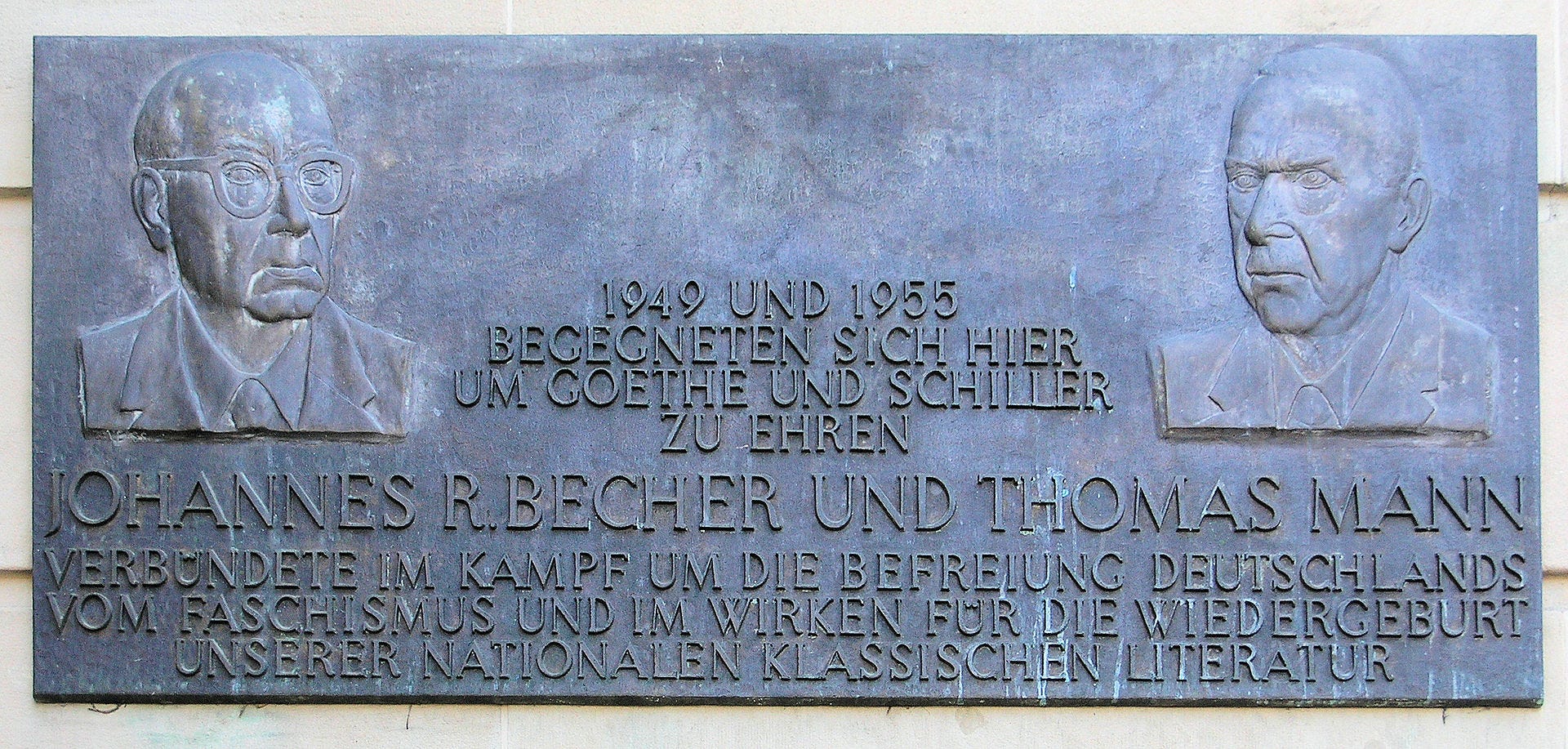
So when the 200th anniversary of the birthday of the most famous German poet of them all, Johann Wolfgang von Goethe, came along in August 1949, two German cities associated with Goethe took the chance to invite Mann to speak and receive honours. Frankfurt am Main, where Goethe was born, awarded the exiled writer the Goethe Prize. Weimar, where Goethe lived most of his life and where he died and was buried, bestowed on him the Goethe National Prize. Frankfurt was in the West, Weimar in the East. Mann said he didn’t care about that. It was the first time he returned to Germany since 1933, and his visit was to Germany, not to occupation zones.
He was not universally welcomed back in his fatherland. Some people saw him as a traitor for leaving the country. Others resented Mann’s view that people who had stayed in Germany were morally complicit and that the bombings were a price paid for the war. Many German intellectuals had gone into what they called “inner migration”. They had stayed in Germany but opted out, mentally and intellectually, from the world around them. They had often been targeted by the regime for that and accused Mann of taking the easy way out, sitting out the regime and the war in a comfortable home in California. Mann and other exiles rejected this and argued in turn that nobody can produce art in a dictatorship without making themselves complicit. It’s just one of many themes the movie picks up.
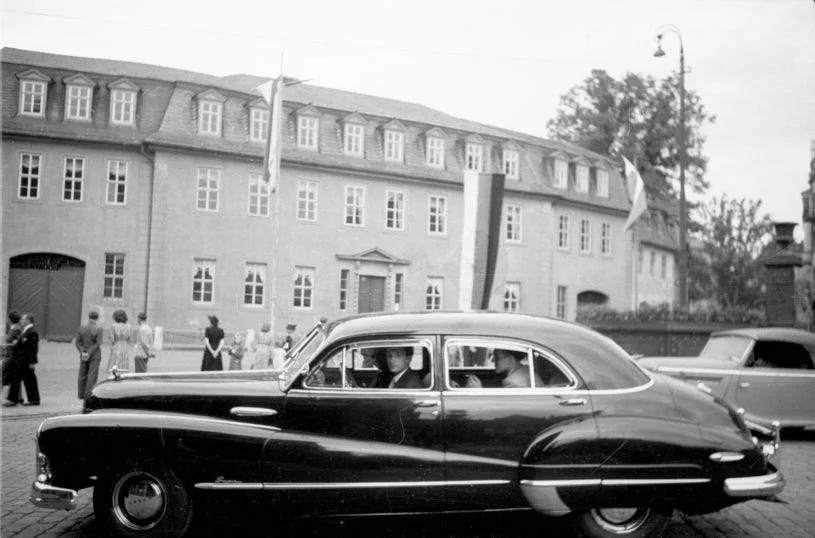
Fatherland is a beautifully shot road movie that takes us from Frankfurt to Weimar in Mann’s shiny black Buick, as this symbol of American might and prosperity makes its way through a ravaged and ruined German post-war landscape and across the ideological fault line of the emerging Cold War.
As if a famous exiled writer returning to his morally bankrupt homeland wasn’t enough to set this historian’s brain on fire, a range of real-world characters each face their own demons. First and foremost, there is Erika Mann, the writer’s daughter, brilliantly played by Sandra Hüller. Hüller was herself born in Thuringia in East Germany, the state of which Weimar was once the capital. In reality, Mann was accompanied on this journey by his wife Katia rather than his daughter Erika, but I can see why this choice was made for the movie.
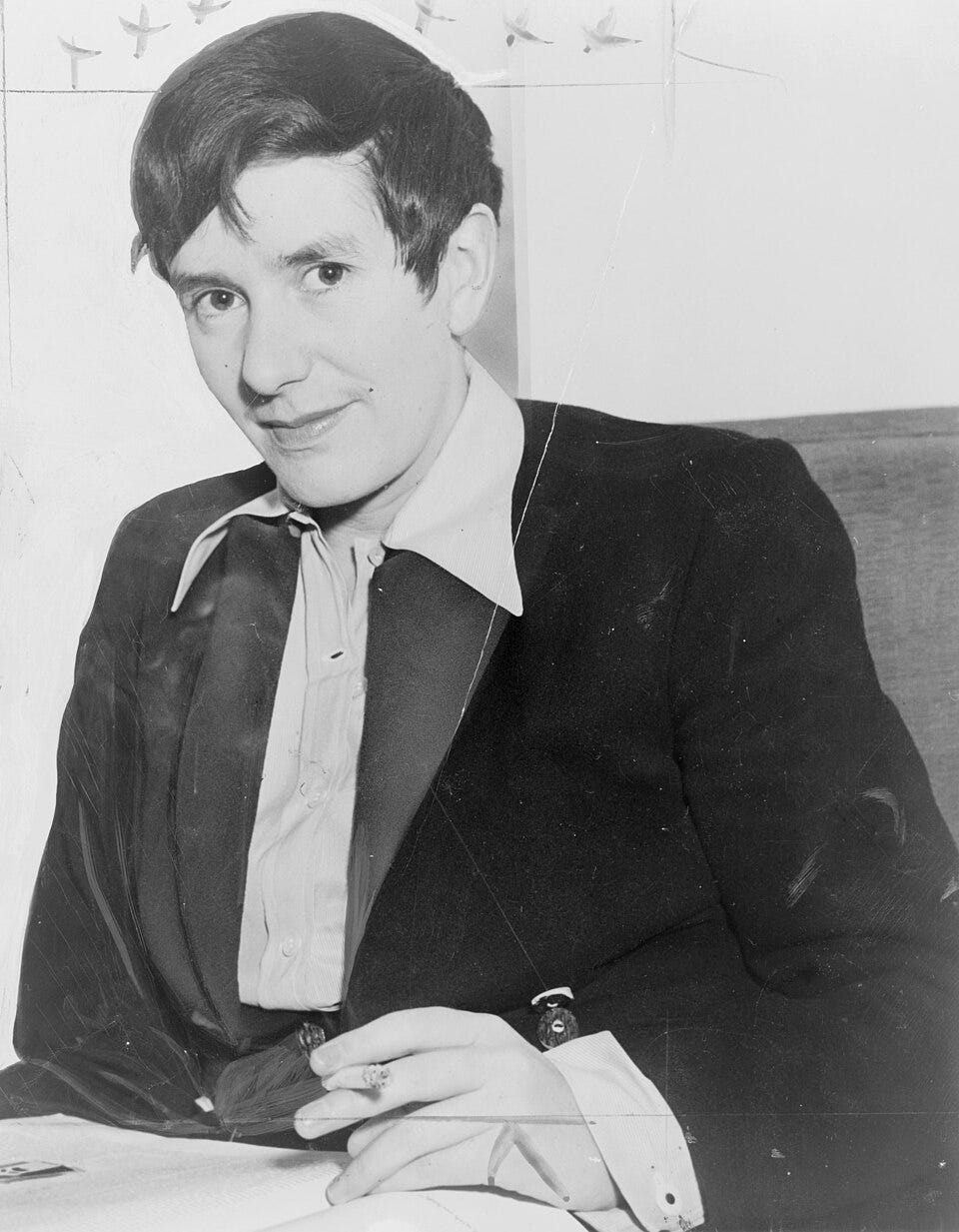
Erika is a fascinating character in her own right. Unlike her father, she found it difficult to believe in the idea of a “good Germany” after everything that had happened. She got out of being stateless after Nazi Germany had revoked her citizenship by marrying the poet W. H. Auden, purely to obtain a British passport. Auden, being gay, was happy to agree to this marriage of convenience. In a previous marriage, Erika had been the wife of actor Gustaf Gründgens, who was also widely known to be gay. He stayed in Nazi Germany, where he became a favoured theatre director and a close friend of Hermann and Emmy Göring. In the film, Erika meets Gründgens again in Frankfurt and slaps him for that.
So the film packs the complexities of messy post-war Germany into a comparatively short runtime, making it an intense and stimulating watch. The Manns had never really fully felt they belonged in America, despite it becoming an enthusiastic and welcoming home for them. This is encapsulated quite well at the beginning of Fatherland when Erika’s brother Klaus, with whom she was incredibly close, tells her on the phone that he feels the Manns’ choice is now between “Stalin and Mickey Mouse” – neither ideological superpower providing a satisfying intellectual environment for those German literary giants. But the Germany they ached for no longer existed and never would again.
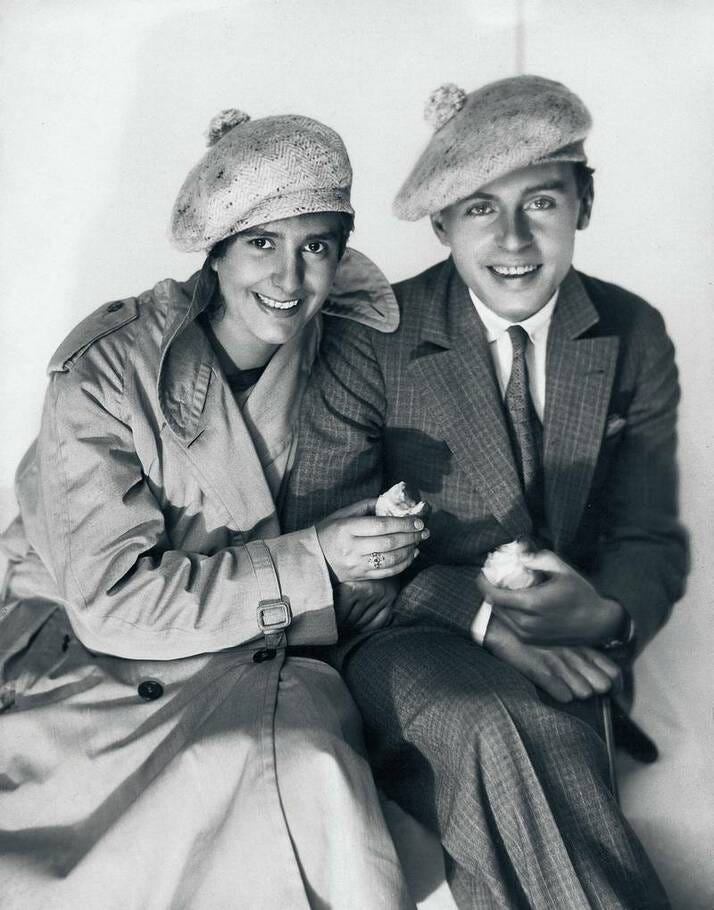
For his father Thomas Mann, his visit to Weimar must have been particularly stark. The last time he visited the town, this shrine to Goethe, was in 1932, during the centenary of the poet’s death. This was before Hitler became chancellor of Germany a few months later, but the town was already bedecked in swastikas as local Nazi activists had called on sympathisers to hang flags from their windows. Mann, who was awarded a Goethe Medal in Weimar, wrote that he found the town’s “mix of Hitlerism and Goethe” deeply disturbing. “Weimar is a centre of Hitlerdom,’ he observed, adding that “the type of young person who roams the town with unguided certainty and greets one another with the Roman salute dominates the town”.
When he returned in 1949, he found this beautiful place of culture reduced to rubble by bombing. Rebuilding had begun. The famous German National Theatre, for instance, had already been rebuilt. The young people he saw now performed different salutes. He no longer saw the uniforms of the various Nazi organisations but those of the Red Army. He moved into the Hotel Kaiserin Augusta opposite the train station, which overlooked the large square where just a few years earlier thousands of Jews were disembarking from trains to be beaten onto lorries and taken up the hill to the Buchenwald concentration camp.
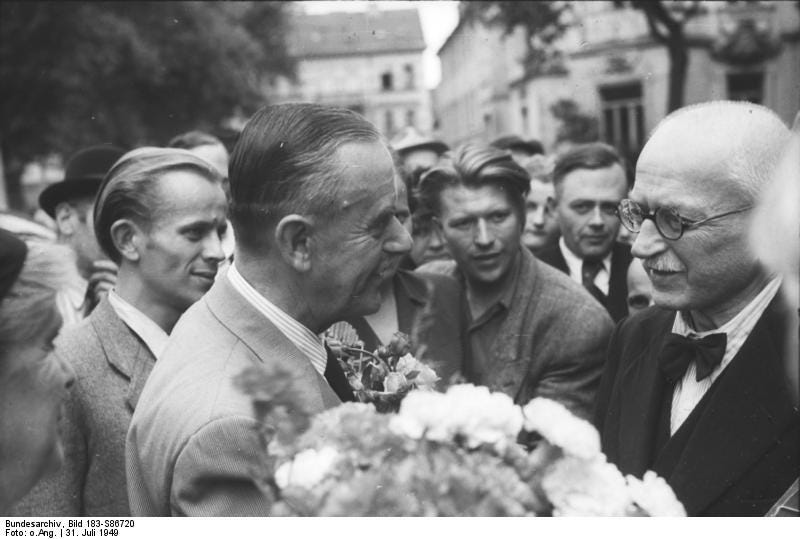
Johannes R. Becher, a fellow writer who had also spent the Nazi years in exile, personally received the Manns. For his refuge, Becher had chosen the Soviet Union, not California. He was to write the lyrics for the East German national anthem and would become the GDR's culture minister.
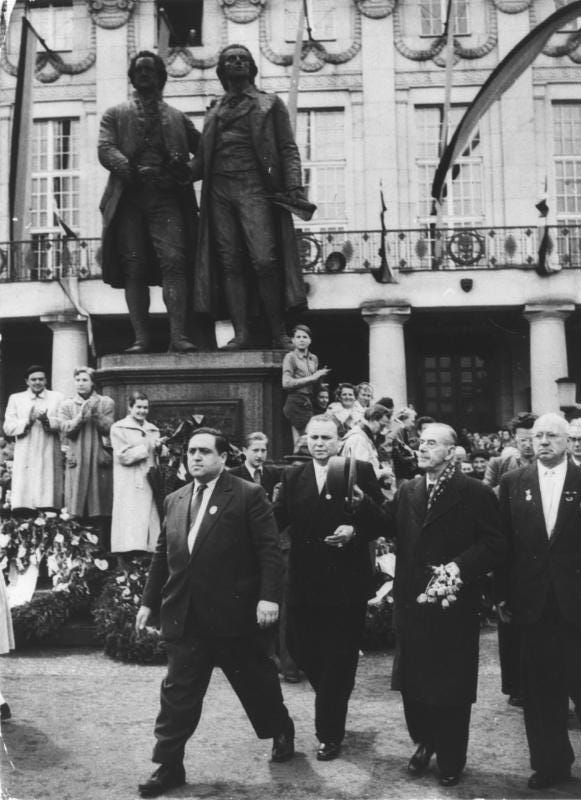
In real life and in the film, Mann talked animatedly with Major General Sergei Ivanovich Tiulpanov, director of the Propaganda Administration of the Soviet Military Administration in Germany which governed eastern Germany from 1945–1949. According to one witness, he spoke much more highly of Weimar than Frankfurt to the Soviet intellectual and military man, who spoke fluent German. Mann is also said to have enjoyed the enormous fanfare with which he was escorted out of Weimar at the end of his visit. We’ll never fully know, and the film makes no obvious judgement on Mann’s thoughts either, leaving viewers to ponder how he might have felt.
So there I was with all these thoughts and many more running through my head as the lights in the Regent Street Cinema came back on, and I was asked to return to the stage. Was Fatherland the movie I had expected to see? No, I don’t think it was. That’s because I had had no idea what to expect, could not envision how anyone could press all those complexities of themes like exile, guilt, family, history, home, language, literature, morality, politics and disorientation into 82 minutes.
Hats off to Polish director Paweł Pawlikowski, who knows a thing or two about these themes, for pulling it off in style. Pawlikowski was born in Warsaw in 1957, that is to say in a city destroyed by Nazis and ruled by communists. His Jewish grandmother had been murdered in Auschwitz, a German concentration and death camp on Polish soil. As a teenager, he moved to London and into exile. He also spent time in West Germany, married a Russian, speaks six languages and has now moved back to Warsaw. If anyone understands what history and dislocation can do to families and identities like those of the Manns, it’s Pawlikowski.
Fatherland is well worth your time if you’re interested in the German post-war mess and the wider themes interwoven with it. It’s a subtle, elegant, and intense film that will keep your mind reeling long after you leave the cinema.
I am anxious to see the film as soon as possible, but am worried that it won't be shown in San Diego. It sounds very worthwhile.
Thanks forthe thoughtful review. It opens here in Los Angeles Friday on limited screens.