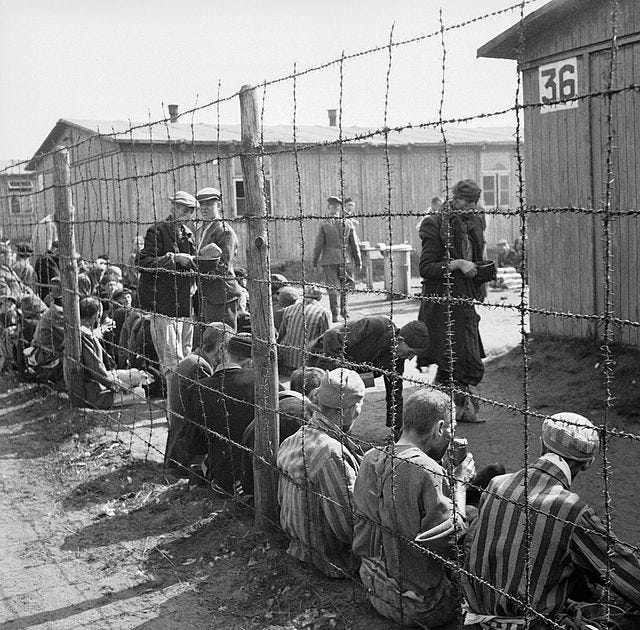
Filming the Unbelievable: How the Allies Recorded the Holocaust
And how we still view Nazi crimes through their lens

It was Holocaust Memorial Day this week, an occasion marked annually on the anniversary of the liberation of Auschwitz concentration and death camp by the Red Army on 27 January 1945. It’s also a day when harrowing images make the rounds on social media: pictures of piles of bodies, of sick and starving people, of mass graves. But few people ever pause to wonder where these images came from, who took them and why. It’s a question well worth asking. The answer explains how we know what we know about the worst crimes in human history, and why the way that knowledge was first presented still matters today.
Even over eight decades after the event, we understand and study the Holocaust in no small part through the images that were taken of its horrific conclusion. The footage and photographs Soviet, British and American troops captured as they entered concentration and death camps continue to shape our view of these events to this day. Asking why they were taken and how they were assembled and selected not only helps us understand how hugely important it is to document atrocities if they are to stay in the public consciousness, but also how the Allied powers themselves began to make sense of Nazi crimes.
In the spring of 1945, Allied soldiers advancing into Germany and occupied Europe stumbled upon places that many of them could scarcely comprehend. Behind barbed wire and locked gates, they found starving prisoners, piles of unburied corpses and evidence of mass murder on an industrial scale. Faced with scenes so extreme that they feared they would not be believed, Allied commanders made a crucial decision. Before the camps were cleared, they had to be filmed.
British, American and Soviet cameramen were ordered into newly liberated camps such as Bergen Belsen, Dachau, Auschwitz and Majdanek. The purpose was neither artistic nor primarily educational. It was evidential and political. These images were meant to stand as proof of what had happened, proof that could be shown to enemy populations, to the wider world and in court. Yet even before that raw footage was shaped into films, the different Allied powers took notably different paths, revealing contrasting explanations for what had happened and different political priorities in the immediate aftermath of the war.
The British approach was the most methodical and, in some ways, the most solemn. The Ministry of Information placed the project under the supervision of Sidney Bernstein, a senior figure in wartime film production. Bernstein – despite being an ardent anti-fascist from a Jewish background – believed that the material demanded a careful, almost forensic treatment rather than placing too much emphasis on emotion or overt messaging. He assembled a distinguished team and brought in Alfred Hitchcock as a treatment adviser. Hitchcock’s role was not to dramatise events but to ensure clarity and credibility. He encouraged long, uninterrupted shots and clear spatial geography by using classroom-like maps, allowing viewers to see camps in relation to nearby towns, while German civilians were also to be shown walking past the dead.
The resulting film, German Concentration Camps Factual Survey, was intended as a definitive record. Its narration was restrained, its structure deliberate. The message was carefully spelt out in plain language. The harrowing scenes that the soldiers had found in the camps were not accidents of war or isolated atrocities. They were the result of a system planned and run by the Nazi state and its collaborators. Responsibility, the film insisted, was collective and could not be evaded by claims of ignorance. For the British, the message was a universal one for all of humanity: this is what can happen when civilisation is allowed to break down.
They expected this film to be shown to German audiences and to endure as a historical document. Yet it wasn’t released at the time. By late 1945, Britain was exhausted economically and politically after six years of war. Its occupation policy in Germany became increasingly pragmatic, focused on stability and reconstruction rather than prolonged confrontation. In that context, a long and uncompromising film about German crimes came to be seen as a hindrance. As Cold War tensions emerged, priorities shifted again. There was a conflict with the Americans over this, along with differences in style and messaging. The completed film was shelved and largely forgotten, only resurfacing decades later and eventually reaching the public in restored form as Night Will Fall in 2014. This is well worth watching. If you’re in the UK, it’s available on Channel 4 at the moment.
The American response was more immediate, ambitious and more forceful. The US Army commissioned a short film designed explicitly for German audiences, directed by Billy Wilder. Wilder had fled Nazi Germany in the 1930s and later learned that members of his family had been murdered in the Holocaust. His film, Death Mills, ran for little more than twenty minutes and made no attempt at detachment. It confronted viewers with rapid sequences of corpses, mass graves and skeletal survivors, accompanied by a blunt narration that told Germans they could not deny what was shown. Interestingly, it used some of the British footage, but the assemblage turned it into something very different.
Unlike the unfinished British film, Death Mills was screened compulsorily to German civilians in 1945 and 1946. It formed part of a broader American programme of denazification that, at least initially, was more ambitious and more ideological than the British effort. The United States aimed to remake German political culture, using questionnaires, dismissals from public office and enforced exposure to evidence of Nazi crimes. In that context, a short, portable and accusatory film made sense. Where the British film sought to document for posterity and be effective through the self-evident horror of the long shots depicted, the American one sought to shock and confront in the present.
These different films reflected different circumstances rather than simple moral choices. Britain, drained by war, moved more quickly towards compromise. The United States, less damaged at home, believed it could afford a harder line. Both, however, understood the central importance of visual evidence.
This was also true of the Soviet Union, which filmed extensively at camps it liberated, including Auschwitz and Majdanek. This is extremely important. For all the horror the British and American liberators encountered in camps on German soil, those were originally built as prison and labour camps. What the Red Army found in Eastern Europe were death camps whose sole purpose had been the destruction of human life. Soviet footage documented the existence of gas chambers, crematoria and vast stores of victims’ belongings and was used in newsreels and at the Nuremberg trials. Although Soviet presentations were shaped by their own political narratives, the images themselves remain indispensable.
Looking back, it is clear why filming mattered so much. The scale of the crimes discovered in 1945 defied ordinary understanding, and they still do that today. Holocaust denial and distortion remain rife. Even at the time, Allied soldiers struggled to process what they were seeing. Without photographic and film evidence, it would have been even easier for denial, minimisation and distortion to take hold.
Holocaust Memorial Day reminds us that historical images were not inevitable. They exist because soldiers and officials made a conscious choice to document before erasing traces of horror. The British, American and Soviet films differed in length, tone and fate, but they shared a core purpose. They created a visual record that made disbelief harder then and continues to challenge denial now. In a world still wrestling with how to confront mass violence, that decision to film remains one of the most consequential acts of the war’s final months.


Katja,
There is also "Nuremberg: Its Lessons For Today", which was the official American film using the film shown at the Nuremberg Tribunal. It was assembled by the novelist Budd Schulberg and his brother Stuart, working after the war with the OSS to find the German original film. It wasn't completed until early 1948, by which time US policy toward Germany and the USSR had changed with the onset of the Cold War and the Berlin Airlift and the creation of the Marshall Plan. The film was "disappeared" by the government. However, in 2009, Stuart's daughter Sandra discovered his personal 16mm copy of the film when she went through her parents effects following her mother's death. She created a foundation and worked to restore it in 35mm, which was completed in 2022 - I just learned about this in a documentary shown on Turner Classic Movies, "Filmmakers for the Prosecution" which tells the story of the Schulberg brothers, and how the German originals were found and used at the Tribunal. A little internet research afterward shows it's available to be seen now. Here is the site at the US Holocaust Museum. It's 1 hour 18 minutes long and it "pulls no punches" but it presents Justice Robert Jackson's hope that there would be a film to remind people that the horror wouldn't go away (as you could see here on the streets of Minneapolis last Saturday with the assassination of Alex Pretti by ICE thugs.) here's the link: https://encyclopedia.ushmm.org/content/en/film/nuremberg-its-lesson-for-today
A thought provoking read with my Thursday morning coffee. I have heard of the Sidney Bernstein film, the decision to shelve it, and some of the explanation for that decision. As you say we Brits were strapped, the demands of occupation duty, and of course the politics of the Cold War and the necessity of getting the German civilian population on side. Nevertheless given the frightening extent of Holocaust denial these films must play a key role in keeping the memory alive; particularly as the survivors pass from our midst. Let’s face it most of the deniers are not reading a serious study of The Holocaust anytime soon. I think as Adie said Ike ordered films made for the explicit purpose of challenging deniers. Thank goodness serious players realised it was important to record the aftermath of The Holocaust.