

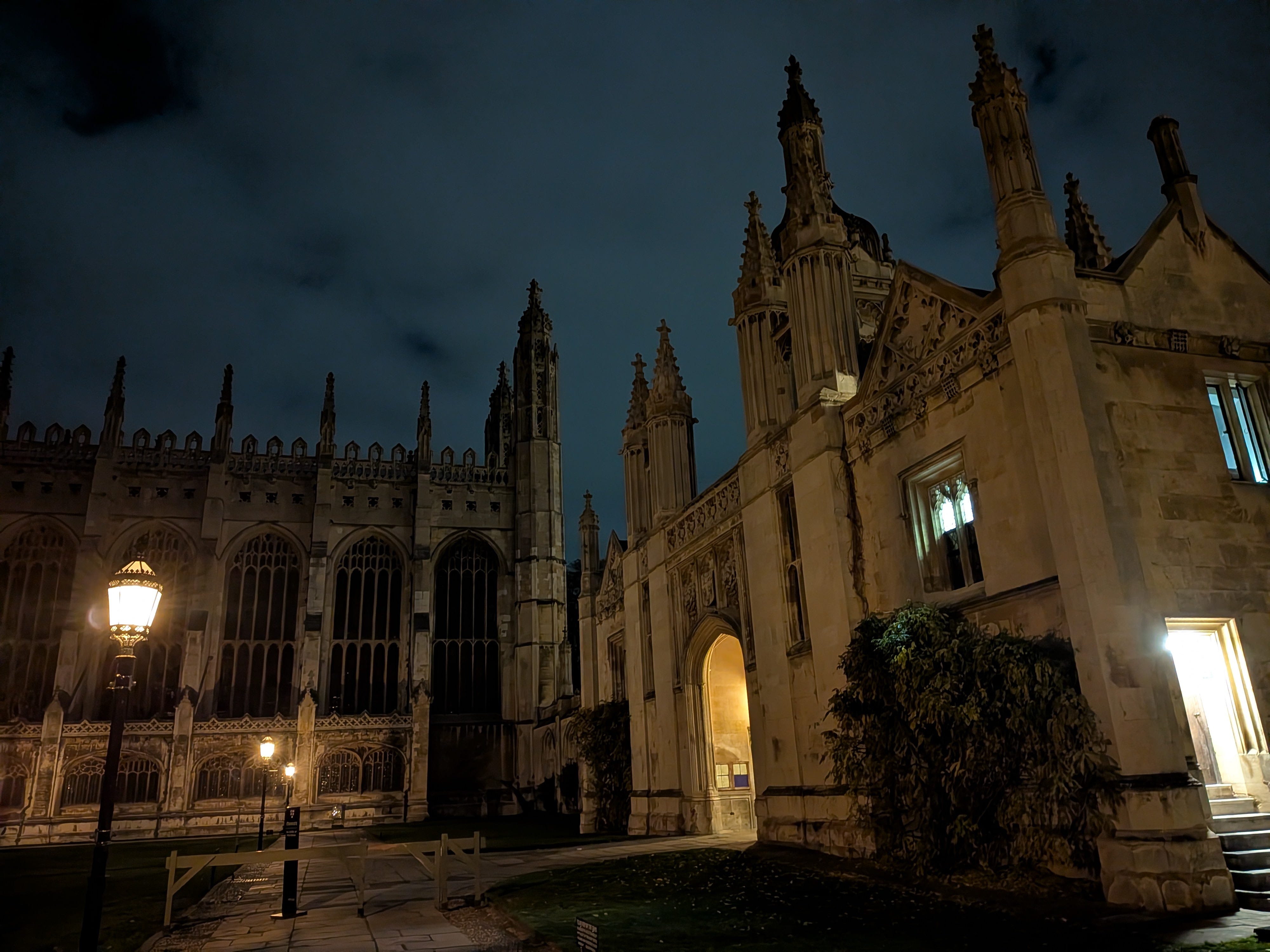
I always enjoy visiting Cambridge, especially when I get the chance to give a talk or a lecture at the university. Of course, that’s an amazing privilege in itself. It’s one of the oldest and best universities in the world. Students are bright and enthusiastic, and it’s quite something to be invited to speak at a place that has educated people like Isaac Newton, Charles Darwin, Alan Turing and David Attenborough.
But I also love how the place feels like it belongs to a different time. Many of the buildings are historic — some beautiful and elaborate, others cosy and quirky. Earlier this week, when I arrived at Peterhouse College, founded in 1284, I was taken to the Senior Parlour, where a roaring fire had been lit. Picture a place that could happily serve as the set for the Gryffindor Common Room in the new Harry Potter series: comfortable old armchairs, people in robes sipping pre-dinner drinks, a cheerful professor hurrying up with more logs on this cold November night.
Soon, a gong rang, and we proceeded in a set order down an ancient spiral staircase into the medieval dining hall, used by students and fellows for over 700 years. I was told it’s the oldest part of the university. I could well believe it. It wasn’t difficult to picture the scene that awaited me having played out much the same way for centuries. Candles lit the wood-panelled room. There were paintings on the walls, stained-glass windows, beautiful tiling and a huge fireplace. Graces were read in Latin before everyone sat down. Afterwards, we retreated to the packed parlour, and I spoke about Weimar from an armchair by the fire.
When it was finally time to leave, I walked along historic Trumpington Street for a couple of minutes before it turned into King’s Parade, where I swiped a card at the King’s College Porters’ Lodge, opened the ancient wooden door and walked in, taking care not to stumble over the high wooden step at the entrance.
King’s College Chapel, an iconic landmark of Cambridge, stood to my right and looked quite magical in the silvery light of a full moon. Old lanterns lit the paths as I made my way to George “Dadie” Rylands’ suite, which inspired a scene in Virginia Woolf’s A Room of One’s Own — and where I’d be spending the night. It’s a marvellous room full of leather-bound books, antique furniture and history.
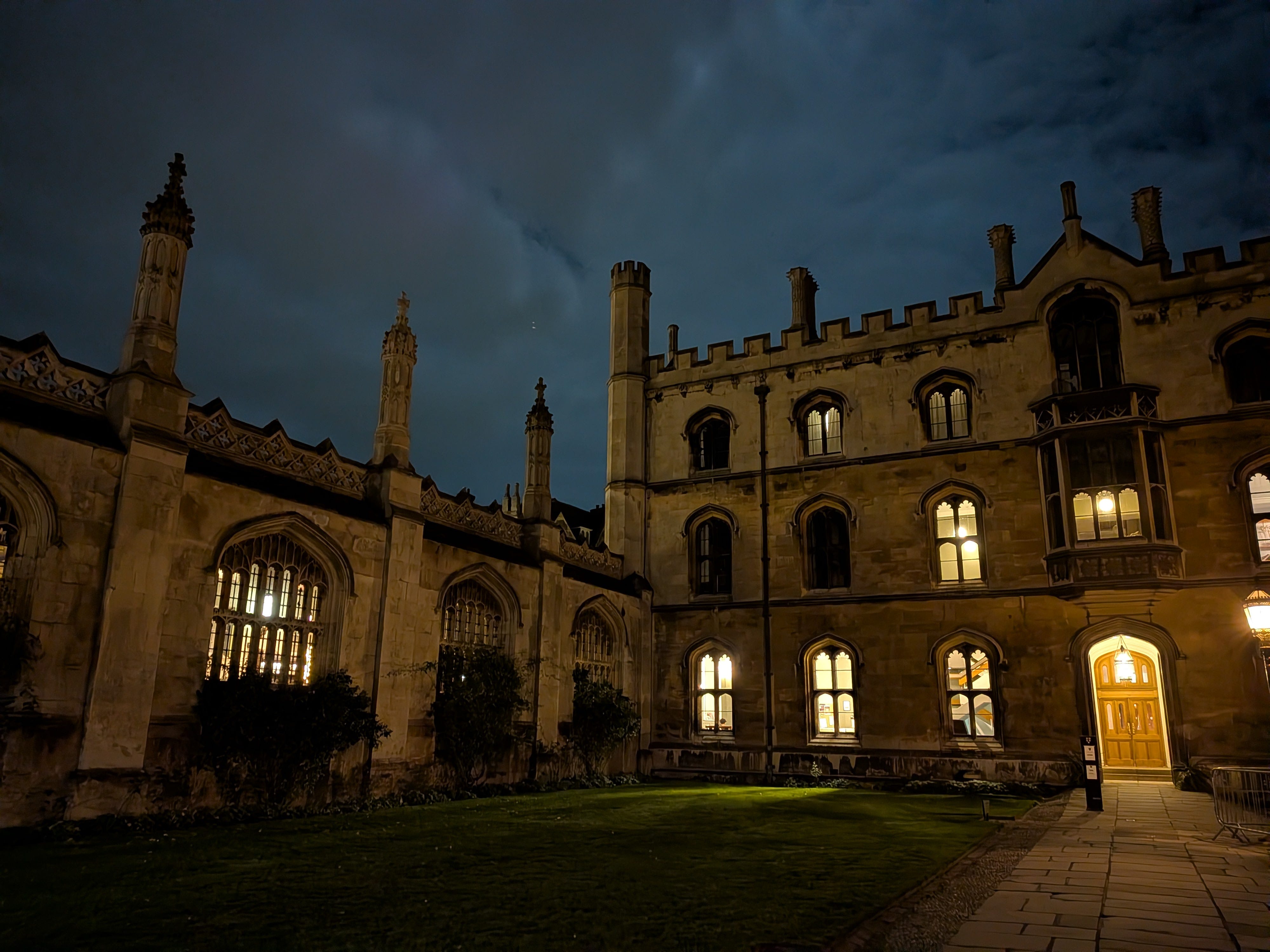
The whole evening had felt pleasantly surreal. I said as much to the students, fellows, alumni and guests who had gathered that night to listen to my talk. I was born in East Germany. If someone had filmed the evening in Cambridge and then travelled back in time to the GDR in 1985 to show my mother the footage, she would probably have struggled to believe that the place was real, never mind that her daughter would one day end up giving a talk there.
I grew up in a prefab block of flats. The schools I went to had linoleum flooring and PVC windows. The local church had been badly bombed, and the rebuild was a modern construction that doubled up as an event space. Nothing wrong with any of that, but it’s a world away from ancient spiral staircases and storied chapels.
Perhaps the relatively modern, prosaic environments I grew up in led me to consider two of Germany's oldest universities for my history studies: Greifswald on the Baltic Sea coast (founded in 1456) and Jena in Thuringia (founded in 1558). I went with the latter in the end and loved the Old University Building with its quaint courtyard and old wooden benches.
But even that historic building is “only” from 1908, and many other buildings were brand new, like the university library, which was nearly 500 years old as an institution but housed in a glass-and-concrete construction that had only opened a few years before I arrived in Jena. No ancient dining rooms or fireplaces. Few robes and rituals. Even in its most historic institutions, Germany has a fundamentally different understanding of what kind of a space a university is and what it means to belong to an academic community.
To some degree, this stems from a post-war ambition to make German universities more egalitarian and less hierarchical. It’s a development that reflects two very different experiences and ways of dealing with the past. The suspicion that German universities harbour regarding many forms of ceremony has a lot to do with the idea of building a different society after Nazism, the Holocaust and two World Wars. There was a general feeling among young intellectuals in both East and West Germany — albeit in different ways — that continuity wasn’t the way to go after the experiences of their parents and grandparents.
As I also show in my Weimar book, German university students were among the earliest and most enthusiastic supporters of Hitler. Under the leadership of Baldur von Schirach, who had grown up in the town of Weimar, the Nazi student movement gained considerable traction. Students also played a leading role in the 1933 book burnings. Many supported the exclusion of Jews from universities.
As institutions prone to embracing continuity and tradition, universities were slow to change after 1945. There was an added problem in that, by definition, academics are highly specialised people who are very difficult to replace. So many professors retained their positions, and institutional continuities with the Nazi period remained more unchallenged than was the case in other fields. This failure to confront the past became a central theme in the West German version of the 1968/69 student movement.
They adopted the protest slogan “Unter den Talaren – Muff von 1000 Jahren”, which translates as “Under the gowns, the stale air of a thousand years”. It was a demand for radical reform, the reference to “a thousand years” a provocative allusion to Hitler’s “Thousand-Year Reich”.
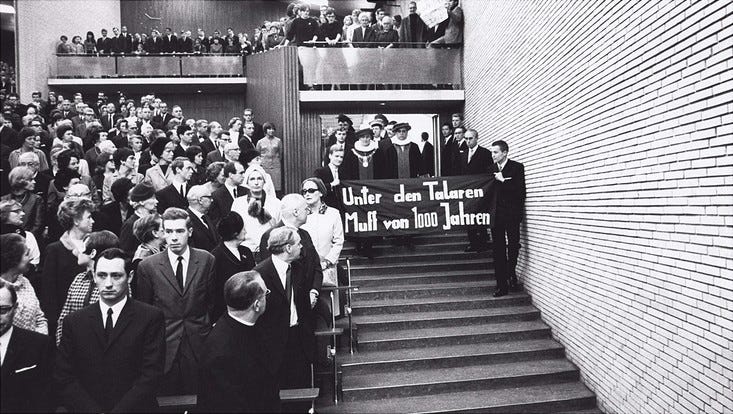
West German students rebelled against everything from old-fashioned clothing and pompous ceremonies to overcrowded rooms and poor conditions. They questioned the authority of professors whose careers were often entangled with Germany’s undemocratic past and with it the entire hierarchical tradition of academic life.
They demanded a democratisation of campus culture, greater student participation and an end to the traditional gulf between professors and students. Academic gowns were seen as symbols of an elitist and authoritarian university, and so they disappeared from many West German institutions.
In East Germany, robes and other traditional symbols also disappeared but for different reasons. Academic hierarchies and status distinctions were regarded as incompatible with a classless society. So, despite differences between the political movements in East and West, both German states ended up abandoning many traditional symbols of academic life.
Interestingly, since the 1990s, some German universities have begun reintroducing gowns in some contexts — including at my alma mater, the Friedrich Schiller University of Jena. Heidelberg University has also brought back robes for doctoral ceremonies and official occasions. At several universities in the former East Germany, their reintroduction is seen as a symbol of newfound academic freedom.
But German universities will never be like Cambridge. They lack the historical continuity that underpins the kind of tradition in architecture and ritual you find there. Indeed, gowns, Latin prayers and elaborate seating arrangements still seem anachronistic to many German visitors, students and staff at Cambridge. Some love it and embrace it as something they’d never get at home. Others find it pretentious, elitist or eccentric — an English quirk to be endured rather than cherished.
I personally think that, while they can be rather intimidating, especially to students from state schools, never mind those from working-class backgrounds, they can also create a powerful sense of continuity and belonging. The collegiate system, in particular, gives academic life a social dimension that is less pronounced in the German university system.
I had very good friends in Jena, but we didn’t feel that we belonged to an academic community as such. We just happened to be people who studied at the university at the same time. There was no high table for communal eating, no common clothing to signify your place in the community and few rituals that distinguished you from other professions or places of education.
Of course, traditions such as those in Cambridge can also reinforce status distinctions. Nevertheless, I find something rather attractive in the idea that a university is more than an educational institution. I quite like the idea of a community with its own history, rituals and collective identity — though I’ve never lived it myself.
I don't think either approach is right or wrong as such. They just come out of very different histories. Germany’s rejection of academic ceremony was shaped by a confrontation with historical baggage. Britain’s preservation of tradition is a demonstration of greater continuity across generations.
As a German historian hanging out in Cambridge, I found myself caught between these two worlds: appreciating the beauty and eccentricity of this type of British academia while remaining conscious of the reasons why my own country abandoned these traditions. The jarring clash of those two worlds didn’t stop me from enjoying a fireside chat over a glass of wine, of course. As one other German in the room put it: “I can think of worse ways of academic exchange.”