

My uncle has bought himself a bicycle. An actual, honest-to-God, real-life pushbike. That may not be big news to the rest of the world, but it is to me. When I was a kid, I used to think it was the coolest thing ever when my Berlin uncle rocked up on his big motorbike… now here he is, a plastic helmet on his head and a wide grin on his face. “Sod Super Unleaded,” he says. “I’m getting super legs.” Well, that’s a consequence of the Iran war I did not see coming…
In Norfolk, where I live, people have also responded in different ways. Local firewood suppliers say they are experiencing panic buying. Many households are on oil-fired heating, and as oil prices have doubled, neighbours are telling me they are trying to get through March by putting on extra layers of clothing and hoping to delay their next oil order until calmer times prevail.
But then there is always one... “Ah, that’s nothing,” said a middle-aged man in the shop the other day. “I remember the oil crisis in the 1970s. We didn’t have petrol or oil back then. I had weeks off school because of it. Didn’t do me any harm.”
I’ve heard such stories often since moving to the UK. The oil crises of the 1970s, with their complex ramifications for the economy, society and politics, have left a deep imprint on collective memory in Britain and the Western world more widely.
It’s made me realise how different the historical backdrop to my own upbringing was because I happened to spend the first few years of my life on the other side of the Iron Curtain. Sure, middle-aged and older East Germans will tell you plenty of stories of shortages and making-do, but they are different stories. None of them are obviously linked to the oil shocks of the 1970s. Stories of long petrol queues, sharply rising prices and sudden economic turmoil belong to others.
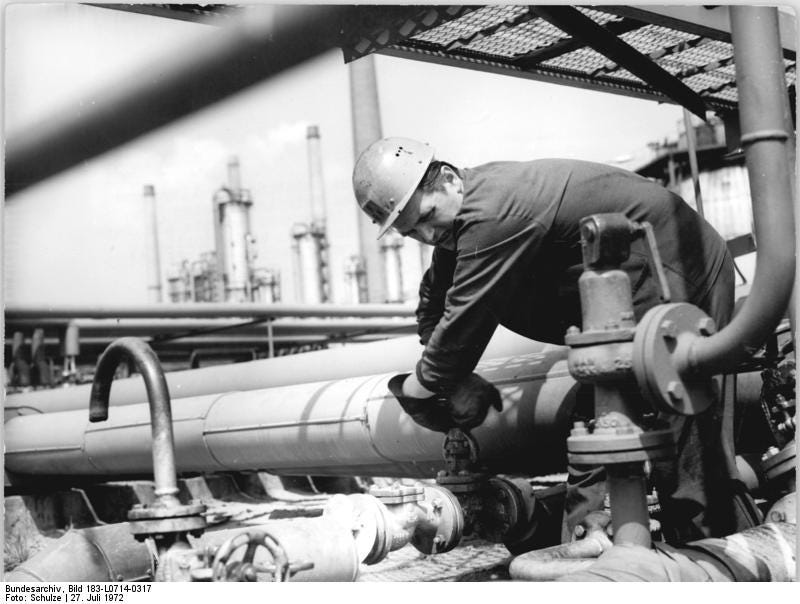
Yet the impact of the oil shortages reached far beyond the capitalist world. They just hit the Eastern Bloc with some delay and in a different form. In fact, I’d go as far as to say that these crises played a fundamental role in weakening the GDR's economic foundations, contributing to the conditions that eventually led to its collapse in 1989. This strand of the Cold War story has never been as evocative as that of rock music “shaking the Wall” or the spirit of freedom overcoming oppression, but it’s a crucial one.
To understand why, let’s go back to the oil crises themselves and observe how they destroyed the very premise upon which the GDR economy was built.