
Germany and the Great War
Or: The Great Seminal Catastrophe of the 20th Century

“What about the Treaty of Versailles? How did ordinary Germans really feel about it?” Questions along those lines have been among the most common ones put to me these last few weeks in interviews about my upcoming book Weimar. I shouldn’t be surprised. Countless historians, school children and hobby theorists have tried to answer the question of the fairness and impact of the Treaty of Versailles, which formally ended the First World War between the Allied Powers and Germany. It continues to fascinate us because we’re still debating the causes of the rise of Nazism and the Second World War.
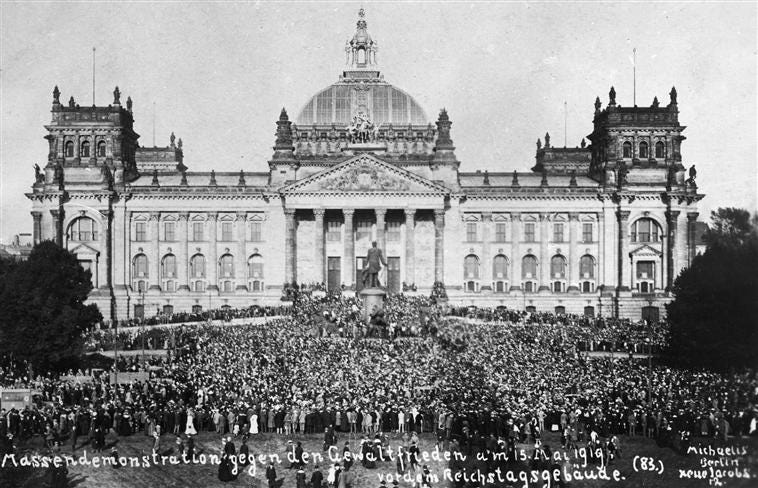
When I took this question down to ground level, to the town of Weimar and its residents, I found that the Treaty of Versailles indeed loomed large in the way Germans made sense of their post-war misery. In the first half of 1919, the townspeople struggled with starvation, rampant outbreaks of disease, homelessness, lack of coal and many other issues. The unprecedented levels of destitution drove many Weimarers to despair. According to police reports, Weimar’s suicide rate was twice as high as the national average in 1919 and 1920, affecting men and women in equal numbers.
But if there was one political event that cut through the daily struggle, it was the end of the peace negotiations. On 7 May 1919, the German delegation at the post-war conference in Paris received the conditions from the Allies. The German Foreign Minister was so shocked when he saw the terms that he said the treaty “would always trigger renewed objections against it. Nobody would be in a position to sign it in good conscience.”
I don’t want to go into the ins and outs here of whether he was right to feel this way. But the psychological effect of the treaty was similar among the wider public, especially regarding the “War Guilt” clause, Article 231, which forced Germany to accept all the blame for the war, allowing vast reparations to be demanded for decades to come.
In Weimar, the Foreign Minister’s outrage was mirrored on the ground. One local paper called the treaty a “rape document”. Käte Lehmann, a middle-class Weimarer, wrote in her diary that the conditions were even more “shameful” than “we could have imagined”. Curt Weiß, headmaster of a local girls’ school, called the Allied leaders “executioners” who “strangled Germany after it had stabbed the deadly dagger into its own body with both hands. The right hand: the arch-conservatives, the left one: the Social Democrats. Now, proud Germany, that beautiful and venerable figure, lies on the floor and bleeds out.”
This visceral form of anger continued to simmer and flare up again and again, especially in times of crisis. It was eventually channelled effectively by the Nazis, who promised to reverse the terms of the hated Treaty.
But do I think a more lenient peace – even if it had been considered right and feasible at the time – would have made everything all right for Germans in the 1920s and early 1930s? No, I don’t. I think the Treaty acted as a catalyst for the misery, ignominy, shame and brutalisation brought about by the war itself.
It’s hard to overestimate the impact this all-encompassing and catastrophic conflict had on German society as well as on the economy and politics. The influential American diplomat George F. Kennan (he of the “Long Telegram” which injected the concept of containment into American Cold War strategy) called the First World War “the great seminal catastrophe of [the 20th] century“. Many historians, myself included, agree with this.
I originally intended to write Weimar purely as an interwar study, 1919 to 1939, starting with the first post-war elections and the foundation of the Weimar Republic. But it didn’t take much looking at that none of what happened in the twenty years between the wars makes much sense without the First World War as a direct or indirect factor. I simply had to write a prelude chapter on Weimar, 1914-1918, to give readers a glimpse of the war experiences of the main “protagonists” I follow in the book.
Take a boy called Hanns Wagner, who enters my account as a blond, bright-eyed seventeen-year-old from a family of book printers. This was in the spring of 1914, when he was just moving out of his parents’ house in Weimar to rent a small room in the nearby university city of Jena, where he intended to learn his trade. He’d been a bookish kid, reading secretly by candlelight until the small hours of the morning. In the small attic room in his childhood home, he’d kept an aquarium with salamanders, water snails and frogs.
A few months later, that same teenager was cowering in a half-finished trench somewhere between Ypres and Menin in Belgium. Around him, fountains of mud erupted. Shells tore through the air, exploding with ear-splitting noise upon impact – each barrage louder than the previous one. It wasn’t long before he stared in utter horror and disbelief into the lifeless, pale faces of boys who had, just a few months earlier, been his school friends in Weimar. When he briefly returned home for Christmas, his leg was bandaged up. He’d been shot in the foot, and the infection that followed had nearly led to amputation.
Hanns wrote later that when he saw his parents at Christmas 1914, he was only “skin and bones, a skeleton limping along on crutches”. His uniform, while cleaned and brushed, was tattered. His parents were ashamed at the state of him and made him limp over to the tailor to have a new uniform made. In the end, Hanns was almost glad to go back to the front. He had changed, and there was now a gulf between son and parents that was hard to bear. He wouldn’t return to Weimar for Christmas again until the war was over.
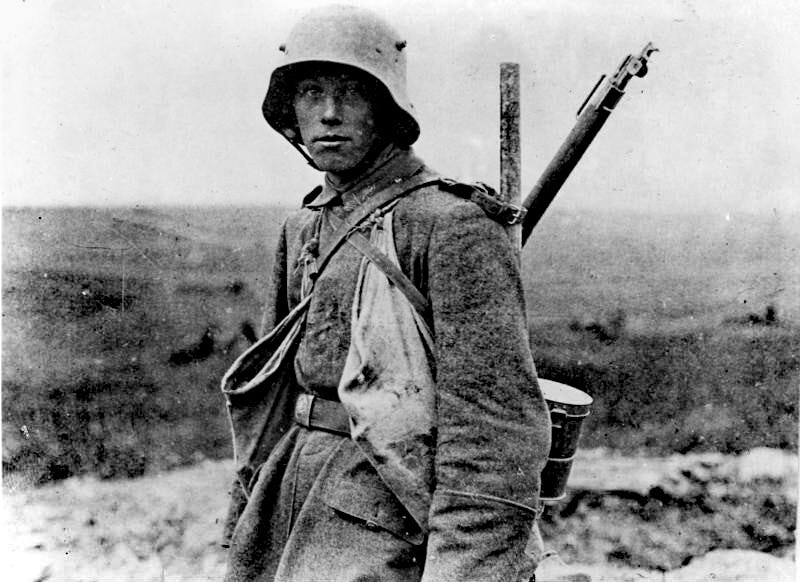
When the war was finally over four years later, Hanns was twenty-one. He resumed his bookprinting apprenticeship from the same small room in Jena that he had last occupied in 1914 as a wide-eyed teenager who loved books and music. The scar on his foot was a permanent reminder that the terrible things he had seen and done were not the “distant dream” they quickly began to seem.
Hanns was changed and scarred, and so was Germany. Take Weimar as a stark example. Of its nearly 35,000 pre-war inhabitants, 4,000 had been sent to serve in the military. Its local Regiment 94 had suffered an enormous casualty rate. Well over a quarter of the recruits perished at the front, compared to 15 per cent nationwide. Weimar mourned the military deaths of 1,338 men and three women. Precarious levels of malnourishment had claimed many more civilian victims. Veterans often rejoined incomplete families. Careers had been disrupted.
It was a sacrifice, both at the collective and individual levels, that seemed enormous to Germans. And what had it all been for? The outcome was defeat, the loss of land, people, and pride, and untold misery. What was left was a humiliated, frustrated and desperate society.
I’m not saying this to evoke sympathy but to explain the impact of this war on the next two decades. You simply cannot explain, for example, the willingness of different groups to fight their domestic political battles with arms without the mass brutalisation of the war. Even the Social Democrats had their own paramilitary group. Think of the rise of today’s new parties, left and right of the established spectrum, what you will, but by and large they don’t maintain private armies and set up barricades and machine gun positions on the streets of European cities.
Germany’s enormous economic challenges, too, weren’t a result of the Treaty of Versailles or the reparations payments, but of the war itself. The government had borrowed enormous amounts of money, including from its own citizens and planned to repay that by extracting reparations from the countries it sought to vanquish. Since that didn’t happen, there was a giant hole in the finances. On top of that, the social fragility after the war necessitated very high welfare spending in the form of unemployment insurance, support for injured veterans and for widows, as well as a number of other projects like addressing the severe housing crisis.
The Treaty of Versailles acted as a catalyst for those problems and as a vent for people’s frustration and despair – after all, it’s easier to blame remote foreign powers for the abject personal catastrophes that befell people than it is to contemplate diffuse ideas of individual and collective responsibility for the war.
The matter is, as we historians are fond of saying, more complex than that. But I strongly feel that the war itself is a much bigger factor in explaining the events that followed over the next two decades than the peace treaty. The Germany of 1918 was not the Germany of 1914, and that’s before the Treaty of Versailles was conceived, drafted or signed.
More on that and much more besides in Weimar: Life on the Edge of Catastrophe, which will be released on Thursday (7 May) in the UK, Germany and the Netherlands. Signed copies with global shipping are available from Blackwell’s. Dussmann have the German edition with signed bookplates.
In today’s Sunday Times, you can find a detailed and illustrated feature on Weimar and me.
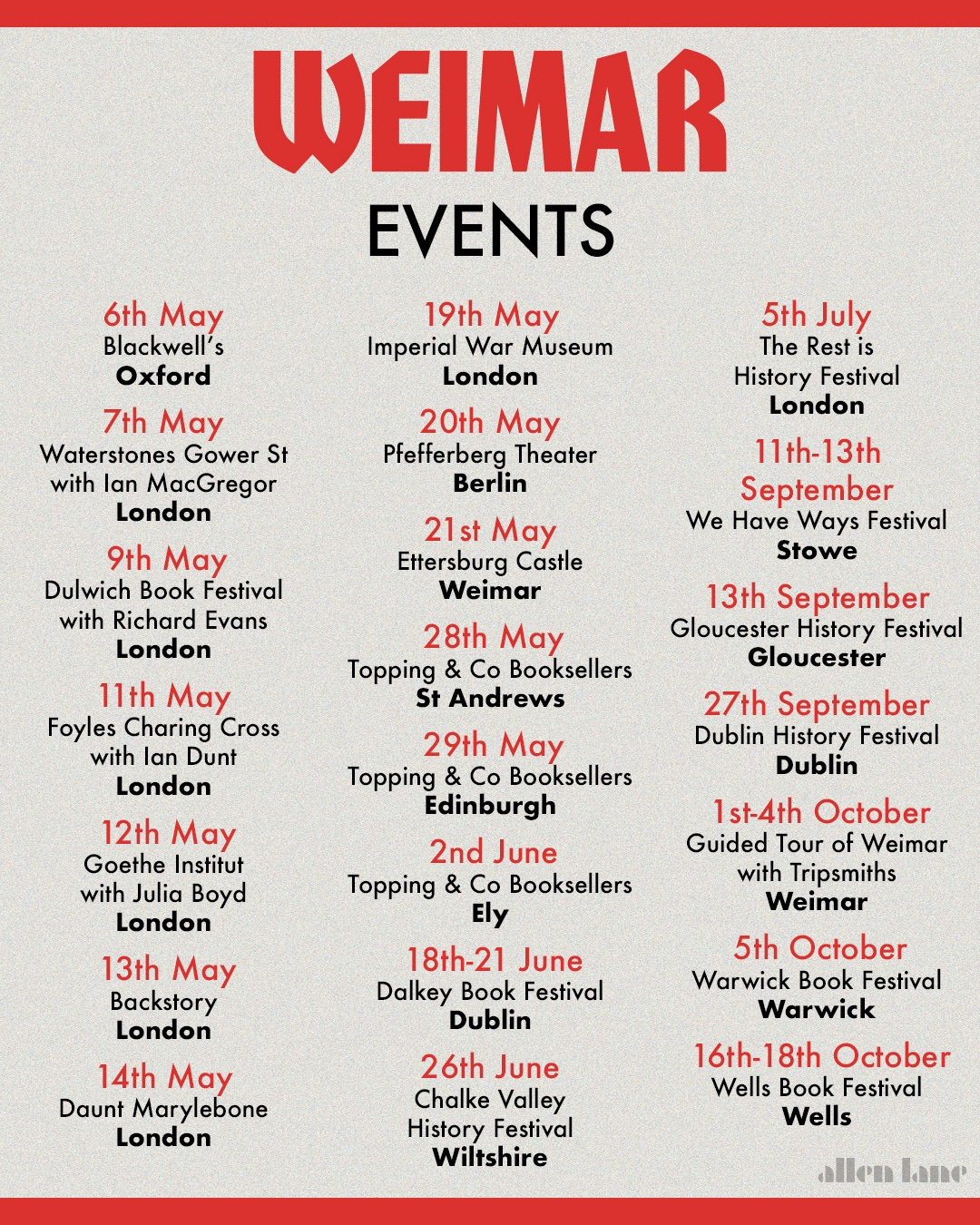
If you’d like to join me live for one of my book events, take a look at my slightly daunting tour schedule below. You should be able to find tickets by searching for the respective events online.
An excellent piece. I would only add this- I think the Germans in 1914 considered themselves THE rising power in Europe, who could only be stopped by the jealousy of its neighbors. Germany's contributions to science, medicine, and education, along with its rapid industrial development, the country's high rate of literacy, and its rising standard of living were proof of this assessment. Germans dominated nearly every field of endeavor at that point in time or would shortly. Plus, their army was second to none. This state of facts fueled the patriotism and pride present in the country when war came. And even as late as the spring of 1918, I think there was a feeling among Germans that they would win the war. After the Treaty of Brest-Litovsk, over 1 million German soldiers were released to fight on the Western Front. The collapse of the German army that then occurred was a direct result of, and continuation of, the massive strategic errors committed by German leadership, both civilian and military. These errors had plagued the country from the beginning of the war. However, to the average German, it must have seen inconceivable that Germany could lose. At war's end, rather than the rising star it was in 1914, Germany was now viewed as a pariah among nations. This mind set was then fruitful soil for what was to come next.
PS-Katja- when are you coming to the US? I would love to attend that tour for sure!
Wow that is one busy schedule ,August will be time to relax although knowing you the writing will continue, ready for the second half and the run up to Christmas. But you do get to meet lots of fans and new readers must be a most rewarding part of being an historian.