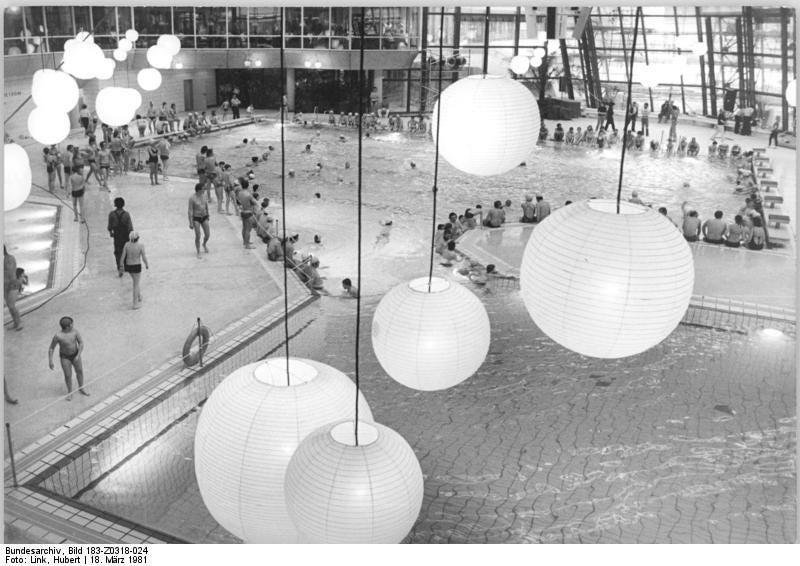
I loved the SEZ, East Berlin’s iconic sports and recreation centre. Opened in 1981, it may have been one of the GDR’s prestige projects, built to impress on a population that couldn’t leave that socialism could be fun. But I didn’t know or care about that when I went there as a kid in the 1990s. To me, the place was just enormously enjoyable. I mean… it had a wave pool, slides, a bowling alley, an ice rink and all manner of other good things all under one roof. What’s not to like?
Now, the SEZ may be about to disappear forever … again. I’ve lost count of all the news headlines over the years that were all a variation on a theme: “SEZ about to be demolished” or “Demolition of the SEZ halted”. Since the place was shut down in the early 2000s, the big question of what to do with the site has been debated with great emotion on all sides.
The latest developments were that the Berlin government wanted to raze the SEZ and replace it with housing. The demolition date was set for March this year but then suspended because rare species of bats and birds were found to be nesting in the abandoned building, and killing them would have broken environmental legislation. A new date was set for 2027 — cynical minds say this was for tactical reasons because Berlin has city elections in September and the ruling parties fear demolishing the once-popular SEZ beforehand would hurt them.
But last week, diggers were spotted at the site, and those trying to protect it fear that the state-owned building company that wants to go ahead and construct the flats is doing this on its own initiative ahead of the elections in case a new Berlin government comes in in September and re-opens the debate over the future of the SEZ. It’s fair to say the situation is a mess. That’s because it’s one of those things where politics clashes with people’s emotions. Much-needed new apartments vs much-cherished spaces.
I really get why this is such an emotive issue. I didn’t grow up in Berlin but visited often enough to think of the SEZ as a fixture of the cityscape — and more than that, as a fixture associated entirely with positive memories. Let me take you inside the SEZ as was, and you’ll see why it holds such a firm place in many East Berliners’ hearts.

The SEZ, short for Sport- und Erholungszentrum (Sport and Leisure Centre), opened on 20 March 1981 on a street that was then called Leninallee (Lenin Avenue) in East Berlin. It was an extraordinarily ambitious project.
Construction had begun in 1978, with the complex designed under the direction of East Germany’s star architect Erhardt Gißke and involving a Swedish architectural team as well as East German planners and builders. Interestingly, a West German company based in Essen built it. The result was pretty spectacular, almost futuristic with big open spaces framed by over 15,000 square metres of glass.
While the idea itself was fairly simple, giving East Berliners somewhere to spend their free time, in practice, the place was enormous, designed to have space for over 20,000 visitors a day. The centrepiece was a swimming complex with several pools, including the famous wave pool. Erich Honecker himself pressed the button on inauguration day, setting the artificial waves in motion.
Well over a decade later, I still found the wave pool the highlight of my visits to the SEZ. It sat elevated at the top of the complex, and we used to build up to it by making our way through lit-up water terraces that had little waterfalls and alcoves. The wave pool itself was quite large. You walked in at a shallow end, and the further you got to the end where the waves came from, the deeper it got. It was great fun with friends, throwing each other into the waves or sitting on each other’s shoulders trying to withstand the water pressure.
Other highlights included the diving facilities and an outdoor pool. The latter was very cool because it was heated and you could only get there diving beneath a thick rubber wall. In colder weather it was fun holding your head up in the freezing air and then diving back into the warm water. There was also a large slide and places to sit in the sun by the poolside in the summer.

But the SEZ wasn’t just a swimming pool. There was also an ice rink (which turned into a roller skating rink in the summer), a bowling alley, sports halls where you could play badminton and table tennis, a fitness centre, saunas and lots of different restaurants and cafes. From memory, they had amazing ice cream sundaes there and a very sticky version of rice pudding with cherries on top. When we went there on class trips, we could choose which part of the SEZ we wanted to use, which caused great discussions among friends weeks in advance: swimming or ice skating?
I never attended any events since I was still a small child during the GDR era, but back then the SEZ was also a popular venue for concerts, dances, sporting events and even TV shows broadcast from there. There were also childcare facilities for infants, so adults could drop their children off for a few hours and enjoy themselves.

Unsurprisingly, all this was very popular – there were often queues outside to get in – but also very expensive to maintain. The GDR, being a socialist state with a point to prove, was happy to subsidise tickets so they stayed affordable despite the eyewatering sums involved in running the place. The Berlin Senate, which inherited the SEZ after German reunification, was less keen. The place was shut down bit by bit and eventually sold to an investor for the symbolic price of one Euro.
The deal was that the investor was supposed to modernise the facilities and reopen the SEZ as a swimming and leisure centre. He never did and faced no legal consequences for breaching the terms of privatisation. There’s been much public criticism and outrage but no consequences as such. An undignified legal tussle ensued over the years, and eventually what’s left of the decaying SEZ came back into the hands of the city of Berlin. But the Senate still wants to demolish the building, so for those who want to preserve it, I guess it makes little difference.
Don’t get me wrong. While I feel a pang of nostalgia over the SEZ, there is no easy answer here. On the one hand, the proposal to build 500 apartments instead of keeping the derelict ruin of a former leisure centre seems reasonable. Berlin has a big and growing problem with affordable housing, and standing in the way of solving it to preserve a place for the sake of happy memories seems petty.
But the flipside is that the architecture of the SEZ was genuinely remarkable and innovative. Other GDR landmarks, most famously the Palace of the Republic, have already been eradicated from the cityscape. In this case, another distinctive building that many Berliners once knew and cherished would make way for nondescript residential blocks. Unlike the Palace of the Republic, which also housed the GDR’s token parliament, the SEZ was pure fun.
There are examples where GDR architecture has successfully been preserved and transformed for modern use. The most recent example is the Haus der Statistik near Alexanderplatz, which the German government owned and wanted to demolish. But there was resistance, and it’s now been renovated and back in use – even though it’s arguably much uglier than the SEZ.
Other examples include the “Palace of Culture” or Kulturpalast in Dresden, which was modernised and reopened in 2017, complete with its socialist murals and artwork.
And the former State Council Building in Berlin, where the GDR government was based. This temporarily housed the Federal Chancellery when it moved back into Berlin after reunification. But then a new building was constructed for that, and the European School of Management and Technology (ESMT Berlin) moved into the old State Council Building. I’m glad it did. The site is beautifully preserved, including the large stained glass panels in the foyer.
But the SEZ would be more difficult to preserve, I think. It’s not a government, culture or office building. Whether privately or publicly owned, a vast swimming and leisure place of the scale and opulence of the SEZ would be extremely expensive to run. I can see the appeal of bulldozing it and building much-needed – and easy-to-maintain – housing on the site. The responsible politician is Christian Gaebler, a West Berliner, presumably with no emotional attachment to the SEZ but a drive to fulfil his brief as Senator for Urban Development, Construction, and Housing.
Having stood empty and more or less unused for over a decade now, I think the story of the SEZ is only going to end one way – with another piece of East Berlin bulldozed.


