
Habermas is Dead. Will his ideas live on?
On Germany's most famous public philosopher

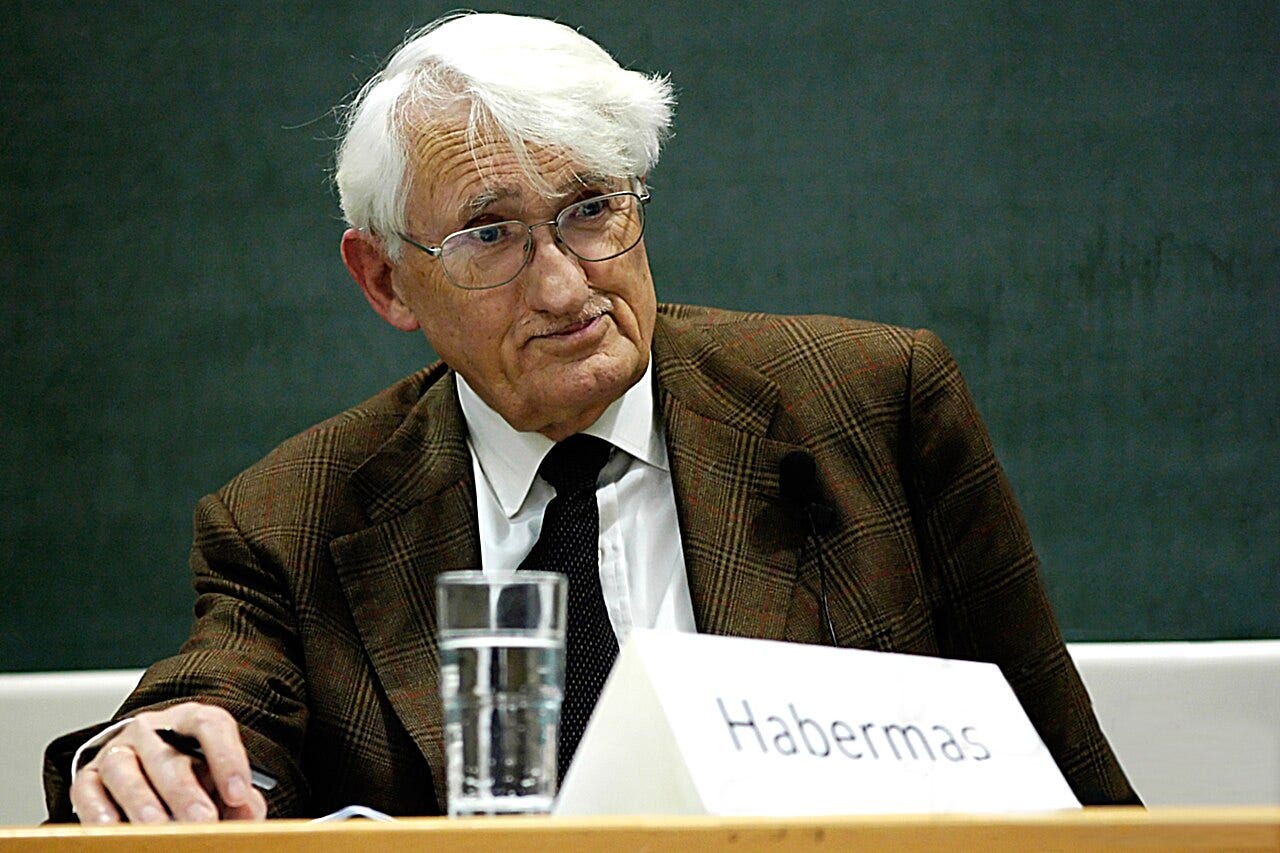
Jürgen Habermas is dead. His passing away yesterday at the age of 96 marks the end of one of the most distinctive and influential thinkers in modern German history. For more than half a century, the philosopher was a public intellectual in the truest sense of that phrase. Habermas helped shape how post-war Germany understood itself.
In West Germany, he became perhaps the closest thing the country had to a public philosopher. Despite the fact that much of his theorising took place in dense theoretical books that were by no means an easy read, he also knew how to communicate his thoughts to a wider audience through the pages of national newspapers and by intervening in current affairs and debates.
When German society argued about its past, its democracy or its place in the world, Habermas was very often part of the argument. His voice carried weight and — whether people agreed with him or not — his views couldn’t be ignored.
To understand why he mattered so much, it helps to start with the circumstances that formed him. Habermas was born in 1929 in Düsseldorf and grew up in Nazi Germany. Like most boys of his generation, he passed through institutions shaped by the regime. His father had been a Nazi Party member and was later judged to have been a “fellow traveller”. He himself was too young to have made conscious decisions about his life choices at the time. He was still a teenager when the Third Reich collapsed in 1945.
Nonetheless, Habermas was in the “Jungvolk” section of the Hitler Youth (a junior stage for boys aged 10-14) and took on a leading role within it. Towards the end of the war, when the Wehrmacht tried to draft him, he hid until the Americans turned up and occupied the territory. He would be shaped by both experiences: a youth in Nazi Germany and American “re-education”, as he later put it.
Especially, the discovery of the regime’s crimes, which came in shocking parcels through American posters, in trials, photographs and in public debate left a deep impression on him. For Habermas and many others of his generation, the question of how and why a modern society could descend into dictatorship was the central moral puzzle of their lives. Habermas tackled it with the tools of his trade: philosophy.
His intellectual development began within the circle of left-wing thinkers known as the Frankfurt School. Figures such as Max Horkheimer and Theodor W. Adorno had already developed what they called “critical theory,” a form of philosophy rooted in Marxism but critical of Soviet-style communism that tried to analyse the deep structures of modern society, including its economy, culture and power dynamics.
Habermas belonged to a younger generation of this tradition, and he gradually pushed it in a new direction. The earlier Frankfurt thinkers often sounded pessimistic, perhaps even despairing, about modern society. Habermas, by contrast, wanted to recover a more hopeful idea: that democracy contained the tools to correct itself.
His first major book, The Structural Transformation of the Public Sphere, published in 1962, explored what now appears a simple idea: Democracies work best when citizens have spaces where they can argue about politics. In eighteenth-century Europe, he wrote, these spaces emerged in coffee houses, salons, reading societies and newspapers. In other words, places developed where people debated public issues outside the direct control of the state. Habermas called this the “public sphere.” In his view, this was the beating heart of democratic life.
The concept turned out to be remarkably influential. Today, when people talk about the importance of “civil society”, free and open debate and independent media, they often echo arguments Habermas helped usher into the mainstream.
Yet his ambitions went further than describing the conditions of democracy. In the 1970s and 1980s, he built a vast philosophical system centred on the idea that human beings coordinate their lives not just through power or money, but crucially also through communication, that is, by talking and arguing with one another to reach a mutual understanding and coordinate their actions.
This idea was outlined in The Theory of Communicative Action, widely regarded as one of the most influential and discussed works of sociology of the century. It basically argues that rationality is not just about calculating the most efficient means to an end, but that it also exists in conversation, in the process of people arguing, questioning and trying to persuade one another. That’s how it links to the idea of the importance of public spaces for democracy. In other words, Habermas argued that democracy has to be more than a set of institutions. It also needs ongoing and free conversation.
This chimed with a West German society that wondered how to build back from Nazism and protect its fragile new democracy from ever lapsing back into tyranny like the Weimar Republic had. In this context, what made Habermas particularly influential was that he did not keep these ideas inside academic journals. He intervened repeatedly in the country’s political debates.
As early as the 1950s, he publicly criticised the philosopher Martin Heidegger for failing to confront his involvement with Nazism. That willingness to challenge intellectual authority became a hallmark of his career. Later, during the social and intellectual upheavals of the 1960s, Habermas sympathised with the democratic impulses of the student movement but warned against revolutionary fantasies. He even spoke of “left-wing fascism”, believing change should come through democratic debate and institutions rather than through political rupture.
Perhaps his most famous intervention came during the bitter intellectual conflict known as the Historikerstreit (“historians’ dispute”) in the 1980s. The argument revolved around how Germany should interpret the Nazi past. Some historians suggested placing Nazi crimes in a broader context of twentieth-century violence, especially communism rather than seeing them as exceptional and specifically German. Habermas pushed back hard, arguing that any attempt to relativise the Holocaust threatened the moral foundations of the country’s democracy.
His position helped reinforce what became a defining element of German political and memory culture: the idea that Germany must remain permanently conscious of the crimes committed in its name. By helping to drag this conflict down from the ivory towers of academia and into the culture pages of popular national newspapers, he had a huge impact on shaping thought and debate at the time and beyond.
Another of Habermas’s supported ideas was Verfassungspatriotismus (“constitutional patriotism”). In a country where nationalism appeared dangerous, he argued that citizens should ground their political loyalty not in ethnicity, cultural identity or history as such but in democratic principles and institutions themselves, especially those embodied in the constitution. This concept became particularly important during the debates surrounding German reunification in 1990. Habermas supported unity, but he worried about the return of national pride untethered from democratic reflection. At the same time, he feared the process was too driven by economic and administrative dynamics rather than by an inherent democratic transformation.
Not least due to this focus on moving away from nationalism and towards institutionalised democracy, Habermas was also one of the most fervent defenders of the European Union as a political project. He argued repeatedly that the EU needed to evolve into a more political community, not just an economic arrangement.
Remarkably, he remained active in public debate well into his nineties, publishing essays that continued to provoke discussion about democracy, nationalism, Europe’s future and the war in Ukraine. With his death, Germany loses a figure who belonged to a particular postwar tradition: the public intellectual who believed philosophy should participate directly in democratic life.
Habermas spent decades arguing that democracy depends on citizens reasoning together in public. Whether or not one agrees with all his conclusions, the ambition behind his work remains important. He wanted to show that the survival of democracy ultimately rests on people's ability to argue with one another… and listen. That seems a message as relevant as ever.
"the survival of democracy ultimately rests on people's ability to argue with one another… and listen". That is the false promise of social media. Everyone is shouting into the wind, refusing to listen to counter arguments.
Thank you Katja for bringing Habermas' legacy to our attention.
I studied and worked with Habermas’s ideas in my doctoral studies and he remains in my intellectual hinterland even though I hadn’t engaged with his work for years. My interests had moved on to other things; it felt more important to do Habermassian things than to read Habermas. Now he has passed away I feel called back to his work. One debate he was vital to was the debate over postmodernism and poststructuralism, in particular his debate with Foucault. It’s an open question who won intellectually (probably not even a very good question). But the world we now live in is one in which Foucault’s ideas have achieved a sort of practical dominance and the same is true of many of the ideas of postmodernism. What once were critical challenges to the mainstream (and useful as such) are now the ways we are governed. So the answer to the question in your headline is: maybe not. And this is profoundly to be regretted. However one lesson of The Structural Transformation of the Public Sphere is that the Public Sphere was born under specific historical conditions; it can therefore die when those conditions no longer obtain. So then the issue is what can we hope for in its place, and how do we make it? This seems to me a Habermassian question. And so his “ideas” may not live on, if that means the answers he proposed. But his questions continue to be vital.