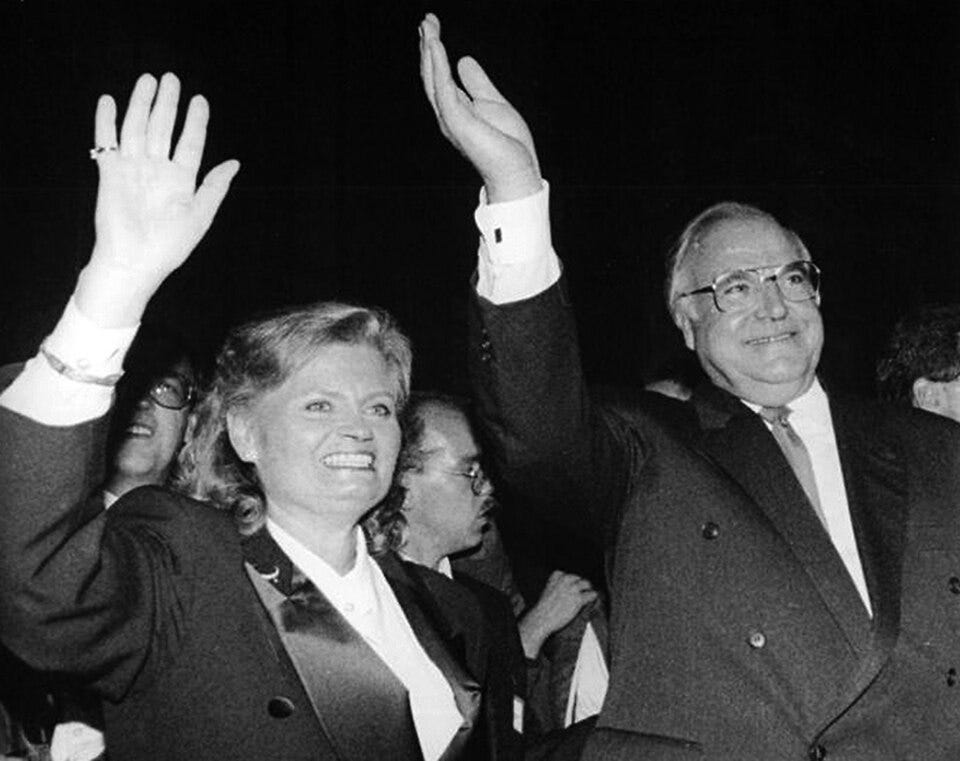
Hannelore Kohl and the silence that still surrounds wartime rape
How shame, guilt and politics buried the voices of victims for generations

I remember the death of Hannelore Kohl with remarkable clarity. It was 5 July 2001, exactly 25 years ago this week. I was a teenager then, busy with school, friends and seemingly endless summers. But the news of her death cut through the happy haze. It felt so profoundly tragic.
As ex-chancellor Helmut Kohl’s wife, Hannelore’s life had never really seemed to have been her own. The years before her death had been marked by public scandals, bad health and deep depression. She was in the news a lot, and not usually for good reasons.
Aged 68, Hannelore Kohl was all alone when she took an overdose of sleeping pills and painkillers. Then she lay down on her back with her arms and legs close to her body and waited for death to come and release her from both mental and physical pain.
Media reports claimed that this particular sleeping position had been her habit since 1945. Johanna Eleonore, or Hannelore for short, was 12 years old then and fleeing out of Leipzig, which was being bombed. There were times when the family slept cheek by jowl in a tiny laundry room. Children were told to be mindful, which involved sleeping in a compact position without moving their limbs so as not to wake others from what little precious sleep they got.
Other reports claimed that her death may have been linked to another wartime trauma. In her last years of life, Hannelore avoided daylight, suffering from an extremely rare and painful form of light allergy or photo allergy, triggered by an allergic reaction to penicillin. Her biographer and confidant, Heribert Schwan, said that he suspected that this was a psychological response to her suppressed war trauma, and he claimed to have seen medical evidence for this assertion, too.
The brutal truth that Hannelore never spoke about in public was that in the last days of war, she was gang raped by Soviet soldiers. One family friend later explained that during one of these rapes, the 12-year-old Hannelore was pressed onto a stone on the ground, which permanently damaged her spine – an injury that caused her pain and difficulty throughout her life. Schwan said Hannelore described to him how Stalin’s men simply threw her out of a window when they were done with her, “like a sack of cement”, as she put it. Even years later, Hannelore told friends she couldn’t stand the stench of stale sweat, garlic or alcohol. They brought back unbearable memories.
Why, you might ask, did she not talk about this in public? After all, she wasn’t the only woman building a life for herself in post-war Germany who had to learn to live with such memories. It is estimated that 2 million German women were raped by Soviet soldiers – around 100,000 in Berlin alone – often several times in gang rapes or over the days and weeks of the Red Army advance. The cold statistics obscure the true horror of these crimes and the psychological scars they would inflict.
Yet Kohl was also not alone in staying silent. When I interviewed older East German women for Beyond the Wall and asked them to tell me about 1945, many became evasive or told me well-rehearsed stories that had become acceptable over the years: stories of hunger, death and personal tragedy. Nobody used the word “rape”. When they spoke of sexual violence at all, it was in coded words and phrases like “the Russians came calling” and of neighbours or friends to whom such things had happened, never themselves.
This is what girls and women felt they had to do in the 1940s. They were expected to move on. For one thing, there was a widespread assumption that everyone had seen and done terrible things. One’s own story was no worse than others’. Stories of sexual violence were something few in Germany could bear to hear for decades to come – on either side of the Iron Curtain. The last thing men returning from the frontlines or from prisoner-of-war camps wanted to know was that terrible things had happened at home or that there was a child that wasn’t theirs. Many struggled with their own experiences and began to drink or break down. They had little emotional strength left over for their wives and daughters.
There was also a collective sense of guilt and shame. As the German historian Götz Aly shows in his great work, the Nazis deliberately and successfully cultivated a universal kind of culpability, involving millions in terrible crimes either by deed or knowledge. In the war, there’s already been a sense of “if we lose this, what we have done to others will come back to us.” The violence inflicted upon women was seen as part of this.
After 1945, powerful ideological and cultural pressures weighed down on victims of rape. In West Germany, notions of sexual violence offended the conservative sensibilities of the time. In the East, open descriptions disrupted the concept of Soviet “liberation”.
Take the case of Marta Hillers, a journalist, who was raped repeatedly in Berlin. Published anonymously, Hillers’s collection of diary entries from the time was first translated into other languages as A Woman in Berlin. A German version in 1959 was so reviled that it was withdrawn, and Hillers never wanted it published again in her home country while she was alive.
It was only in 2003, after her death, that a new edition was released in Germany and her identity was revealed. It was as much the graphic detail that Germans were not ready to hear as it was the unashamed pragmatism of the young woman who learned how to live and survive in that situation.
This week, the 25th anniversary of Hannelore Kohl’s death has prompted some social media posts about her story, and the responses showed that the dynamics that forced the victims of rape into silence are still at play. When I reposted a tweet about her, some of the replies to that were shocking. One person wrote that there was “no evidence” of Soviet soldiers committing such crimes; others said that she deserved it because she was a Nazi’s daughter. Yet another said I was a typical German for focusing on German suffering rather than on what the Nazis did. Hannelore’s country shouldn’t have started the war etc.
I shouldn’t have to spell this out in this day and age, but since there are clearly people out there who are ready to find ways to make excuses for terrible crimes, I will say it again: there is no justification for rape ever, especially not child rape.
Yes, Hannelore Kohl’s father, Wilhelm Renner, was deeply embedded in the Nazi war industry as an engineer and a leading figure in a major arms manufacturing company. He also joined the Nazi Party in 1933. But how is that his daughter’s fault? She had absolutely zero choice in the matter, nor in the fate of her country. The fact that the types of crimes inflicted on her – and worse – had also been inflicted on others by Germans doesn’t make what happened to her any less horrific or worthy of remembrance.
The logic that German women and children deserved their fate not only led to their dehumanisation in the first place but also to the suffocating blanket of silence in the decades after the war. Even 25 years after Hannelore Kohl’s death, there are those who say that her story should never be told. I refuse to believe that. To legitimise rape as an aspect of war in the past is to legitimise it in the present and future. It can never be right, and that clearly still needs to be said in 2026.

