Hotel Elephant: Where History Came to Stay
Or Hitler's favourite hotel
Wednesday was a long day for me. I had woken up at some ungodly hour in the morning in a dodgy hotel in East London, made my way to the airport, flown to Berlin, whizzed into the city for an interview, whizzed back out on a train to Erfurt and then boarded another one to Weimar. But here I was sauntering down the familiar avenue from the train station to the old town centre in the late evening sunshine of a mild spring day. I took a deep breath and felt the day's rush dissipate.
I’ve spent so much time in Weimar during the last few years that it’s become comfortably familiar. After the hustle and bustle of London and Berlin, of airports and train stations, the streets of Weimar seemed wonderfully calm and tranquil. The last few birds that hadn’t gone to bed yet were still singing their spring songs, quiet chatter emanated from an Italian restaurant where guests had just sat down for dinner, and a single bus rattled by, taking train passengers to the town centre who had been less keen on a walk.
I dropped my bag in my hotel room and soon found myself down in the lobby, shaking hands with a journalist who had come to Weimar to interview me about my new book, Weimar: Life on the Edge of Catastrophe. “Let’s have dinner somewhere historical,” he said. No problem. That’s very easily done in Weimar.
I could have taken him back up the hill towards the station, for instance, where the Hotel Kaiserin Augusta has offered food and accommodation since the 19th century, when it was named after the wife of Kaiser Wilhelm I. Augusta was born in Weimar to the Grand Ducal House of Saxe-Weimar-Eisenach before finding her roles on the national stage as Queen of Prussia and the first Empress of Germany.
The hotel that bears her name also played a role during the period I’m looking at in the book. Adolf Hitler spoke here in 1930 – three years before he became Chancellor of Germany – addressing an audience of 300 “bigwigs”, as his propaganda man Joseph Goebbels put it. Hitler was speaking to politicians and businessmen to convince them that Germany's future lay in National Socialism. “It reeks of poshness,” Goebbels, who came from a working-class background, somewhat resentfully wrote in his diary that night. But “Hitler speaks fabulously. I rarely see him like this.” After the talk, he sat with Hitler and the other senior Nazis long into the night. “We had much cause for laughter,” Goebbels mused.
After the war, the Hotel Kaiserin Augusta took on an entirely different role. It had survived the war almost unscathed and became a headquarters for Soviet officers. There are many places like this in Weimar, a small town in central Germany that remarkably often attracted the movers and shakers of German history. On Wednesday night, I opted to take the journalist to a different historical venue, the tavern Zum Weißen Schwan or The White Swan.
The White Swan is first mentioned in historical sources in 1688 and became even more famous when Germany’s most famous poet, Johann Wolfgang von Goethe, moved in next door in the second half of the 18th century. The Swan not only became Goethe’s local, but many of his illustrious guests also stayed there when they visited him in Weimar, where he would stay for the rest of his life and die in 1832. “The White Swan,” Goethe once wrote, “always greets you with open wings.”
In 1919, the Swan welcomed the delegates of the National Assembly with open wings. This was Germany’s first parliament elected through free and universal suffrage. All adult men and women had had a vote, and the first delegates they had elected met in Weimar rather than Berlin to write and pass a constitution for the new Germany that was supposed to emerge from the First World War. They convened at the theatre a short walk away, but met in taverns, pubs and restaurants in the evenings to continue their discussions. The White Swan was one of them, making its guest book of the time a fantastic source for the mood of the meetings.
The President of the National Assembly and future German Chancellor Constantin Fehrenbach ate and drank here, writing in the guest book: “We fled from Berlin and found a secure and cosy site here; may there be better days ahead soon for beautiful Weimar and for our dear fatherland.”
“Hear, hear,” I thought as I sat in the same place over a century later, beer in hand and a plate of Thuringian sausages with sauerkraut in front of me. I talked with the journalist about the incredible story of how the Weimar Republic was founded in this town and how the newly elected politicians had hammered out a framework for its brand-new democracy right here where we were sitting, with no idea of the horrors that lay in the future. In fact, Fehrenbach himself would never see that future. He died in 1926 at the age of 74, still in office as the leader of the parliamentary group of the Catholic Centre Party.
After dinner, we stepped out onto the cobbled Frauenplan square. The sound of water tinkled in the air from the nearby Goethe Fountain, and it was still surprisingly mild for the time of year. It was easy to forget that the day had started many hours ago and miles away with a rushed journey to the nearest Tube station. We decided there was still time that day for a drink at the Hotel Elephant, which was just around the corner on the historic market square.
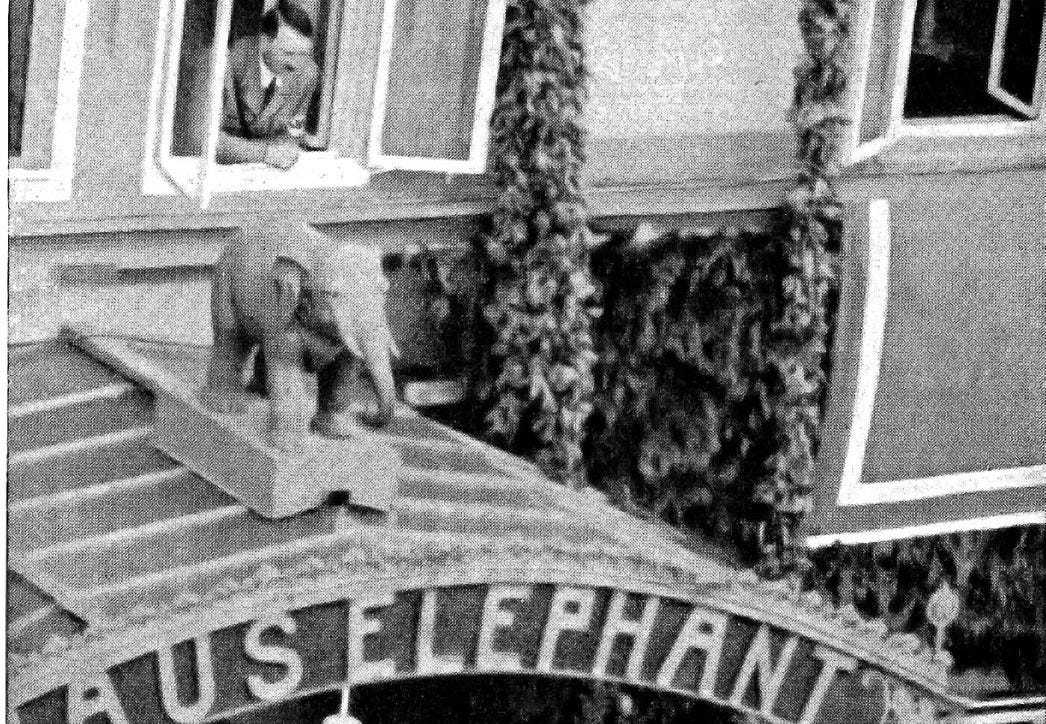
The original Hotel Elephant is almost a contemporary of the Swan. It was founded in 1696, just eight years after the Swan was first mentioned. Goethe had also dined here, as had his friend and fellow writer Friedrich Schiller and many other celebrities such as the composers Franz Liszt and Richard Wagner. More recently, during the period my book covers, the architect Walter Gropius and many of his Bauhaus colleagues and authors had met, slept, eaten and drunk at the Elephant. In 1926, Adolf Hitler checked in for the first time, naming his profession as ‘Schriftsteller’ or ‘author’ upon registration
From 1926 onwards, the Elephant became Hitler’s base in Weimar. It was ideal. Local Nazi Hans Severus Ziegler described Hitler’s accommodation there as “simple and plain … in the early years, one room, which served as both living room and bedroom”. But crucially, the set-up gave Hitler privacy with windows facing the garden to the back while also being located directly at the busy market square, allowing the “Führer” to appear right in the centre of Weimar for public speeches or to greet his followers. Ziegler regarded Hitler’s room at the Elephant as his “headquarters in the centre of Germany”.
Almost exactly a century after Hitler first checked in here, we walked through the door and sat down in the elegant armchairs in the lobby. When you’ve just written a book about this, it’s hard to push the thought aside that this is where Hitler convened his followers during the important 1926 Nazi Party rally, less known than the later Nuremberg ones, but crucial for the consolidation of the movement at a time when it didn’t do well in elections.
It was at the Elephant that Hitler held a “political tea” in 1930 to discuss his party’s first-ever participation in a state-level government in Germany. It was here that the conservative parties agreed to give the notorious Nazi Wilhelm Frick the two most important ministries of the state of Thuringia, of which Weimar was the capital. It was here that Hitler stayed during every one of his many Weimar visits from 1926 to the Second World War.
Today, the Elephant oozes understated luxury. It’s a well-designed hotel with clear lines and a stripped-back kind of classiness that gives it a timeless appeal. But this is not the same building that Hitler slept in in 1926. He loved the Elephant so much that the centuries-old building was torn down for him in 1937 and rebuilt from scratch.
What we were sitting in now is the brainchild of one of Hitler’s most favoured architects: Hermann Giesler. Giesler promised to make the new Elephant “Europe’s most modern hotel”, which would be “trailblazing in its facilities and architecture”. Hitler loved the idea and helped finance the project from Nazi Party funds. In exchange, he expected to get an exclusive apartment with garden views, in a quiet part of the hotel that would never be used by other guests. There would be a balcony out onto the market square, complete with flagpoles and the eagle emblem of the Reich.
That’s the building we were drinking “Elephant Beer” in now. The balcony is still there, as are the flag poles. The eagle emblem has gone, and now a famous Goethe quote hangs above the balcony: “Hier bin ich Mensch, hier darf ich’s sein!” – “Here I am human, here I can be“. But the 1930s elegance is still the same.
The large meeting hall next to where we were sitting is familiar to me from historical photographs, for example, of the writers’ conventions that Goebbels convened here. The first one was in 1938 and featured one of Germany’s best-selling authors, Ernst Wiechert. Wiechert had been critical of the regime, and Goebbels loathed him for it. He’d thrown him into the Buchenwald concentration camp, right on the outskirts of Weimar, where he was badly maltreated. Then he’d forced him to take part in the poetry summit at the Elephant, where he turned up physically broken and with his head shorn down to a short stubble. Everyone knew why he looked that way.
Hitler, Weimar and Germany were excited when the hotel was reopened, complete with an exclusive 80-square-metre Führer suite. Hitler had an emotional attachment to a hotel in which, as one Nazi newspaper put it, “many a decision of historical importance for the movement and therefore for Germany” had been made. The Berliner Tageblatt reported after the opening: “That Adolf Hitler in these times demanded to be kept abreast of all phases of planning, that he was the first guest to move into the transformed rooms, shows the importance of this architectural feat. It is not only a part of the party buildings which the Thuringian capital is erecting, but at the same time it is the most modern hospitality enterprise in Europe.”
Hitler had not only decided on the style, materials and details of the new Elephant but also made conceptual decisions on pricing and image. According to the architect Giesler, he’d said to “make sure that the costs for overnight stays remain low. Guests who have to save up must not be excluded from the Hotel Elephant… Hire good staff who get paid decently... Everything has to be so good that word gets round.” It’s jarring to sit in a hotel today that is exactly what he’d intended it to be, well, apart from the price points.
The market square had been empty when we walked here, but I had told the journalist about the crowds of Weimarers that had turned up for opening day. As Hitler was shown around the hotel, the people outside shouted themselves into a frenzy. The crowds wanted Hitler to come out on the balcony and speak to them. They began to chant: “Dearest Führer, pretty please – Direct your feet to the balcony.” He obliged, briefly appearing to frenetic applause. He’d barely gone back inside when the crowds started chanting again, coming up with increasingly creative slogans, right down to: “Dearest Führer, can’t you hear, we’re running out of breath down here!”
The Hotel Elephant marks a stark contrast to the hotel where Hitler stayed during his earliest visits in Weimar, the Hohenzollern by the train station. The handsome white building had twenty-three rooms with gas heating and electric lights. There were flushing toilets. In 1912, a cinema had been installed. It was by no means Weimar’s finest address. It didn’t have the old-fashioned grandeur and legendary reputation of the Hotel Elephant in the town centre, but it had been the perfect base for Hitler’s early stays. He liked the neat, tidy establishment. Its managers, Arthur and Rosa Schmidt, ran a respectable establishment. Hitler was so impressed that he returned there again and again. He had no idea that Rosa was Jewish, and Rosa had no idea what Hitler’s regime would one day do to her and her family.
Hotels are odd and evocative places for historians. They often find themselves at the heart of events, as places where people slept, ate, drank, met and debated. Nowhere is this more true than in Weimar, where history so often came to stay.
***
If you would like to stay at the Hotel Elephant and explore it and other places in Weimar with me, please allow me to engage in some more shameless promotion. I will be conducting a guided four-day tour of Weimar later this year, where we’ll explore the town’s fascinating history between 1919 and 1939, from the founding of the eponymous republic and the establishment of the influential Bauhaus school of art and architecture to the rise of the Nazis and the foundation of the Buchenwald concentration camp on Weimar’s doorstep. The group will, of course, be staying at the most historic hotels of them all: The Elephant.
If you’re interested in joining us, you can find the details here.


A fascinating read on a sunny Sunday morning. A town with history on every corner. I was emailed by Tripsmiths and took the plunge. I am looking forward to reading your new book and then visiting Weimar. I am keen to see how the Elephant deals with its history. Does it I wonder have a problem with what we call wehraboos?