

It’s not every day that I get to report to you from a five-star hotel. But today is one such day. I’m sitting at my rather neat desk at the Hotel Elephant in Weimar. Next to me, a little coffee machine hisses and takes its time pouring a steaming espresso into a porcelain cup embossed with a little blue elephant.
The hotel is all understated elegance. It’s not showy. There’s no opulence. But everything is just right. The beer – especially made for the hotel at the local Ehringsdorf brewery – comes in beautiful glasses. The staff “have to” – as one of them put it – try all the food and drink on the menu themselves so that they can make authentic recommendations to guests. And yesterday morning, at breakfast, the waitress remembered that the previous morning I’d had filter coffee with milk and scrambled eggs with my toast. It’s service and design perfection.
And then my historian brain kicks in, and I remember where I am: Adolf Hitler’s favourite hotel, a centuries-old institution that was demolished in the late 1930s and rebuilt exactly to his specifications, including a private apartment for his exclusive use. Architect Hermann Giesler promised to build Hitler “Europe’s most modern hotel” which would be “trailblazing in its facilities and architecture”. It feels somewhat jarring to know that this was the ambition behind the Hotel Elephant while admiring and enjoying the same facilities and architecture today.
The contrast between the elegance of the Elephant and the horrors of the ideology under which it was rebuilt was already present in the late 1930s. While researching for Weimar, I found countless examples that highlighted this. Try to picture the following scene that took place in October 1938:
Propaganda Minister Joseph Goebbels has summoned Germany’s and Austria’s foremost writers to the first annual “Weimar Poets’ Convention”. The meeting point is the Hotel Elephant, where they would come together to discuss literature and to network. The most prominent delegate of them all walks in, looking physically broken. His head is shorn down to a short stubble. He has clearly been badly maltreated. Everyone knows exactly why he looks that way.
Ernst Wiechert was simultaneously Germany’s most-read author and a critic of the Nazi regime. The authorities continually failed to intimidate him. Finally, Goebbels had had enough and decided to make an example of him. Wiechert was arrested and taken to Buchenwald concentration camp on the outskirts of Weimar. “This piece of dirt,” Goebbels fumed in his diary, “wants to rise up against the state. 3 months concentration camp. Then I will deal with him personally.” He meant it.
The Nazi regime had no qualms at all about putting a bestselling author into a prison system that had no legal basis and then letting his entire profession know that they had done that. As I sat in an elegant armchair in the lobby of the Elephant last night, I stared at the entrance for a moment, wondering what went through those writers’ minds almost exactly 88 years ago as one of their own stumbled in, visibly battered and humiliated.
Just under a year later, in August 1939, a German-American tour group, in the country on a “study visit to get to know the Greater German Reich better”, enjoyed drinks at the Hotel Elephant. Then they were shown the famous cultural sites in Weimar, especially those related to the poets Goethe and Schiller. And then they got onto a bus and were taken up the nine kilometres to the Ettersberg hill, where they toured the Buchenwald concentration camp. I remember reading about this during research in a newspaper from August 1938 and thinking: “These people went from the ‘most modern hotel in Europe’ to a place of unimaginable cruelty in the space of about 15 minutes.”
It occurred to me yesterday that we were about to retrace that disturbing juxtaposition of German high culture and Nazi barbarity. I’m in Weimar with a tour group, consisting of British and American guests. We’re staying at the Hotel Elephant and are surrounded by all the settings that make Weimar famous. Some of us had dinner at the White Swan, which is right next to Goethe’s house and used to be his local. We went to see the theatre where the Weimar Republic was founded, with its statues of Goethe and Schiller in front. And then we got on a coach to drive the 15 minutes up to Buchenwald.
Just to be clear, I’m not trying to compare the two situations. The German-American group in 1939 were shown an active concentration camp in an attempt to convince them that it was well-run and so that “they could convince themselves with their own eyes how ridiculous the lies of the Jewish world press” about the terrible conditions in the camp had been, as one Nazi report put it. In 2026, we were visiting the remnants of that camp, a memorial and museum site, to delve into the German interwar story and to try to understand how it was possible for a town like Weimar, that prided itself on its culture and civility, to tolerate and enable a horrific concentration camp on its doorstep.
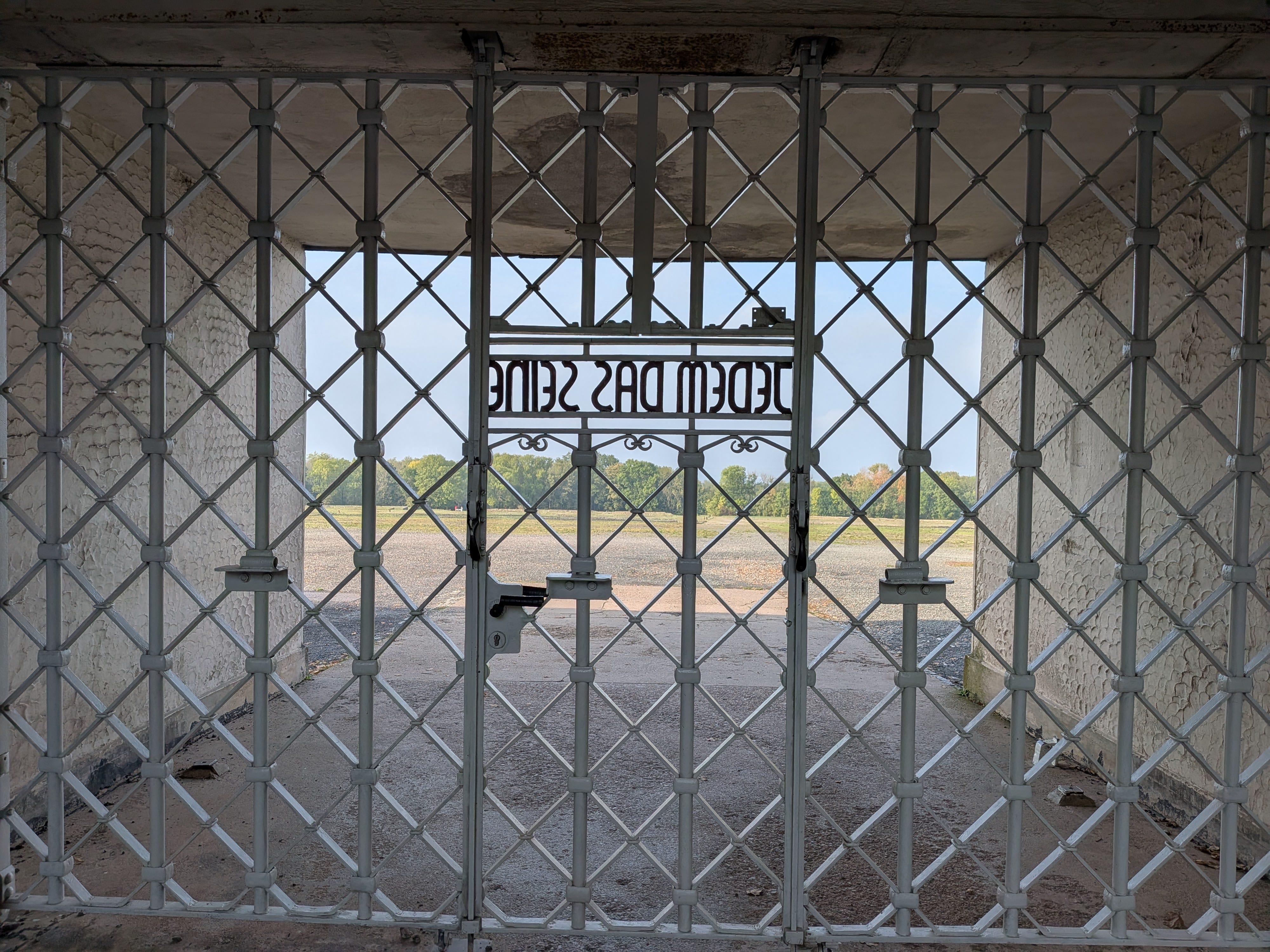
No matter how much research I undertake into this story or how often I read and learn more about it, the proximity of Weimar and Buchenwald never fails to hit me with blunt force. I stood by the entrance gate of Buchenwald yesterday, pointing at the red lettering of the slogan “Jedem das Seine” (“To Each His Own”) and explaining that an incarcerated Bauhaus graduate designed it in a Bauhaus typeface. In that moment, I was also standing just 8 kilometres away from where the Bauhaus was first set up. In fact, we’d been to the Bauhaus museum the previous day.
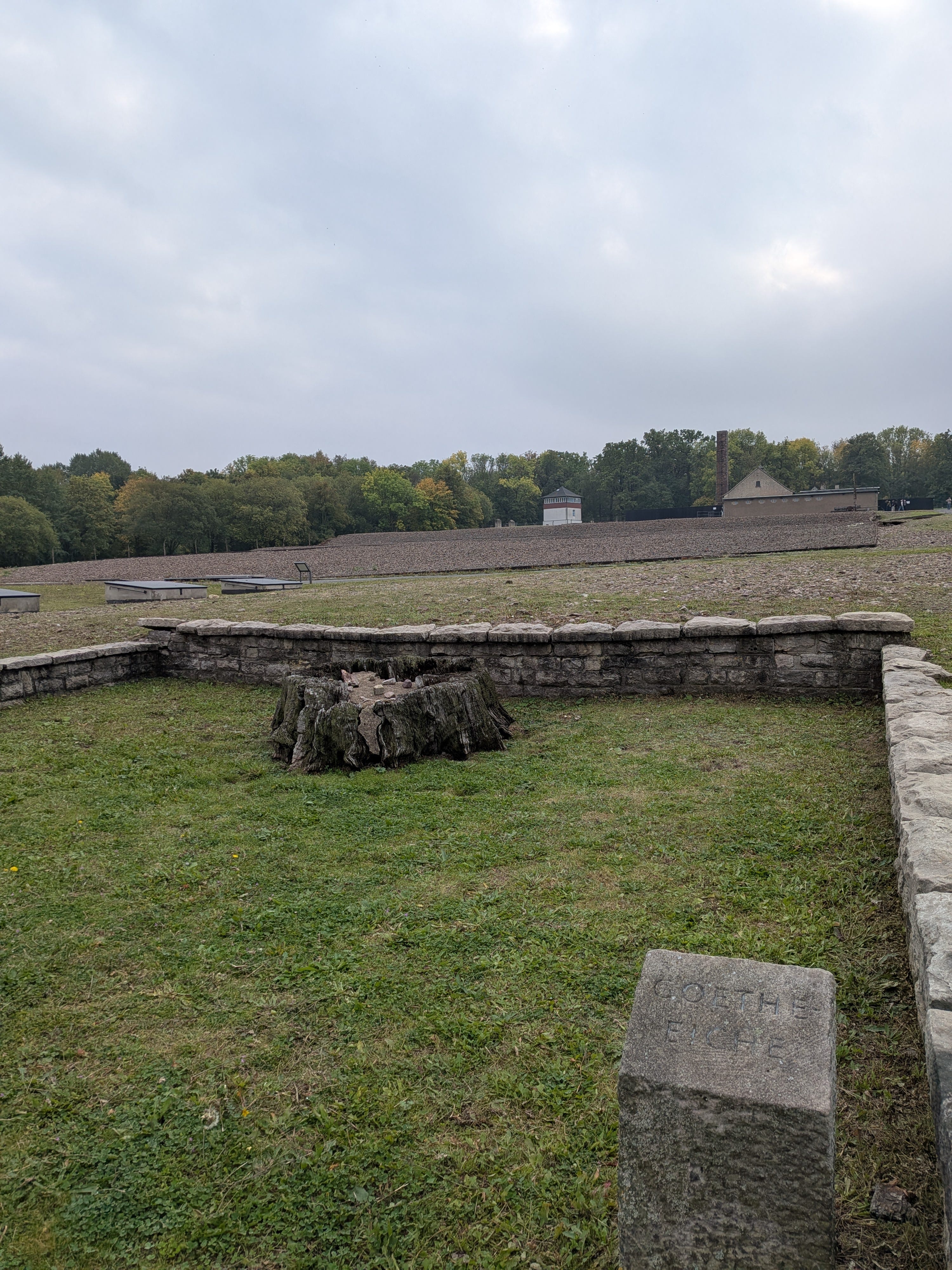
One of the most poignant things that brings this contrast home is the famous “Goethe Oak” on the grounds of the Buchenwald concentration camp. Legend had it that Goethe had carved his initials into an ancient oak on the Ettersberg. Preserved by the Nazis’ environmental protection laws, it was the only tree spared from deforestation for the camp, standing tall between the camp kitchen and laundry. Prisoners would fell this “Goethe Oak” in 1944 after it was hit by a bomb. Today, the oak's stump remains as a memorial. When you stand by it and gaze up, you see the chimney of the crematorium.
The sharp, almost unbelievable contrast between alternate realities of Germany that existed at the same time and were deeply connected struck some Buchenwald prisoners as incomprehensible, too. In 1938, Julius Katz, an inmate at the camp, remembered how a fellow prisoner had screamed at his captors: “I fought for Germany. I lay at the front for over four years. I’m a German Jew. We’ve been persecuted for 2,000 years, and you claim to be a cultured people!” He was punished immediately, receiving twenty-five cane strokes. Katz recalled the man’s screams when he described the incident later: “You could really hear how the SS man took aim, cut the air with his cane so that it whistled . . . I just thought of Weimar, Buchenwald, Goethe. It made no sense.”
Walking through Buchenwald 88 years later, well-fed, free and safe, I felt we have to try to make sense of that apparent contrast between culture and cruelty today. If the story of interwar Weimar shows anything, it’s that we can’t rely on past achievements to protect us from radical ideology, violence, injustice and war.
It’s a sobering, even disturbing thought but one worth recalling: No amount of history, tradition and culture is an automatic civilisational safety net. It’s the decisions we continue to make as individuals and as societies day by day that uphold or erode the values we live by.
What terrifies me is I can see a Trump Cabinet Secretary making a statement like Goebbels about a regime critic and using the State apparatus to harass and punish them. The veneer between civilisation and barbarism is frighteningly thin in Germany then and now even in one of the oldest democracies in the world.
Well said Katja and I won’t try to compete. It’s a trite cliche but true, walking through the camp and museum is very thought provoking. Although not a death camp like the Reinhard camps for example; cruelty and violence were designed in.