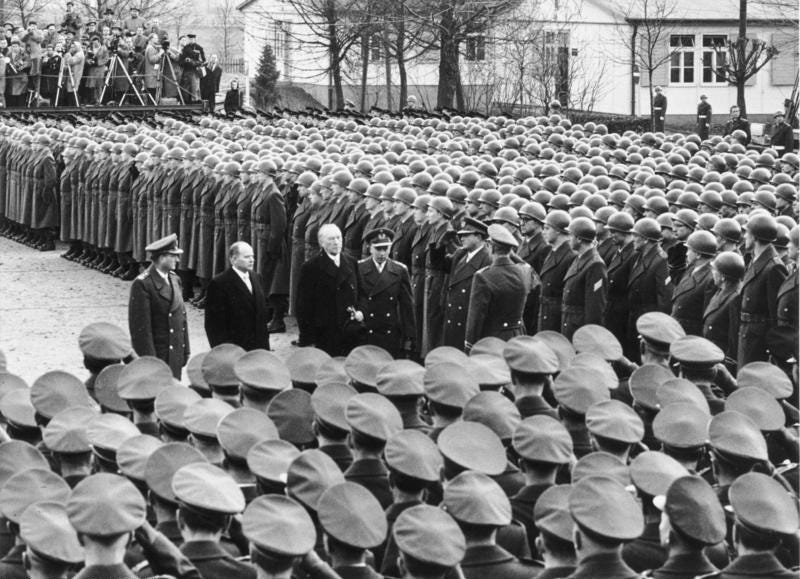
How Germany Rearmed After WWII
...and why the ghosts of the past still haunt its military today

Something remarkable happened this week: Germany launched its first military strategy since the Second World War. The Bundeswehr, as Germany’s post-war military is called, has decided who its main adversary is (Russia) and what it needs to do to stand up to it (build the largest conventional army in Europe). That’s so new and ambitious that I don’t think we’re overstretching the word “historic” here.
It’s true that both post-war German states once had sizeable armies and conscription during the Cold War, and that the current rearmament efforts could be seen more as a restoration of this status than as something new. But I disagree. What we’re seeing now is fundamentally different in three key ways:
A) Neither post-war Germany had to think strategically.
B) Their forces weren’t expected to be deployed in earnest on larger combat missions.
C) Having lost two World Wars and remaining shellshocked by the crimes that accompanied the Second one in particular, neither East nor West Germany developed a military ethos that celebrates military service in the way that other countries, including the US, Britain, France and Russia, do. For good historical reasons, German post-war culture has been wary of all things military and even the very idea of patriotism itself.
The current national effort to rearm by building a huge military force of 460,000 people, including 200,000 reserves, all following the first-ever post-war strategy made in Berlin, is entirely new. It will require a careful rethink and reform of established attitudes toward war, service and country if it is to succeed. It’s worth examining how Germans rearmed after the Second World War to understand the roots of the Bundeswehr we see today.
When Nazi Germany lost the war in May 1945, its military, the Wehrmacht, surrendered unconditionally and was dissolved wholesale by the Allies shortly after. In fact, demilitarisation was one of the few principles regarding Germany's future that all sides could agree on.

This means that when East and West Germany were established in 1949, they didn’t have their own military forces. Both contained soldiers from the countries that continued to occupy them. It would have probably stayed like that much longer if it hadn’t been for the emergence of the Cold War, which triggered a rethink in the US in particular. Washington needed West Germany to help bolster the European front lines against communism.
As early as 1951, West Germany began to build up paramilitary police units to help guard the inner-German border (the long one in the middle of the country, the Berlin Wall would not be built for another decade). Vague plans to rearm West Germany had been underway for a few years already, pretty much since tensions began to escalate in 1947/8. But this specific development stemmed from a new kind of urgency triggered by the Korean War, which began in 1950 and not only tied the Americans down but also confronted them with the reality of communist expansion by military means. They needed West Germans to help hold the line in Europe.
Regardless of the practical necessities, it is absolutely astonishing in hindsight how this process unfolded. In the autumn of 1950, a meeting took place at Himmerod Abbey, a Cistercian monastery in the far West of the country. There, former officers of the dissolved Wehrmacht met, tasked by Chancellor Konrad Adenauer to outline options for the rearmament process.
The resulting memorandum reckoned the new West German army should have around 500,000 men, so more than today’s plans foresee, based on a much smaller population. In spirit, the memorandum argued that the only way to build a new German military was to rehabilitate the old one to maintain a degree of continuity in personnel and traditions. “Western nations,” the chairman of the meeting demanded, “must take public measures against the ‘prejudicial characterisation’ of the former German soldiers.”
In January 1951, Dwight D. Eisenhower did just that, declaring that “I have come to know that there was a real difference between the German soldier and Hitler and his criminal group ... For my part, I do not believe that the German soldier as such has lost his honour.” This helped create and maintain the myth of the “clean Wehrmacht”, a concept that still triggered significant debate in the 1990s and early 2000s when a famous two-part Wehrmacht exhibition challenged it by focussing on the crimes committed by regular armed forces during the war.

In the early 1950s, the clean Wehrmacht myth unlocked the path for rearmament. But, importantly, under the condition that Germany would not make strategic decisions on its own. Western European integration was underway, and in 1955, West Germany joined NATO. The latter happened at the beginning of May, i.e. almost to the day, 10 years after the end of the Second World War.
It was a done deal. There would be a new and large German military force: the Bundeswehr. It was officially founded on 12 November 1955. But it was going to be contained by the Allies’ decision-making, most importantly that of the US. Adenauer’s plans to develop nuclear weapons for West Germany were also shut down immediately.
East Germany responded to the process by building its own military, the National People’s Army, starting with military police units in 1952 and culminating in the official formation of the NVA on 18 January 1956. Ten days later, it joined NATO’s communist counterpart, the Warsaw Treaty Organisation, often referred to as the “Warsaw Pact”. Both the Bundeswehr and the NVA introduced male conscription, and both received comparatively large proportions of GDP.

By and large, the young men (and in the case of the GDR, women too) who chose military service as a career did so because they enjoyed the stability and camaraderie of this kind of life. Those who were forced into it for a time (especially in the East, where there was no civilian alternative to military service as there was in the West), often resented the experience. But both groups could expect to avoid active combat.
One example that illustrates the point is the suppression of the Prague Spring, a reform movement in Czechoslovakia under the leadership of the Slovak politician Alexander Dubček. When, in the late hours of 20 August 1968, an invasion force of 500,000 Warsaw Pact troops threatened to crush any resistance in the Eastern European country, the GDR’s NVA forces were among the support units. East German leader Walter Ulbricht had wanted to send them in fully to prove his country’s worth to the Soviets, but even they were cautious not to deploy German soldiers in Eastern Europe just one generation after WWII. NVA troops never actually crossed over the border into Czechoslovakia, but were nonetheless helping directly under Soviet command. It was a decision made in Moscow not to deploy NVA troops in open combat, not in Berlin.
The practical implications and relationships were different, but the principle of following the grand strategy set by their Allies was similar in West Germany. After unification, Germany also didn’t develop its own strategy paper. After the full-scale Russian invasion of Ukraine, then-Chancellor Olaf Scholz kept emphasising that his country would “not go it alone” when it came to supporting Ukraine, but would wait for cues from the US. Scholz also emphasised that Germany would never be a “party” in that war.
Those founding principles of German rearmament after WWII are now changing:
A) By developing its own comprehensive military strategy, Germany is beginning to think strategically for the first time since 1945.
B) Defence Minister Boris Pistorius has said that he wants Germany to be “kriegstüchtig” or “war-ready”, clearly expecting soldiers to be deployable.
C) There are small-scale attempts to celebrate military service more, for instance, with Germany’s first Veterans’ Day last year.
This is a huge shift for any number of reasons, and it will have to be carefully thought through and managed. The launch of the new military strategy certainly should be a much bigger news item than it is, given the vast cultural, political, economic and social transformations that will have to underpin it.
There is no easy way to solve this conundrum. Germany will have to strike a very careful balance when trying to reconcile the need for military strength with a deep-seated reluctance to let militarism take hold again.


I had the good fortune as a military historian to meet and spend time around three famous Luftwaffe World War II pilots: Adolf Galland and Major General Walter "Count Punski" Krupinski, and Lt. General Gunther Rall (both ranks in the Bundesluftwaffe). Rall had just retired as the commanding general of the Bundesluftwaffe. I wanted to talk to them about their wartime experiences, but Rall and Krupinski also talked about the post war Bundesluftwaffe, which was quite interesting. Rall made an important point to me that the WW2 Luftwaffe was not as "clean" and "apolitical" as most writers at that time were proclaiming.He pointed out that all the new aircrew from 1939 onward he been in the Hitler Jugend, and had to have a recommendation from the group they had been in, to be accepted into the Luftwaffe. As he said, most young boys were not political, but they still absorbed Nazi ideology in the HJ. Also, when the Bundesluftwaffe was formed, they took great care in trying to keep the overt Nazis like Hans Ulrich Rudel out "But there were many who weren't as public as Rudel, who agreed with him - they were the problem."