

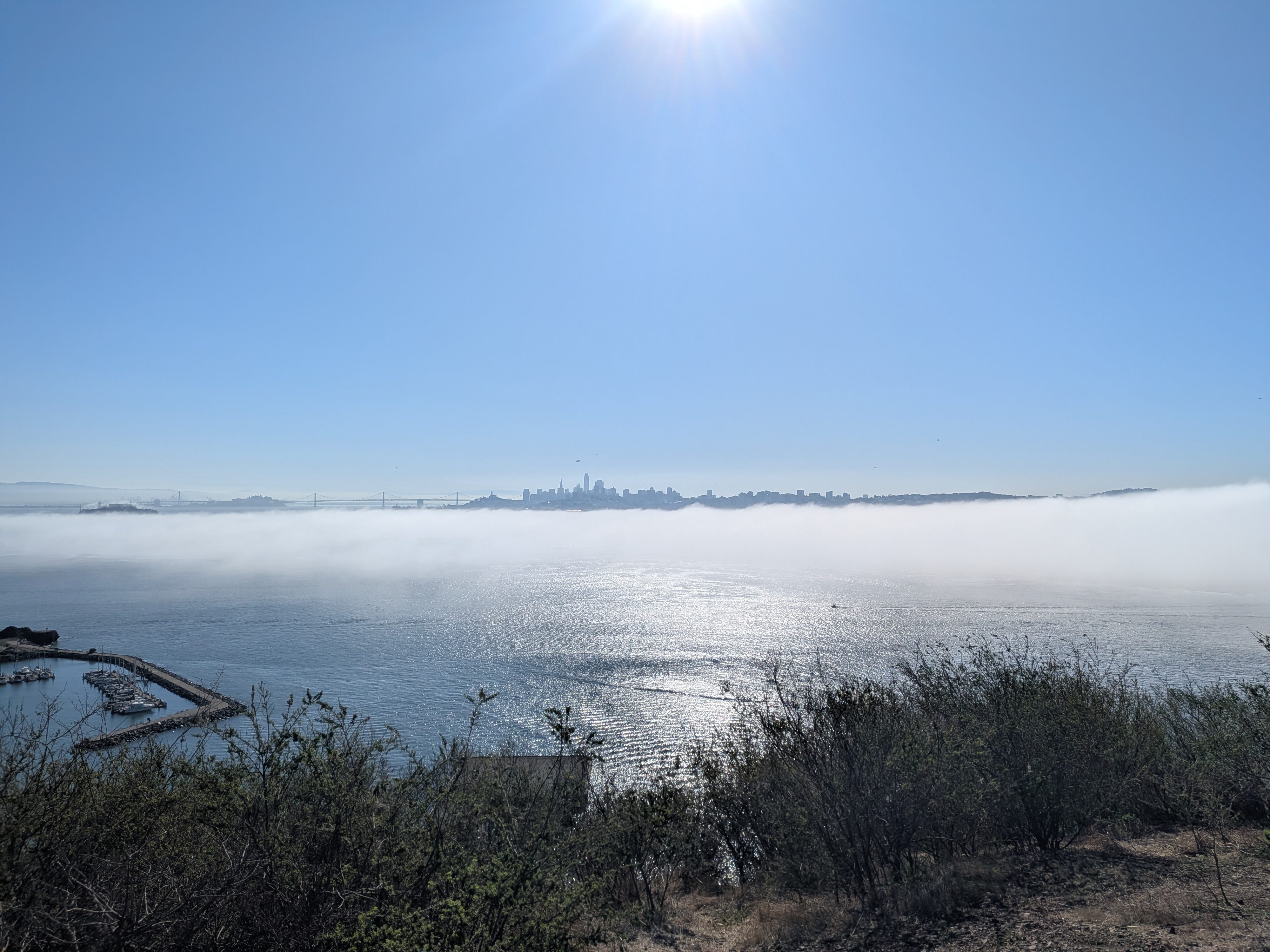
I didn’t know driving across the Golden Gate Bridge in a convertible BMW sports car was on my bucket list. But if I’d known how much fun it would be, I’d definitely have scribbled it on there….
The car belongs to a friend who is originally from the San Francisco Bay Area and happened to be in town when I arrived in San Francisco or, as locals like him call it, “The City”. He kindly offered to show me around — in style.
We spent the evening walking around the waterfront area of Fisherman’s Wharf, had some pasta with a friend of his in North Beach, San Francisco’s historic Little Italy and visited the iconic City Lights Bookstore, famous for being the first all-paperback bookseller in the United States and a cornerstone of the Beat Generation literary movement.
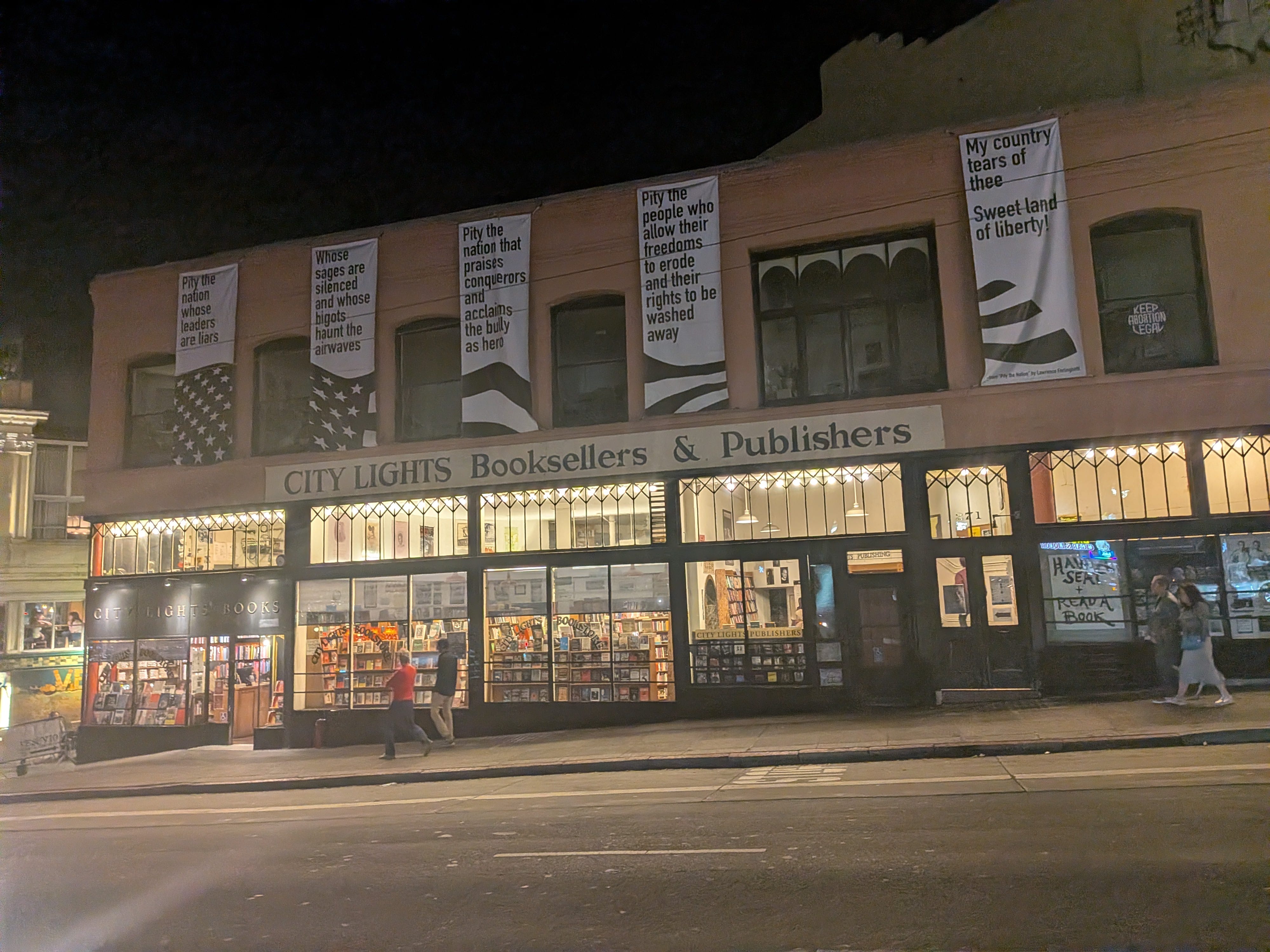
Between bookshelves labelled “Muckraking”, “Anarchism” and “Class war”, we found my books Beyond the Wall and Weimar. Like any author, I’m always pleased to see my work in the wild, but finding it here, at the other end of the world, was quite something.
I also learnt much about San Francisco's swimming culture, where doing “an Alcatraz” is a thing, as in swimming the 1.25 miles out to the famous prison island. In the morning, we crossed the Golden Gate Bridge and back before heading to Stanford University, whose German motto, a quote from the knight and poet Ulrich von Hutten, is: “Die Luft der Freiheit weht.” – “The wind of freedom blows.” That seemed entirely appropriate as I closed my eyes on the highway, enjoying the warm Californian sun on my face and the wind in my hair.
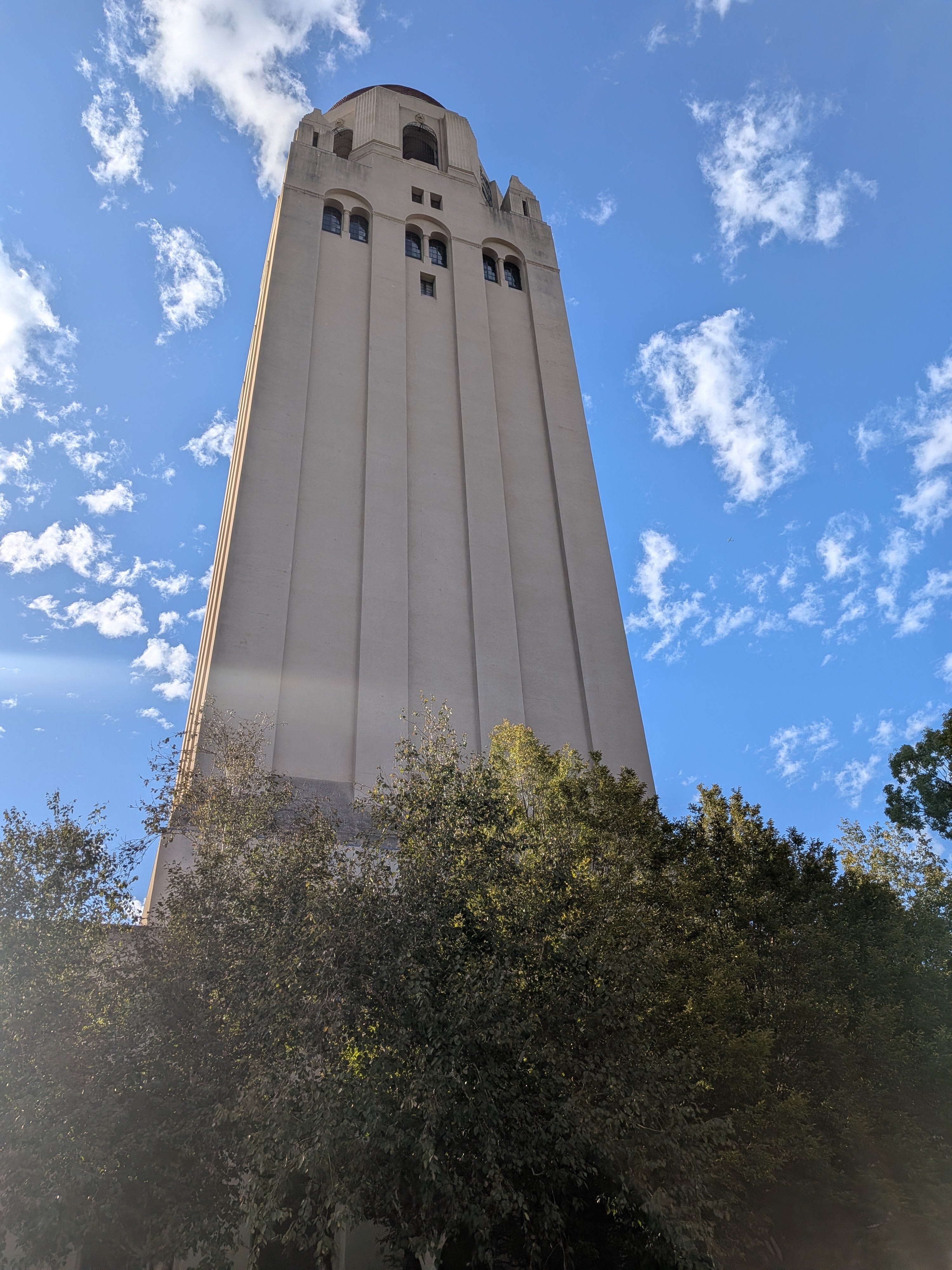
Stanford, or rather the Hoover Institution housed on its vast and beautiful campus, is what I had come here for. It’s where the “Military History in Contemporary Conflict Working Group” holds its regular meetings to discuss … well … the role of military history in contemporary conflicts.
Unsurprisingly, the focus was Ukraine, Iran and the Middle East. I hadn’t expected to hear quite so much mention of the Prussian military theorist Carl von Clausewitz. Nor the Ludendorff Offensive, Germany’s last-ditch effort in 1918 to win the First World War. Nor about the lessons on tank production that Germany drew from that conflict and applied to great effect in the Second World War.
I suppose I shouldn’t have been surprised to find that Prussia’s and Germany’s aggressive expansion efforts in Europe in the 19th and 20th centuries should still be called upon for lessons on current military conflicts, but it seemed a little jarring after the incredibly chilled atmosphere of San Francisco.
One of the most interesting contributions came from Condoleezza Rice, former secretary of state and current director of the Hoover Institution, who offered some reflections on the effect that military conflict has on political decision-making. She was National Security Advisor when 9/11 happened.
In this room of dozens of American military experts and historians, I also hadn’t quite expected to be talking about the Stasi, East Germany’s infamous secret police and intelligence agency. But the Hoover Institution Library & Archives holds many interesting sources on this history, the most exciting being the collection of Markus Wolf, who headed the Stasi's foreign intelligence department.
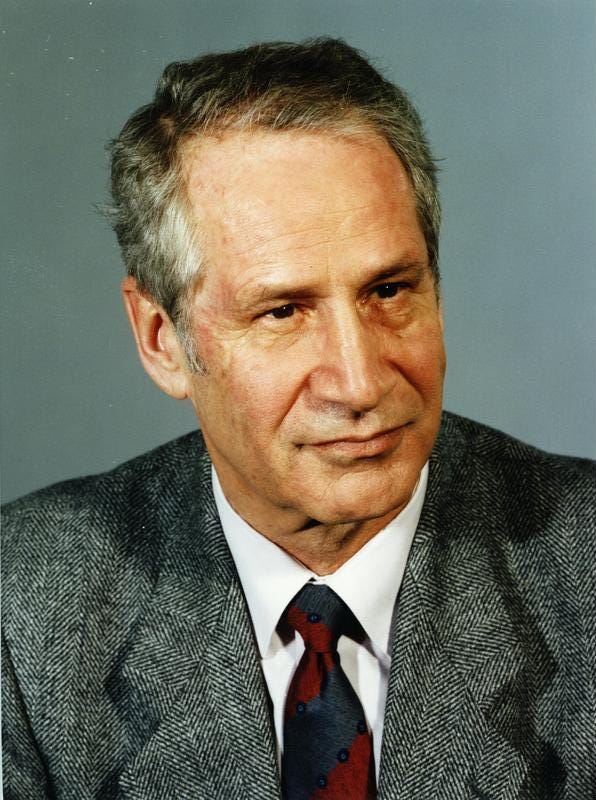
As a spymaster, Wolf was a powerful and elusive figure within the Stasi, cultivating a mysterious aura. For a long time, the West had no photograph of him and no idea what he actually looked like, so he acquired the nickname “man without a face”. The HVA, the Stasi’s foreign intelligence arm led by him, was more or less allowed to dissolve itself when the Berlin Wall fell, which led to the destruction of many of its files.
Wolf, who had retired in 1986, reinvented himself as a reformer, speaking at the huge November 1989 Alexanderplatz demonstration for which he received both scorn and applause on the day.
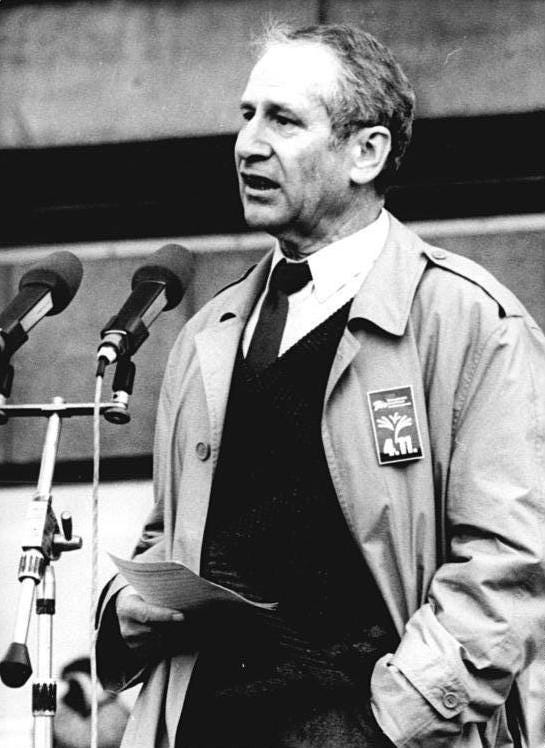
Wolf claimed the CIA offered him money, plastic surgery to change his face, as well as a pleasant and anonymous life in California if he’d collaborated with them on identifying moles in its own ranks and if he shared his extensive knowledge of Cold War activities with them. He said he politely declined, facing a trial and conviction for treason in Germany instead. This, by the way, included the Guillaume Affair, which we recently covered on the Reichs & Republics podcast.
Interestingly, the German constitutional court later overturned the verdict. Wolf couldn’t have committed treason against the Federal Republic of Germany since he worked for a different German state that no longer existed. Other convictions followed for deeds that were illegal in both German states: detention, coercion and bodily harm. He received a suspended prison sentence for those in 1996. He died in 2006 and was buried, alongside many other famous communists and socialists, in the Friedrichsfelde Central Cemetery.
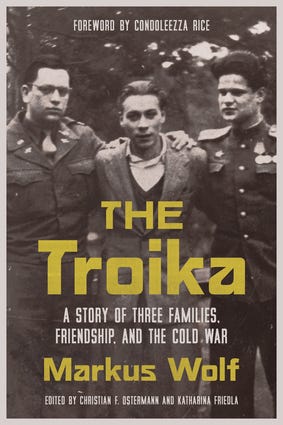
Quite how all his papers and documents ended up here at the Hoover Institute, I haven’t been able to establish, but it’s an exciting prospect that both the original documents, covering his life from around 1930, when he was just 7 years old, to 1999, are here alongside materials gathered for his memoir, The Troika. I must return to look at those. During the lunch break at the Military History gathering, I was told that restrictions on their accessibility will be lifted very soon.
The Troika was originally published in both East and West Germany in 1989 — after Wolf’s retirement but before the Fall of the Berlin Wall. It caused an absolute sensation. Now, The Hoover Institution Press is publishing The Troika in English for the first time — with a foreword by Condoleezza Rice.
You can find a fascinating excerpt from the book here. It’s edited by Katharina Friedla and Christian F. Ostermann. I used Ostermann’s fascinating research on the 1953 uprising in East Germany for Beyond the Wall and also consulted him directly on some of his findings.
And then there were the personal stories from some of the historians at the conference. One of them, an expert on Eastern European history, told me about his frequent visits to the GDR in the 1970s and 1980s. As an American, he found it easy to cross over into East Berlin frequently, but he also travelled to archives around the country for information. Naturally, this was closely watched by the Stasi. “Did you ever ask to see your file?” I asked him over dinner.
I always find this aspect particularly fascinating. Anyone who thinks the Stasi may have monitored them can apply to have their file found. The responses vary hugely. Some people are appalled to find out exactly which neighbour, friend or colleague betrayed their trust. Other names are redacted due to data protection, but it’s often possible to work out who passed the information to the Stasi. For that reason, many East Germans have chosen not to look, afraid of tainting or breaking friendships.
Among many Westerners, on the other hand, there is a thing I’ve heard described as “file envy”. I found the concept entirely alien at first. Imagine being an eminent historian from Britain or the US and remembering yourself as a daring, adventurous researcher who ventured deep into Cold War East Germany as a class enemy.
Years after the fall of the Berlin Wall, you apply for your Stasi file, expecting to be sent a thick folder filled with hastily snapped images of your younger self at train stations or in hotel bars. You’re excited to read about yourself as a dangerous agent of foreign powers, on the right side of history. Instead, you get a curt message: Sorry, no file found. “I was devastated to find that I clearly wasn’t seen as important enough by the Stasi”, one hurt historian once told me.
But others were watched. The well-known British historian Timothy Garton Ash even wrote about it in his book The File. Here at Stanford, the American historian I was talking to at dinner said he also received his file. “It was quite bizarre,” he said, “because the accounts varied so widely”. They’d clearly received them from different sources. “One time, I was a ‘tall and handsome young American of neat appearance’. The next time I was described as ‘dishevelled and unkempt, tie hanging loosely off the neck.’”
So in a strange way, my visit to California has come full circle. I expected to come here and find sunshine, hippie culture, jeans, Silicon Valley, and military history — and I did. But I also found a lot of fascinating German history, including the elusive “man without a face”. In 1996, the spymaster himself was denied a visa to the US for being an “unreconstructed communist”. Two decades later, his writings are published here, of all places, in one of the most iconic heartlands of capitalism.
Ah the famous files! A German friend of a friend asked for it, there were two entries about what she had bought in a shop, something like half a kilogram of potatos bought on date + time.
Another discovered that her awful husband who was beating her up was a Stasi agent.
All sorts.
There must be some contemporary novels about this?
In the UK it is well known that MI5 maintained a similar, althought presumably less comprehensive, database of 'pfs' (personal files) for people they were interested in. They say that all this material has long been destroyed. However, a small number of heavily redacted files on known Nazis and Communists and supposed felllow travellers are available at The National Archives at Kew (and most are online through TNA's website). They make fascinating reading revealing the extent that MI5 conducted surveillance of the British population in general.
When I was a young active member of a suburban local Labour Party in the 80s we often talked in the pub about whether the security services were interested in us and whether there was a mole reporting back to MI5 HQ. Frankly we were no more a threat to society than a paperbag, but it gave us a frisson of excitement and sense of 'sticking it to the man'..