Greetings from Cologne. I’m right in the middle of this ancient German metropolis. I’ve come here to talk on German TV about the upcoming elections in the state of Saxony-Anhalt (more on that here if you’ve missed my earlier explainer). But now that that’s done and I’m looking out of the window of my rather agreeable hotel room, my thoughts are drifting off in a slightly different direction…
I recently heard on a German podcast another inventive explanation for why East Germans vote in higher numbers for the AfD than West Germans. This time, the reason given was that they see history differently. East Germans apparently draw a direct transition from Bismarck (who was East German) and Prussia (which had its power base in East Germany) through the Nazis (which …err… also ruled over eastern parts of Germany) and the GDR (which was East Germany) to the present.
Well… perhaps that explains, then, why I’m looking at Cologne Cathedral right now, and my East German mind immediately goes: “Prussia built that.” East German thought or not, it happens to be true. Well, sort of. The origin story of Cologne Cathedral is certainly remarkable — a seat and symbol of Catholic power completed only when Protestant Prussia took over. Come with me as I delve into the *ahem* tall tale of Cologne Cathedral. It’s worth it. Much of German history is tied up with it one way or another.
Let me start by trying to put into words how huge and special this place is. The world-famous Cologne Cathedral looms over the city like a beacon. Only the TV tower is higher up in the skyline. If I go all the way up to the roof terrace of my hotel (which I may or may not have done last night for a cheeky glass of Kölsch beer), it’s still looming over me. It feels like you’re not even halfway up. The thing is absolutely enormous, a real feat of human ingenuity over 600 years in the making.
The story of how Germany itself emerged as a nation-state is etched into its Gothic swirls and arches. Even in this secular age — and even in my East German, atheist mind — Cologne Cathedral still has the power to impress, amaze and enchant. It’s Germany’s most visited landmark and rightly so. Let me take you inside…
If you can bear it, the best time to go would be right now, at roughly the time this dispatch would have landed in your inbox. The Cathedral opens its gates at 6 o’clock in the morning, and this early you stand a good chance of having its mind-boggling grandeur to yourself.
I’ve tried to capture the interior in pictures before, but it’s impossible. My camera doesn’t know what to do with the dimensions. I read somewhere that, floor to ceiling, the nave is so tall that the Statue of Liberty would fit in there — upright! It’s the tallest Cathedral in the world, and the mind really struggles to comprehend the dimensions even when you’re standing in it.
Being a Catholic church, it also doesn’t hold back on design. This is full-fat ecclesiastical architecture, complete with huge vaulted ceilings, stained glass windows, beautifully carved stalls, a black marble altar and the golden, shiny Shrine of the Three Kings, believed to contain the bones of the Biblical Magi. It really is mindblowing to think that humanity was once able to build such things, and now we appear to be struggling to fill potholes.
Then again, it took well over six centuries to complete Cologne Cathedral, so that puts things into perspective somewhat. When work on it began in 1248, wearable reading glasses had not yet been invented. By the time it was finished in 1880, the first cars, trams and light bulbs were about to change our lives forever. The construction of Cologne Cathedral spans centuries of European, and especially German, history. Its completion in the 19th century was suddenly regarded as an all-German effort — a new sentiment that finished this magnificent cathedral but also the process of forming Germany itself.
In short, what happened was this:
There’s thought to have been a place of Christian worship on the site of today’s cathedral since around the 3rd century when Cologne was within the Roman Empire. As the Christian community grew in size and power while Roman rule began to disintegrate, the first formal church was built in the 6th century in the same place where we see it today.
The first proper cathedral was consecrated in 870 and is still remembered as the Hildebold Cathedral — after Bishop Hildebold, advisor to Charlemagne, who’d supported the project. It was a visible manifestation of Carolingian power and, of course, intended to symbolise the ruling house’s direct connection to God. While smaller than today’s version, even this old Cologne Cathedral didn’t lack in size or confidence. It was one of the largest churches built at the time and took its cue directly from St. Peter’s Basilica in Rome. Some even regarded it as the “St. Peter’s of the North”.
In the 12th century, the aforementioned bones of the Three Wise Men arrived, and the significant shrine you can still see today was made for them shortly after. Cologne became a pilgrimage destination for people from all over Europe. That and the fact that it served as a Catholic power hub, with the Holy Roman Emperor himself worshipping there, meant that Cologne needed a suitably grand building.
The decision was made to build a giant Gothic cathedral on the same site, gradually replacing the old Hildebold version. Fire inadvertently sped up the demolition work, though luckily the magnificent shrine could be rescued from the flames.
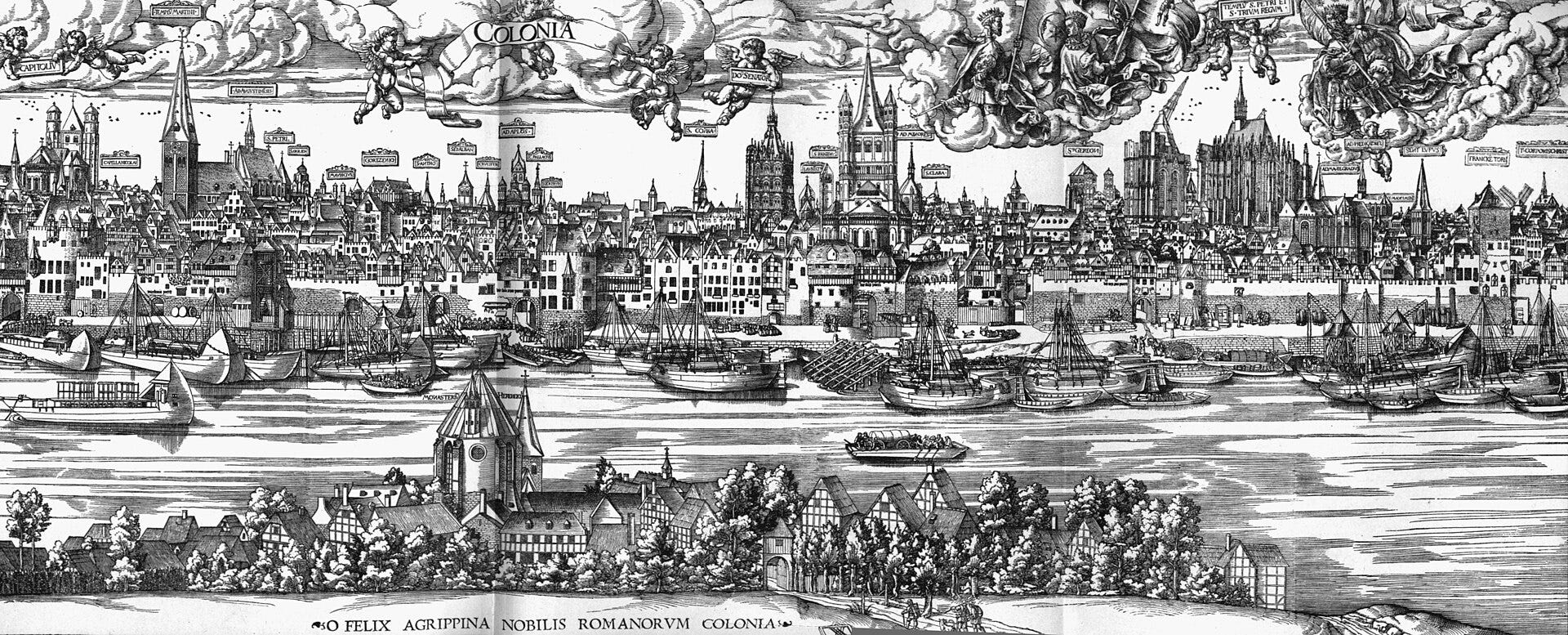
From 1248, Cologne Cathedral was being constructed by generation after generation of workers, architects and engineers until the work finally stalled in the 15th century and came to a complete halt in the 16th century. Remarkably, the giant crane that had been used for the building work just stayed there and became part of the skyline of Cologne… for four hundred years.


Again, perhaps that puts into perspective all the frustrations present-day people may have with railway stations or airports taking so long to be constructed and costing much more than expected. Cologne Cathedral may be an awesome building today, but for hundreds of years — hundreds — it didn’t look like it would ever be finished.
This is where the Prussians come in. Various things happened in rapid succession in the 19th century. For one thing, Napoleon was beaten and Prussia, as one of the victorious powers, gained territory in the western German lands as a result. This included Cologne.
So this ancient powerhouse of politics and Catholicism was now within Protestant Prussia’s domain. This was spectacularly unpopular for decades. If you’re interested, check out our Reichs & Republics podcast episode on Konrad Adenauer, the first West German post-war chancellor and passionate native of Cologne, man and boy. Like many of his fellow Rhinelanders, he considered himself a “Musspreuße” — a “Have-to-be-Prussian”, part of a territory that was forced into the Prussian realm against its will.
But Prussian rule came with perks too. In the context of the clamour for a German nation-state, the completion of Cologne Cathedral suddenly became a symbol of German unity and strength. Of course it was also a way of appeasing unhappy Catholics who felt they’d come under a Protestant yoke. But in general, the spirit was: let’s achieve this together. The enormous funds needed were raised through donations organised by civic associations and the Prussian state.
By 1842, the work could resume. The combination of medieval design and modern building techniques was potent. Something that was both beautiful and achievable was raised from the old walls — which had been left for so long previously that trees and shrubs had begun to grow through them.
In 1880, 632 years after construction had first begun, it was done. Cologne had its Cathedral. By now, Germany was a nation-state and could celebrate this as a national effort. Emperor Wilhelm I came for the ceremony — and no wonder, the thing was a marvel, the tallest building in the world at the time.

In case you’re wondering why I’m still able to gaze at it right now when much of Cologne was reduced to rubble in the Second World War, the answer is that it survived the bombing — if hit several times and badly damaged. But the tall spires were useful target markers, which aided its chances of survival. It was carefully repaired after the war, and restoration is ongoing pretty much continuously to ensure future generations get to enjoy it too.
And what a sight it remains today. The city has agreed not to block the view of it by refraining from allowing any high-rise buildings to be erected nearby. So you get to see it from almost every angle from different parts of the city. The views from the top are amazing, too, well worth the intense climb in my view. So if you’re ever in Cologne, do yourself a favour and visit the splendid Cathedral and its many treasures.
It’s particularly good to have awe-inspiring places like Cologne Cathedral in times such as ours when cynicism, pessimism and anxiety seem to permeate much of public discourse. I’ve found that a stark realisation myself during my visit here in the city. In the TV studio, both on and off the stage, I was asked questions that spoke of worry and anticipation in light of the upcoming elections. A couple of hours later, I’m gazing at a monument that took humans centuries to make and care for. As I say, contemplating Cologne Cathedral puts things into perspective, perhaps even including the very concept of the word “historical.”


