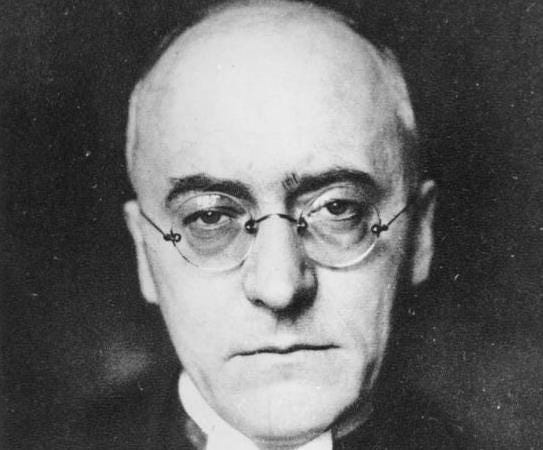
Hunger Chancellor or Democracy’s Last Chance?
The Controversial Legacy of Heinrich Brüning
Chancellor Heinrich Brüning must have felt the weight of history on his shoulder as he toured Germany in January 1931. The country was in the grip of the worst economic crisis in living memory. Unemployment was spiralling out of control. In 1930, over 3 million Germans had been looking for work. In 1931, that figure spiked to 4.5 million – more than twice the pre-Wall Street Crash record of 2 million in 1926. People struggled to pay their bills and their mortgages, and they struggled to feed themselves and their families.
This was bad, and Brüning knew it. But what could he tell the German people? That things would soon get better? It would have been an obvious lie. There was no clear path out of this misery. As far as Brüning was concerned, the Great Depression was a logical consequence of the First World War. Germany had overspent and borrowed eyewatering sums of money – much of it from its own citizens in the form of war bonds – on the assumption that it would win the war and be in a position to extract reparations from the vanquished. It hadn’t turned out that way.
Brüning felt that honesty was the best policy. On 25th January, he took to the radio – then still a relatively new medium – and told the German people: “It is not only through reparations burdens that we have fallen into financial misfortune, but to a very large measure by letting ourselves imagine that despite a lost war, despite huge sacrifices in blood and treasure, both state and individuals could live better than in pre-war times.” In other words, the situation was what it was. Germany would enact strict fiscal discipline to find a way forward. His government implemented a hard and unpopular austerity programme.

When Brüning toured Germany in January 1931 to communicate his plan to the public and restore confidence, he realised just how much hostility it faced. He was greeted by scores of angry farmers in Silesia. In Breslau, he was booed by 40,000 Nazi activists. In Chemnitz, unemployed workers threw stones at his motorcade.
In parliament in Berlin, things weren’t much better. The political landscape was deeply fractured and polarised. A tide of extremism swept through the country. Brüning implored the deputies to respond by pulling themselves together in a show of strength and unity. But the Nazis and communists in parliament had no intention of shoring up democracy. The left and the right hated each other more than ever.
At the end of his tour, Brüning concluded that it was easier to believe in parliamentary democracy when things were going well.
I recounted this story on German TV on Thursday because it is directly relevant to today’s situation. When the current German coalition under Chancellor Friedrich Merz began its work in 2025, some of its members regarded the newly-formed government as “the last shot for democracy”. The worry is that the party-political spectrum could become so splintered that the country would become ungovernable, and the AfD could become the largest party at the next election. All of this is happening amid an economic crisis as well as cultural and social tensions.
There are certainly major differences between past and present that we cannot ignore. For one thing, there is the unique severity of the Great Depression after 1929 and the terrible levels of political violence the Weimar Republic suffered from the outset. But there are striking parallels to Brüning’s time, too. When he took over as Chancellor in 1930, he struggled to implement effective reform measures due to a highly divided parliament that couldn’t agree on the right way out of the crisis. While moderates bickered and argued, the political fringes benefited.
After just a few months into his term, the Social Democrats (SPD) barely tolerated Brüning (who was from the Catholic Centre Party) and did so only because they feared that new elections would make the Nazi Party even stronger (it had gained 18.3% in the 1930 elections, a huge increase from the 2.6% it got in 1928). Brüning, who, through President Hindenburg, passed more laws by presidential emergency decree in 1931 than by parliamentary vote, held on by a thread until forced out of office in May 1932. A few months later, in January 1933, Adolf Hitler was appointed Chancellor.
Today, Friedrich Merz’s conservative Christian Democrats are in an uneasy coalition with the SPD. All sides know that swift, drastic reforms are necessary to turn Germany’s economic crisis around, but they cannot agree on what to do. Meanwhile, the AfD is in first place in the polls. In some polls, it looks so bad that Merz’s conservatives would currently not even achieve a majority together with the SPD and the Greens. The phrase that you hear again and again in political conversation is that the ruling coalition now “has a duty to be successful”.
Interestingly, Brüning’s austerity course has often been regarded in the past as a cautionary tale. Indeed, he was seen as the “Hunger Chancellor” by many Germans at the time. I certainly saw in many diaries, while researching Weimar, that people just didn’t feel that what he was doing was working or leading them toward a better future. In recent years, Brüning’s time in office has often been evoked in the German media when commentators wanted to emphasise that austerity measures were not the way out of economic peril.
But there are historians who defend Brüning as the last man standing in the battle for Weimar Democracy. And it’s true that he achieved some remarkable successes that would later benefit Hitler on his path to economic stabilisation. In June 1931, Brüning met with British Prime Minister Ramsay MacDonald, with whom he issued a joint statement that stressed “the difficulties of the existing position in Germany and the need for alleviation”. US President Herbert Hoover listened and proposed a one-year moratorium for all war debts – Germany’s to the Allies and the Allies’ to one another. This was a generous offer that was eventually accepted and practically marked the end of German repayments for the First World War. That was one weight off Germany’s shoulders.
But Chancellor Brüning and President Hindenburg soon fell out, marking the end of their cooperation in governing the country through emergency decrees while parliament remained paralysed. Two more chancellors and a lot of power-political game-playing followed before Hindenburg appointed Hitler.

So what’s the lesson from all of this? Well, I need to stress again that the situation wasn’t the same then for many reasons, not least the fact that Hitler had millions of rowdy SA troopers under his command, many of whom saw themselves as revolutionaries rather than election campaign supporters. There was not just the threat of a violent coup in the air but very real mass violence already unfolding on the streets of Germany with young people dying for the cause. There was a very different urgency to the political situation then than there is today. This also applies to the scale and severity of the Great Depression compared with the economic situation Germany faces today.
Nonetheless, I told Brüning’s tale on German TV for a reason. Where it does hold an urgent lesson for today is in the fact that Germans didn’t believe his measures would lead to a better future. He used the radio to tell people that their misery was inevitable.
Hitler used the same medium shortly after to ask people to give him four years to make things better. He promised he would alleviate unemployment and poverty speedily and visibly. In other words, he described a way out and a future that was worth holding out for. That had an incredibly powerful psychological effect on many Germans.
It’s remarkable how often I found references to those “four years” in the sources. Emmy Sonnemann, the Weimar actress who was to marry Hermann Goering, remembered how Hitler told her in a park in Weimar that “we won’t take more than three or four years and then there won’t be a single unemployed person in Germany any more.” The central person in my book, Carl Weirich, wrote in his diary: The “new Reich Chancellor demanded 4 years for reconstruction!” and was willing to give Hitler that time.
This isn’t, of course, a call for modern-day politicians to emulate Hitlerian propaganda methods. But democratically elected politicians have to find a way to ensure that voters trust them to build a better future. The moment that optimism, the conviction that your children and grandchildren will live in a better world than you, goes out the window is a dangerous one. People won’t keep voting for politicians that appear to have little to offer but more of the same and pessimism. That, to me, is a potent lesson from Brüning’s tragic political tale.
Brüning himself struggled for the rest of his life to make sense of his own legacy. He fled Germany in 1934. After the war, he began working on his memoirs, which sought to justify his failure to avert the Nazi catastrophe. They appeared only after his death in 1970 and are a clear and blatant attempt to change his place in the history books. In them, he claimed that he’d had a long-term plan all along to get Germany out of its malaise, but that it was cut short when he was pushed out of power.
Brüning claimed that, following the suspension of reparations payments, he would have worked towards a restoration of Germany’s military status and the monarchy, and that this would have appeased conservatives and the wider population enough to take the wind out of Hitler’s sails. Most historians have dismissed those claims since there is no real evidence for them from Brüning’s actual time in office.
Ultimately, Brüning will remain a controversial figure in German history. But I have no doubt that his story will be rediscovered and discussed again more closely in the months and years to come.


Interesting, the expenditure cutbacks are never popular doesn’t matter what century or country , look at how many uprisings through history from people with little food in their bellies