In Search of Pomerania
Travelling the north-east of Germany
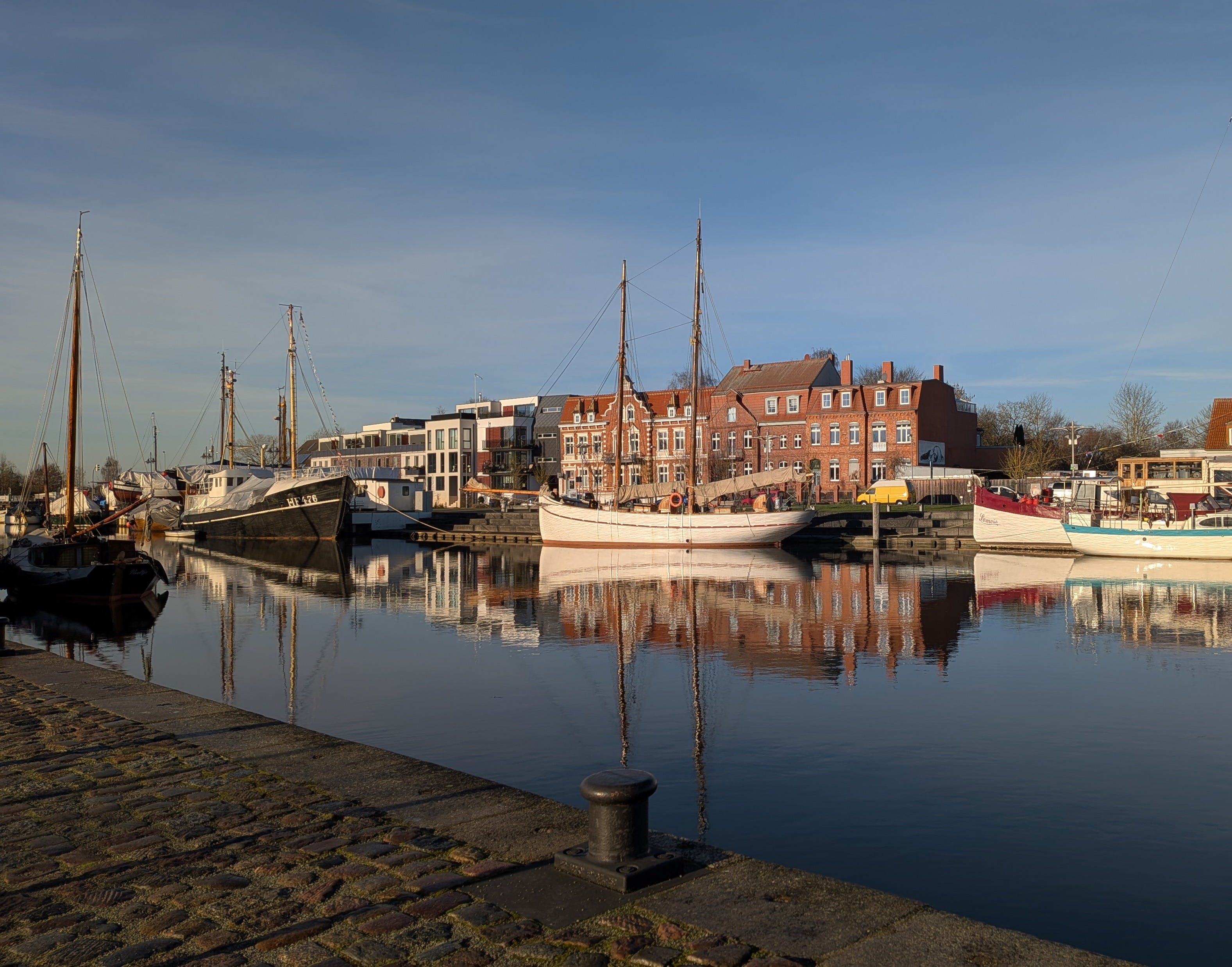
I’ve been in Greifswald for a few days now, long enough to drink mulled wine at its small Christmas market, long enough to stroll along its historic harbour in the bright winter sun and long enough to frequent some of its archives, libraries and museums. What I haven’t stayed long enough for is getting a firm mental grip on the historical region this beautiful Hanseatic town is nestled in: Pomerania.
If your first association when hearing that name is “fluffy dog”, don’t worry, that’s okay. The Pomeranian dog breed is actually named for this region, which stretches along the Baltic coast and is now split between Germany and Poland. In fact, when I visited the State Archive in Greifswald earlier this week, the archivist said that a large group of people visiting and requesting his files are Polish scholars, keen to piece together the history of a place that spans two countries. The word “Pomerania” itself is of Slavic origin. In Polish, it’s called “Pomorze”, whereby “po-” means “along” and “morze” means “sea”. Pomerania is the land along the (Baltic) sea.
The history of this place is mind-boggling. On the ground, it feels layered: sedate on the surface but thick with local pride, salt air and the kind of stories that only borderlands seem to collect.
Greifswald itself is a good place to begin to dig deeper. It’s a picturesque town, home to one of the oldest universities in the region, founded in the 15th century, whose rhythms still set the pace of life here. The town has the only Green mayor in the former East Germany. Bikes outnumber cars, cafés are full by mid-morning and there’s an air of gentle seriousness that comes from centuries of scholarship.
Caspar David Friedrich, the Romantic painter of lonely cliffs and misty horizons, was born here, and once you know that – and how could you not since the man is present at every street corner – the landscape makes sense. The light is wide and pale, the sky always feels a little bigger than it should.
But Greifswald is only an entry point. To understand it, you have to understand Pomerania, Pommern in German. It’s a region that has changed hands so many times that it becomes difficult to think of it as a place at all if you are an outsider to it, as I am.
Long before Germany or Poland existed as states, West Slavic tribes lived along the southern coast of the Baltic Sea, fishing, trading and building fortified settlements. Their presence still echoes in place names, surnames and archaeological sites scattered across the countryside. By the Middle Ages, Pomerania had become a duchy, ruled by the House of Griffin, and Greifswald was growing into a proper town. Its name translates as “Griffin’s Forest”.
Its real rise came through the Hanseatic League, the loose alliance of trading cities that dominated northern European commerce for centuries. Standing in Greifswald’s old town, with its brick churches and gabled merchant houses, seeing sailing boats gently bobbing in its old harbour, it’s easy to imagine ships coming in heavy with herring, grain and amber. The Baltic wasn’t a barrier. It was a busy trading route.
One of the most surprising facts I learned here is that Greifswald spent an oddly contented period under Swedish rule. This, too, is a fact that remains very present in people’s minds and hearts to this day. Museums present this history as a largely positive thing. One of the archivists, a local, man and boy, jovially informed me that people here have a saying: “Unter den drei Kronen, da lässt es sich gut wohnen”. It rhymes in German and translates as “Under the three crowns you can live rather well,” or, if you want to keep the rhyme with a less direct translation, “Never a frown under the three crowns.” It’s an allusion to the Swedish symbols of power, which were omnipresent when Pomerania became part of the Kingdom of Sweden.
This happened after the Thirty Years’ War, the catastrophic conflict that reshaped much of Europe and also caused large parts of Pomerania to fall under Swedish control. From 1648 until the early 19th century, this area was officially Swedish Pomerania. This is still remembered favourably because it had beneficial long-term effects. The university benefited from this arrangement, receiving funding and protection, and the town developed a distinctly northern, Protestant, Baltic character that still lingers. So there I was, sitting in the Störtebeker tavern, sipping at the crisp, north German beer they brew there and thinking that Sweden once governed this place.
After the Napoleonic Wars, Pomerania was absorbed into Prussia and later became part of the German Empire after its foundation in 1871. Now, it was wholly in Germany, though still economically peripheral during the ongoing economic boom, since it was more agricultural and maritime than industrial. But it was an important hub of cutting-edge scientific research. That sense of being slightly off to the side seems to persist today. Life here is calmer than in Berlin or Hamburg, less performative, less rushed. The Baltic sets the pace.
The 20th century, of course, was brutally transformational to border regions like this one. The aftermath of the First World War posed complicated questions, with a newly formed Polish state needing access to the sea in a region that contained millions of Germans. Some of Pomerania became part of Poland. German-majority Gdańsk or Danzig was transformed into the independent Free City of Danzig.
After the Second World War, Pomerania was split along the Oder–Neisse peace line. The eastern part became Polish; the western part, including Greifswald, ended up in East Germany. Millions of Germans fled or were expelled from Eastern Europe, including from parts of Pomerania. Many elderly East Germans, when you ask them where they were originally from, will still tell you that they are from “Pommern”. Poles, many of whom were themselves displaced from territories annexed by the Soviet Union, moved in. The result was a massive cultural reset, one that still shapes identities on both sides of the border. The archivist I spoke to thinks that inter-European cultural exchange is helping bring Pomeranians from both sides of the border together through their shared cultural heritage.
Greifswald also spent four decades in the GDR, and traces of that period are easy to spot if you know where to look, for example, in the prefabricated apartment blocks (although many are in the “historicised” style, intended to blend in with local traditions). Yet the old town survived remarkably intact, and since reunification it has been carefully restored. What could have become a museum piece instead feels lived-in, modestly proud of itself and its complex heritage
.What I’ve enjoyed most over these past few days is how quietly Pomerania wears its complexity. There are no grand declarations about history here, no monuments that are clearly the result of years of agonising introspection. There is a beautifully designed and arranged museum dedicated to the history of Pomerania, and people are very happy to talk with you about the past of their homeland. But I sensed no real grievance.
Instead, history seeps in through details: a Swedish coat of arms carved into a building, a Slavic-sounding village name, Hanseatic architecture, a newly reopened exhibition on Caspar David Friedrich.
Even the food tells a story. One historian I met for dinner looked at me aghast when I mentioned that I’m not a fan of fish. “It must be because you grew up so far from the sea,” he grumbled, clearly horrified at the notion that someone might be a reverse pescatarian. The beer here is crisp, light and bitter – a mirror of the air and light this far north and so very different from the darker, maltier varieties of the south.
A short trip from Greifswald takes you to the Bodden coast, where shallow lagoons blur the line between land and sea. Go a bit further still, and the beaches turn into the finest, whitest dunes you can imagine. Standing there in the bracing winds at sunset, watching birds skim the water and the light flatten everything into silver, it’s easy to see why this region has been both contested and cherished. It’s not dramatic, but its power is subtle, quiet and stubborn – a reputation, incidentally, that north Germans have acquired, too, over the centuries.
Staying in Greifswald has made Pomerania feel less like a historical maze to navigate and more like a place with its own voice, one that’s soft-spoken, perhaps, but confident in its long memory too. This is a region shaped by tides, trade and treaties, by scholars and fishermen, by people who have learnt to adapt.
I still have a few more days on my northern journey, and that means more maps to study, more documents to peruse, more fare to sample and more walks to brace for. But best of all, it means more Pomeranians to meet. Gruff as they can be, they tell a great story when they’re in the mood.


‘History without a sense of grievance.’ Now there’s a thing! Great stuff.
That was a most interesting article i feel slightly more educated now ,nice one ,looks a lovely area.