Inside East Germany - The Last Year
What a West German saw in Dresden in 1990

When the Berlin Wall fell in 1989, West German writer and journalist Martin Gross was fascinated. Here was a real revolution in his lifetime. He decided he wanted to see up close what happens when people power moves history.
So he moved to Dresden at a time when everything was changing for the people there and all across East Germany. A few months later, in October 1990, their country vanished. Gross had observed the last year of the GDR.
He wrote a book about what he saw and heard. But when “The Last Year” came out in 1992, it was largely ignored. Nobody wanted to hear such stories. It was ancient history, or rather, it was not even that, just yesterday’s news. Now his book has been rediscovered and reprinted, Gross’s perspective as a keen outsider at a time of great historical importance has been reappraised and reappreciated.
The book is in German, so I’ve asked Gross to provide a few insights into what he saw in East Germany in 1990, for ZEITGEIST readers. The following is my translation of the article he wrote for us. I hope you will find it as insightful and fascinating as I have.
The Last Year by Martin Gross
Throughout the autumn of 1989, mass demonstrations against the socialist government took place in East Germany, coinciding with a wave of emigration and ultimately leading to the fall of the Berlin Wall. These events were described as a “Peaceful Revolution.” In the following year, in 1990, as a West German journalist, I lived primarily in the East German city of Dresden to observe firsthand how such a revolution would unfold – and who its key players, winners, and losers would be.
At first, I was surprised how easily I struck up conversations with people. From previous visits when the Wall was still up, I knew East Germany as a secretive society: no questions asked, no stopping, keep moving, no entry. A country gripped by an icy silence.
But at the beginning of 1990, the silence ended. There was an urgent need to talk: something had happened that absolutely had to be discussed, discussed, discussed, discussed, even if it was with a stranger – for example, with me.
Complete strangers granted me glimpses into their daily lives. I spoke with a minister’s bodyguard, a cleaner in a government building, a guard at a Stasi prison, but also with protesters and ordinary workers. Everyone wanted to share their story, and everyone also had to constantly remind themselves what was apparently coming to an end: For some, life in the GDR was difficult, a life of oppression; for others, a life of tenacious or clandestine resistance; for still others, a quiet life in seemingly stable circumstances.
What strangely played no role in all these conversations, however, was the question of how to shape the future. What was to become of the Peaceful Revolution? A government had been overthrown, and yet people acted as if that was enough .
A few young people I asked about their future plans on the sidelines of a demonstration said: “Either the Deutsche Mark comes over here, or we go over to West Germany.” That struck me as a strangely timid outcome of a revolution.
A teacher described the situation in schools as utter chaos. No one clearly specified what should be taught, which teaching materials should be used and which forms of assessment should be employed. There had been a brief opportunity in class to discuss freely what one considered essential. However, it was disconcerting because no one was articulating what would be expected of teachers and students in the future.
I rarely encountered anyone trying to take matters into their own hands back then; far more often, I met people waiting for the next set of regulations. For me, as a quiet sympathiser of the Peaceful Revolution, this was a somewhat disappointing experience.
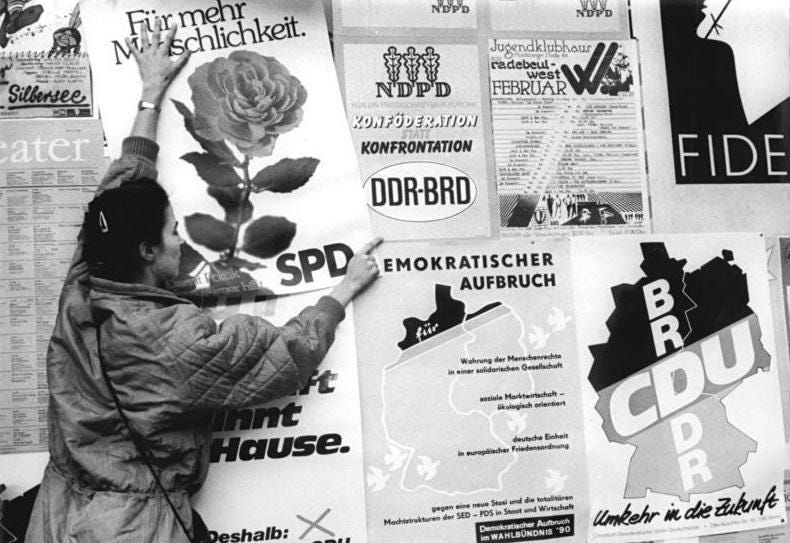
The first free elections in March 1990 made it clear: roughly 75% of the votes went to those parties that sought rapid German reunification. The socialists only received 16% of the vote, but the parties representing the organisers of the mass protests and large demonstrations together garnered barely 4%. The “Peaceful Revolutionaries” and the population went their separate ways.
The reasoning of the majority of East German citizens was simple: why invest time and energy in building a new system when one could simply adopt a seemingly perfect system from the West? The allure of the time was: “We will live like those in the West — not sometime in the future, but tomorrow.” This undoubtedly appealed to Western politicians and business leaders; the former welcomed their gain in power, the latter rejoiced at new markets. Nevertheless, what was emerging was not a hostile takeover, but a voluntary annexation — or a free surrender of sovereignty.

Unlike the Eastern European peoples (Baltic states, Poles, etc.), the East German population didn’t want to take 15 years to join the EU as a sovereign country with its own ideas and personnel. Everything had to happen very quickly. A crucial reason for this was the continued surge of emigration from East Germany. In 1989 and 1990, approximately half a million people left to seek their fortune in the West – primarily young, well-educated individuals who were sorely missed by the already ailing East German economy.
The fact that the inner-German border was open was a long-awaited stroke of good fortune. However, the flood of people leaving East Germany and the influx of goods into the country accelerated the collapse of East Germany as an independent system. The East German economy simply couldn’t compete with Western goods. Thus, the expectation, or perhaps the illusion, of a happy life according to West German standards became the driving force behind German reunification.

And so began the deceptions and disappointments: Among the deceptions was the sudden appearance of Western businessmen in East German cities, selling inferior goods at exorbitant prices or organising the sale of more or less dilapidated Western cars. Others offered day trips to major West German cities, which, after a brief visit to local sights, usually ended in the showrooms of carpet dealers or cosmetics manufacturers. I was astonished to note the sheer force of business acumen and criminal energy that had been unleashed. Apparently, the collapse in the East also served as a catalyst for con artists and opportunists from the West.
Far more serious than being deceived by swindlers, however, were the disappointments systematically woven into the rapid reunification process. For example, because East German textile workers believed that Western cars were superior to domestic ones, East German car manufacturers lost their jobs. And because East German car manufacturers believed that Western clothing was superior to domestic clothing, East German textile workers lost their jobs – and so it went.
The adoption of the West German system also resulted in masses of Western experts being sent to the East. For young Westerners, this was the opportunity of a lifetime: subordinate employees in the West suddenly became managers in the East. The downside, however, was that an entire generation of East German administrators, managers, lawyers, scientists and so on, now had to have “Wessis” explain to them which regulations to observe, how to use which forms and where to apply for which permits.
East German specialists were demoted to unskilled labour or became unemployed. Many of them had admired the West for years. The market economy was their ideal, or perhaps their illusion: “If we had things here like they do in the West... “. Now the market economy had arrived, but it had no use for its admirers. A bitter disappointment! In retrospect, German reunification seems to me a process whose own momentum coldly prevailed over the illusions of its participants.
Even during this time, I still had many conversations with East German citizens, but the topics had changed. Now I was no longer the one asking them about their lives up to that point, but rather the one being asked for advice about the future: Which insurance policies are necessary, and which are superfluous? Which tax bracket should one choose and which health insurance provider? What is the difference between saving on premiums and saving for growth? How and where can one file an appeal if their apartment lease is terminated?
And towards the end of the year, a distance became increasingly apparent that separated me from them: I was the one from “over there,” from the West, who would go on to write a book about the year of change, a winner of the crisis, while they were left unemployed or humiliated and disappointed.


Very interesting perspective. I remember speaking to a (West) German Judge in 1995, and asking him what became of all the East German Judges, and receiving a shrug of the shoulders, and a flinty reply that "Well they all had to lose their jobs of course".
I stayed a night in Dresden after attending the Frankfurter Buchmesse in October 1990. My abiding memory of the trip is of walking into my hotel reception to check in; I suddenly realised that there was a rack behind the receptionist which displayed, rather than the usual free maps and guides, a stack of hardcore pornography for purchase. Porn caught on very quickly - I may or may not be correct in recalling that for a while there were special sex shops for Ossies only?