Is Germany going Nuclear?
How Berlin Learned to Stop Worrying and Love the Bomb

“We could build an atomic bomb within three years,” scientist Rainer Moormann told the German press this week. He was asked questions about that in the first place because something truly remarkable is happening in Germany: there is serious talk of the country developing its own nuclear weapons.
To put this into context, we’re talking about a country that shut down its last nuclear reactors in 2023 due to safety concerns. We’re also talking about a country that is currently banned from developing its own nuclear weapons. Germany would have to leave agreements it once willingly entered and shed decades’ worth of nuclear angst to go down this route. And yet, here we are…
Chancellor Friedrich Merz said this week that European nations are discussing ideas around their own shared nuclear umbrella. As Britain and France are the only two European powers in possession of nuclear weapons, this would have to either mean stronger German involvement with their maintenance and development, a German contribution to a new pan-European nuclear weapons programme, or Germany joining the club with its own arsenal. Some prominent voices have called for the latter.
Brigadier General Frank Pieper told the press this week, “Germany needs its own tactical nuclear weapons,” and fast. “Wake up and get working on it,” he encouraged Berlin. Some historians supported his call, such as Harald Biermann, who is president of the museum “House of the History of the Federal Republic of Germany” in the former West German capital, Bonn. He argued that “the nuclear question is at the heart of the national sovereignty of any state. Germany, too, has to face this question.” Like Pieper, he says, “we must urgently talk about protecting Germany by means of our own or European nuclear weapons.”
Even the former Foreign Minister Joschka Fischer from the Green Party argued for European nuclear weapons this week. This is remarkable because he and his party once formed the core of the pacifist and anti-nuclear movement in West Germany. He now says, “Times have changed.” That seems a vast understatement. The pacifist movement of the 1970s and 80s, from which the German Greens emerged and which was explicitly anti-nuclear, produced some of the largest mass demonstrations in German history.
Let me take you back there to illustrate just how seismic this – so far underreported – shift in Germany’s outlook could be…
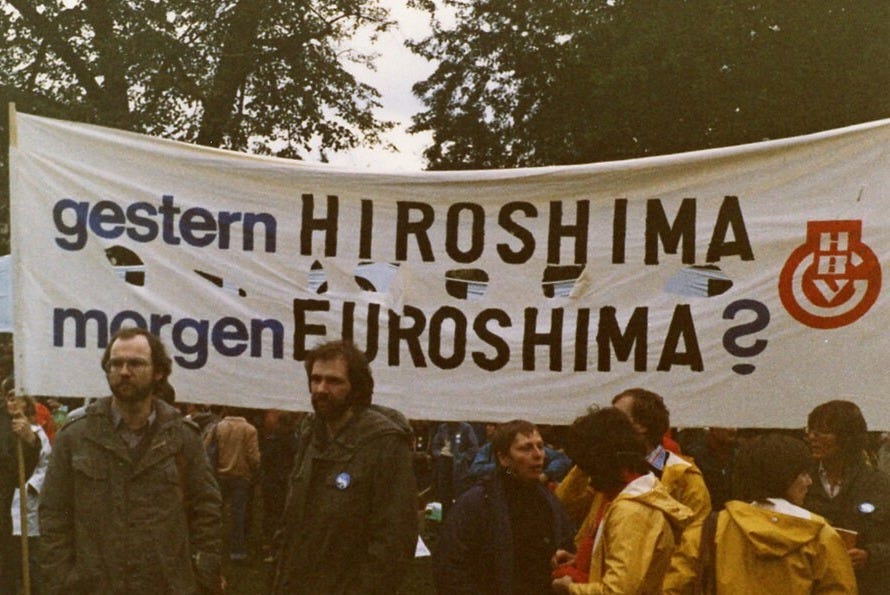
22 October 1983 was a restless day in West Germany. Well over one million people took to the streets. Over 200,000 people formed a 108-km human chain stretching between the south German cities of Stuttgart and Neu-Ulm. In Bonn, half a million people marched towards the city centre where another 150,000-strong human chain surrounded the government district. In Hamburg, 400,000 people tried to squeeze onto the central square.
Specially organised trains and buses transported people from villages and towns all over the country into the cities where they heard speeches, listened to concerts, and carried placards. Among the protesters were Germans of all walks of life: from tractor drivers to university professors. What united them all and brought them out onto the streets to hold hands with complete strangers? Opposition to nuclear weapons on German soil.
Ironically, the protesters wanted the same thing as the West German government against whom they had taken to the streets: secure peace in Europe and to prevent Cold War tensions boiling over into a hot war. Successive chancellors had taken the view that this was best achieved by parrying the threat of Soviet aggression with a nuclear deterrent. There was only one problem: in the Bonn–Paris conventions, which came into force in 1955, Germany had agreed not to develop its own weapons of mass destruction in exchange for an end to occupation and entry into NATO.
Very early on, senior German politicians, most notably the first post-war chancellor, Konrad Adenauer, took issue with this settlement. Only one year after his government had ratified the convention, Adenauer declared in a cabinet meeting in December 1956 that his country needed its own nuclear weapons: “Two large states are the only ones to own nuclear weapons and thereby hold the fates of all peoples of this earth in their hands.” A year later, he even went as far as to agree a secret deal with the French and the Italians to develop their nuclear weapons in a joint project — a remarkable development just over a decade after the Second World War.
When Adenauer casually talked in public of tactical nuclear weapons as “nothing more than the next stage of artillery,” a group of prominent West German nuclear researchers, the so-called Göttingen Eighteen, published a manifesto on 12 April 1957 that declared “tactical nuclear weapons have the same destructive effects as normal nuclear weapons” and vowed that none of the signatories would work towards the development or deployment of them in any way.
Among the Eighteen were prominent names such as Otto Hahn, who is widely regarded as the father of nuclear fission and Werner Heisenberg, a key pioneer of quantum mechanics who helped Germany build its first nuclear reactor. Both had previously worked on Hitler’s nuclear weapons programme but expressed relief at Allied victory in Europe in May 1945 as well as shock at the atomic bombings of Hiroshima and Nagasaki in August.
The Göttingen Manifesto was amplified by its circulation and discussion in the national press. In addition, the first large nationwide protests were organised by the “Fight Nuclear Death” movement. After twelve years of Nazi dictatorship and the hardship of the early post-war years, the thought of nuclear weapons on German soil sparked democratic debate and political opposition outside of parliament.
But Adenauer pressed ahead. The solution West Germany and its American NATO partners came up with was the concept of “nuclear sharing”: Germany would not have its own nuclear weapons, but its military, the Bundeswehr, would be trained to deliver American bombs, missiles, and mines.
When the Bundestag ratified this decision on 25 March 1958, widespread protests followed. Over the course of that spring, 1.5 million people took to the streets — ten years before the more famous anti-war demonstrations of 1968/69. The street rallies were accompanied by themed church services and mass strike action across employment sectors. According to surveys taken at the time, over 80 per cent of Germans objected to nuclear weapons on German soil.
The fires of the anti-nuclear movement had been well and truly kindled, and they would flare up repeatedly throughout the 1960s and 1970s. In annual Easter Marches, hundreds of thousands of people would turn out to protest against nuclear weapons and war more generally. The crowds were a peculiar mix of intellectuals, religious groups, and left-leaning workers’ organisations.
But the government continued on its course. The Bundeswehr was trained by US Army Artillery Groups. One of them was allocated to work with each Bundeswehr Corps. Historians estimate that up to 5,000 American nuclear weapons were stationed in Germany at the peak of these deployments.
The Bonn government and their NATO allies saw this as both a necessary step in the peace-keeping process and a means of allowing West Germany to regain political power on the world stage. When the Soviet Union decided to deploy modern SS-20 Sabre missiles in East Germany, they felt vindicated in this approach. These intermediate-range ballistic missiles with their nuclear warheads were capable of targeting bases in Western Europe and taking out the nuclear weapons stationed there.
Fearing that this made West Germany vulnerable to Soviet aggression, Bonn responded by agreeing to NATO’s so-called Double-Track Decision in 1979. This meant that more medium-range nuclear weapons would be stationed in West Germany while an offer was made to disarm on both sides. That this was done under a Social Democratic chancellor, Helmut Schmidt, meant that voting for any of the two established parties wasn’t really a way to oppose this decision.
Throughout the early 1980s a large and highly politicised anti-nuclear movement began to develop out of the earlier movement. Germany’s Green Party was formed in 1980 in an attempt to give the demonstrations and ideas political weight. In 1983, the year of the biggest demonstrations Germany had ever seen, they first entered parliament with 27 seats, nearly all of which came at the cost of the Social Democratic Party which was seen as supporting the nuclear programme. But opposition to nuclear weapons was so high in the 1980s that even soldiers joined in the demonstrations despite explicit orders not to.
The German anti-nuclear movement of the 1980s was vastly diverse, consisting of hundreds of thousands of people. Communists found themselves shoulder to shoulder with priests. Housewives with soldiers. Welders with accountants. They all believed that weapons could not secure peace. The existence of tactical nuclear weapons made this worse, they believed. If war had broken out between the Soviet Union and the US, it would have happened at the fault-line of the divide between them: divided Germany and its divided capital. The endless drills and regular siren tests made this all too clear to all Germans, as did the network of 2,000 underground shelters across the country.
Yet, their government believed that one-sided disarmament would have led to a dangerous imbalance in the stand-off with the Soviet Union. They argued that it was precisely that balance, and those nuclear weapons, that preserved the peace. In their eyes, the peace movement was advocating a course that led to war.
Now that the frontlines of the West’s conflict with Russia no longer run through their country, many Germans seem to have come to the same conclusion. A survey taken in June 2022, months into Russia’s invasion of Ukraine recorded the first ever majority for the maintenance of US nuclear weapons on German soil. A government consisting of Social Democrats, Greens and Liberals has taken the decision to renew the German commitment to nuclear sharing, replacing the country’s ageing Tornado fleet that was kept to deploy American nuclear bombs if necessary with 35 modern Lockheed F-35 fighters.
Now, US President Donald Trump’s anti-European words and actions have thrown a spanner in those works. Even last year, before the recent escalation over Greenland, a poll indicated that two-thirds of Germans backed the concept of a European nuclear umbrella. However, surveys have also been pretty consistent in finding that a majority of people reject German nuclear weapons with higher opposition in the former East Germany.
It seems that most Germans have moved on from the terrors of their post-war experience. In the face of the new geopolitical realities around them, many are beginning to contemplate the idea that nuclear weapons might bring peace not war. But the thought of Germany developing its own atomic bomb may still be a leap too far at this stage.
Part of this article is a lightly edited version of a piece I wrote for Engelsberg Ideas.

