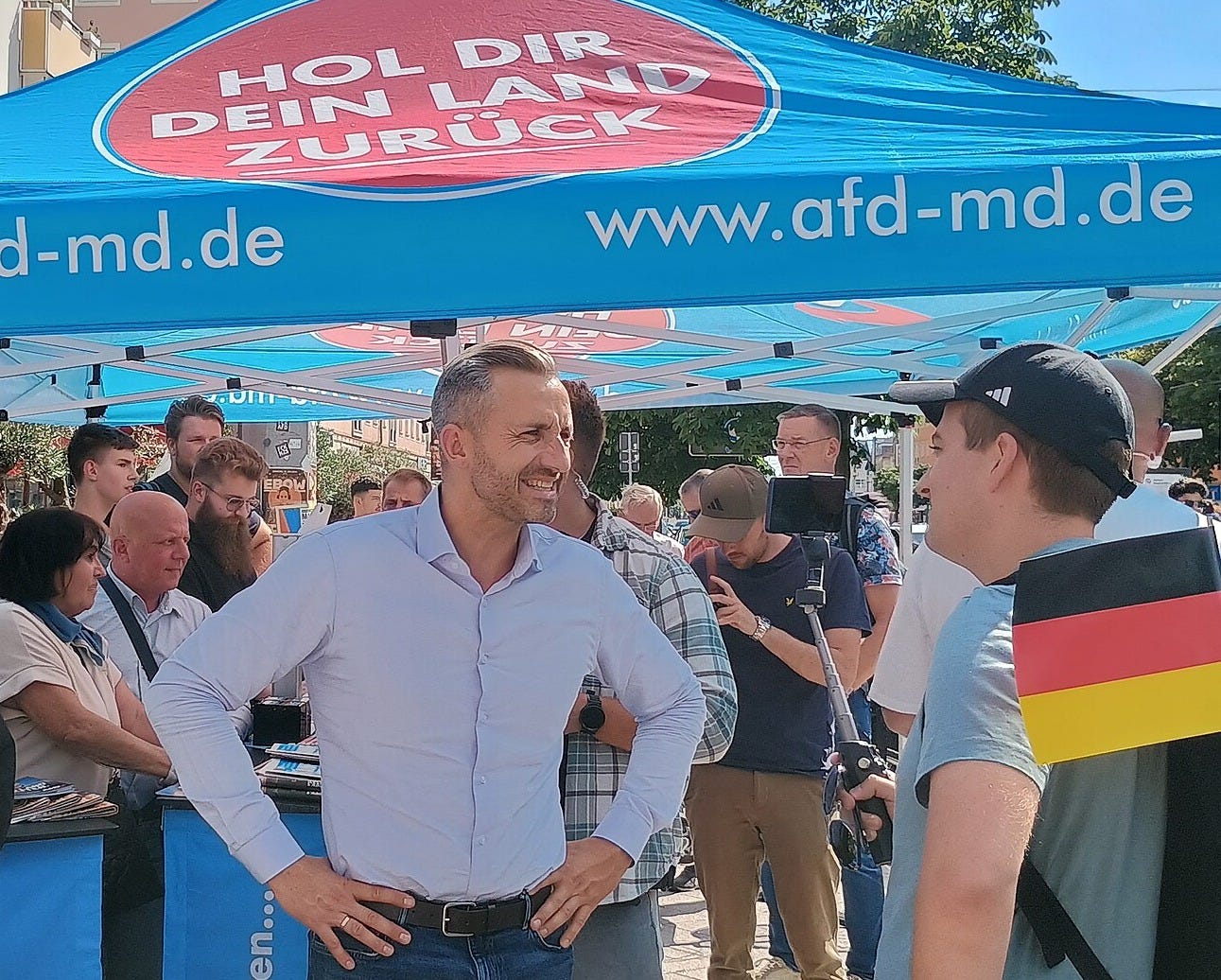
Election fever has gripped Germany and spread well beyond its borders. My own experience certainly reflects that. In the last few days, media outlets around the world have asked for commentary, and I’ve also just spent some time in Germany, giving TV interviews with more events scheduled next week. I’ve never seen this much interest in a German state election.
What’s going on? Well, today the people of Saxony-Anhalt are heading to the polls to elect a new state parliament. Just to be clear, this is not a general election for the government in Berlin. This is only for one of Germany’s sixteen federal states to vote in new regional legislators. It’s an imperfect comparison for many reasons, but picture Wales going to the polls, or Ohio — and the world looking on to see what the outcome might be.
To be fair, such elections are never trivial in Germany because the individual states have quite a lot of power to do their own thing. There’s more at stake here than who collects people’s bins or which politicians get to cut ribbons when new buildings are being opened.
In Germany’s fairly devolved federal system, the states have control over areas like education, policing, transport and culture. But still, these elections aren’t usually of much interest beyond the affected state. For many years, they would barely make headline news in Germany — at best as a kind of barometer of the public mood. And they certainly wouldn’t have been reported on globally.
The Saxony-Anhalt elections are so closely watched this time because they are widely believed to be a potential watershed moment. The New York Times, for example, ran a story on Friday with the title “Something Alarming Is About to Happen in Germany”. The Atlantic expects a “breakthrough” for the AfD, and France’s Le Monde writes of “electrified crowds” attending election rallies.
The reason for the hightened anticipation is that polls have the AfD at 40% or more of the vote share, miles ahead of any other party. I offered a more detailed analysis in an earlier piece, which you can read here in case you missed it. What this all boils down to is that the AfD is closer to power than it’s ever been. Given Germany’s past and its present-day importance, many people want to know the outcome of this election and what it means.
As a historian, the question I’m getting a lot at the moment is: “Is this a ‘historic’ election?” In other words: Are we witnessing a historical moment this Sunday that future generations will point to as a milestone on the path to a different future? Interestingly, both sides of the political divide seem to think so.
AfD opponents fear that the vote in Saxony-Anhalt may mean a weakening or even the end of democracy itself. They worry that if the AfD gains absolute power there, it would replace civil servants with its own people and begin to dismantle public institutions such as they exist today.
They are also concerned that even if the AfD doesn’t gain an outright majority, its large vote share would cause the other parties — all of which have vowed not to enter into a coalition with it — to form a broad front against it, spanning the political spectrum from conservative to far-left. It would be a coalition that nobody voted for, which would, almost by default, be unable to please its very different voters.

It’s a dilemma that might also spread to Berlin. According to the latest polls, the conservatives, the centre-left SPD and the Greens would currently gain just 46 percent together, potentially not enough to form a parliamentary majority. Chancellor Friedrich Merz’s conservatives have ruled out working with the AfD, which is in first place with 28 percent, or with the far-left Die Linke, which stands at 10 percent. So if parliament reflected the polls right now, it would be tricky to form any functioning majority. In a smaller and more extreme form, the Saxony-Anhalt dilemma is a German dilemma.
The AfD itself and its supporters also see the election as “historic”. “Let’s write history together” is a phrase one wouldn’t ordinarily associate with regional elections, which tend to be about local concerns rather than epochal change. Yet ahead of the upcoming vote, the slogan has become ubiquitous at AfD rallies. For them, this isn’t about regional power. They see it as the first step toward a radically different Germany.
To give you some examples of regional AfD policies that have national implications: Reintroducing Russian lessons and student exchanges with Russia at Saxony-Anhalt’s schools, for instance, is a mini version of the much closer relations between Germany and Russia that the AfD is calling for overall. “Remigration” of immigrants from Saxony-Anhalt (a term that is mentioned 17 times in the manifesto) would be seen as the first step towards the “remigration of millions” that AfD groups, especially their youth wing, are demanding at the national level.
So is the state election in Saxony-Anhalt today “historic”? In my interviews this week, I’ve answered this question with a cautious “yes”. Here is why:
Whatever the exact outcome of today’s election, it signifies a permanent shift in Germany’s post-war political landscape. When West Germany was founded in 1949, it was acutely aware of the fact that it had inherited a population that had been deeply nazified, affecting younger people especially, who had known nothing but Hitler’s ideas. With that in mind, the watchful eyes of the Western Allies on all their doings and the experience of the collapse of Weimar democracy in vivid living memory, it set out to tolerate only political parties that were within the moderate spectrum.
The first West German Chancellor, Konrad Adenauer, applied a whole range of methods to achieve this. He banned a Nazi successor party and the Communist Party in the 1950s. He integrated former Nazis into his own government, as well as the civil service and society more widely. And he built a domestic security service to monitor and potentially ban other political organisations if they were deemed to sit outside the constitutional boundaries.
Effectively, this meant that Adenauer’s own conservatives (CDU/CSU) were as right-wing as Germans were supposed to go and the Social Democratic Party (SPD) covered the other side of the political spectrum. The liberal FDP became the kingmaker when government switched from one side to the other. Germans largely stuck to this for many many years because it worked out well for them. For the most part, that includes East Germans after 1990, by the way. Brandenburg, the state where I grew up, has been run by the SPD ever since reunification.
Being “right-wing” or being “left-wing” meant voting Christian-conservative or Social Democrat for much of the post-war era. There were fringe parties and also the Greens emerged in the 1980s, but fundamentally the two big parties were seen as “Volksparteien” or “People’s Parties” because they covered much of the voteshare between them — often over 80 per cent.
When the anti-immigration party The Republicans emerged in West Germany in the 1980s, the prominent Bavarian politician Franz Josef Strauß (a staunch conservative and Cold Warrior) staunchly declared that “There must not be a legitimate democratic party right of the CDU/CSU”.
And that is exactly where the big “historic” shift is that we’re seeing right now. For a long time, the AfD was treated as though it was another version of The Republicans or other far-right parties like the NPD and DVU, which made inroads especially in eastern Germany for a while. In other words, the AfD was treated as a fringe party with regional support. It would never get anywhere near power, people thought, because the “firewall” of the other parties would mean that it would never get anywhere near power.
Now the AfD is not only hovering around the 40%-mark across eastern states, but it’s also leading in the national polls. In other words, its voteshare is now so large that it becomes difficult to ignore. There are calls to ban the AfD, but many other people — including ardent centrists — are now going down a different route. Some think that perhaps the AfD could be encouraged to moderate its course, much like Giorgia Meloni has done in Italy. Others have called for “red lines” rather than a “firewall”, whereby cooperation between the AfD and the conservatives becomes possible under certain set boundaries, for example, if the AfD was willing to change its Russia-friendly outlook.
Such discussions differ widely in aim and tone but they all stem from the realisation that the AfD is here to stay, and not just as a fringe party but as a major political player. This is something the party has also realised itself, beginning to build personnel that can take over government and administration, for instance.
Whatever the outcome of the Saxony-Anhalt election today, the political landscape in Germany appears to have irrevocably shifted. Calling that a “historic” moment seems fair enough to this historian.
***


