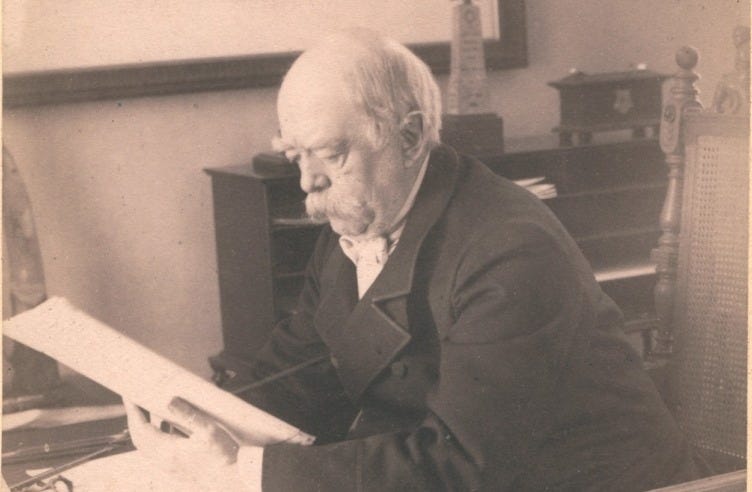
Man and Myth: What was Bismarck really like?
The Iron Chancellor as others saw him
“I consider that it will be found much better by all parties to leave the past to history, especially as I propose to write that history myself,” Winston Churchill told the House of Commons in January 1948. Anyone who has ever watched a feisty British parliamentary debate will immediately recognise this as a typical, humorous retort to a challenge by the opposition. Indeed, Churchill was responding to criticism of his party’s pre-war foreign policy by the Labour Lord Privy Seal Herbert Morrison.
However, the retort was witty precisely because it was true. Churchill was about to publish the first part of his war memoirs entitled The Second World War, which he’d been working on with a team of researchers for the previous two years. They told the story of the interwar period and the war itself from his perspective and helped shape his place in history, not least because they were very widely read. By April 1954, 2.2 million copies had been sold in the US and 2 million in Britain and the Empire. In that sense, Churchill really had written his own history.
Had Otto von Bismarck, the first German Chancellor, done the same? Like Churchill, he also penned his own bestselling version of events: a three-volume autobiography called “Gedanken und Erinnerungen” - “Reflections and Reminiscences”.
But there are many differences between the two. Unlike Churchill, Bismarck wasn’t keen to get his books out as quickly as possible. On the contrary. He began working on them after his forced resignation from office in 1890, and by October 1893, the proofs were ready to go to print. But Bismarck hesitated, tinkering with the manuscript for years and having it checked by his lawyer for possible legal challenges. When Bismarck died in July 1898, his memoirs still hadn’t been published.
Bismarck had been particularly worried about his scathing depiction of Kaiser Wilhelm II, the young successor to the throne with whom he had so fervently clashed and who had eventually forced his resignation. After all, Wilhelm was still the head of state, and revealing unfavourable secrets or character traits of the monarch could be seen as a harmful act against Germany itself. To a lesser degree, the same applied to other office holders, as well as to treaties and foreign political considerations. So the first two volumes were published after Bismarck’s death, and the third – the one dedicated to Wilhelm II’s reign – in 1919 and 1921, after the Kaiser’s resignation.
Bismarck’s memoirs are widely seen by historians as the work of a former statesman at the end of his life, seeking to justify his actions and set the tone for how historians would write about him in the future.
Bismarck had already begun creating his own myth decades earlier. Even as a young politician, when he engaged in pistol duels, outrageous exchanges with parliamentarians and numerous love affairs, he built a reputation as a tenacious, intense and intimidating character. He actively fuelled this image. Take his famous 1862 speech in which he told the Prussian parliament that “Not through speeches and majority decisions will the great questions of the day be decided [...] but by iron and blood.” The nickname “Iron Chancellor” has stuck to this day.
But I think we go too far if we attribute Bismarck’s reputation, then and now, solely to his own mythmaking. Incidentally, the same is true for Churchill. Through their actions and characters, both already appeared as remarkable men to their contemporaries – long before they wrote their own histories.
Take a look at how Bismarck was seen by those who met him, and it soon becomes clear that he didn’t just portray himself as imposing but that he really did have this effect on others. Let’s start with his physical appearance. The man was huge and not in a lanky way, but broad-shouldered and bear-like. This never failed to make an impression on people.
In June 1878, the British Prime Minister Benjamin Disraeli attended the Congress of Berlin, where the “Eastern Question” arising from the breaking up of the Ottoman Empire was being discussed. Bismarck saw himself as the “honest broker” mediating between the other parties. He chaired over twenty debating sessions in person, switching between German, English and French as he went. Disraeli was impressed by his presence and skill. “Bismarck soars above all”, he wrote, “he is six foot four, I should think, proportionately stout; with a sweet and gentle voice, and with a peculiarly refined enunciation, which singularly contrasts with the awful things he says: appalling from their frankness and their audacity.”

The gift for using his voice and his words to great effect is also not a myth invented by Bismarck himself. Others saw it too, some long before he was famous. Even in his early school reports, his teachers described Bismarck’s eloquence as astonishing. Using exceptionally evocative verbal images, he found it easy to provoke, irritate, soothe or charm even his most hostile adversaries.
You can see that in his memoirs too. There is biting criticism of his enemies, especially Wilhelm II, but also wit and irony. They are marked by the same peculiar mix of refinement and bluntness that impressed Disraeli when he saw it live in action. For instance, when Bismarck writes: “For the preservation and development of the state, the overwhelming weight of those who represent the interests of wealth is most useful.” It’s an eloquent way of saying that Bismarck knew power lay with the upper classes, whose interests he staunchly defended, despite introducing an element of democracy into the newly founded Germany.
When Disraeli returned to Britain after his visit to Berlin, satisfied with the outcome of the congress, he told Queen Victoria that Bismarck was “an extraordinary man” and he meant it with all the contradictions this entailed. He’d known the German chancellor for years. When the two had met in London 16 years earlier, in 1862, when Disraeli was leader of the opposition and Bismarck Prime Minister of Prussia, the latter had told the former with shocking frankness that he believed war between Austria and Prussia for German supremacy was inevitable and from Prussia’s point of view, the sooner it happened, the better. There was something about Bismarck’s demeanour that caused Disraeli to see more than sabre rattling in this. “Be careful about that man,” he warned the Austrian envoy, “he means what he says.”
Four years later, in 1866, when Austria and Prussia were on the brink of war, Francis Napier, the British Ambassador to Prussia at the time, formed a similar impression to Disraeli’s when he tried to persuade Bismarck to reconsider and seek a peaceful solution. But after meeting with Bismarck in person, he wrote home: “I do not know how far any person, however familiar and trusted, could influence the resolutions of a man of his peculiar temperament”. Bismarck was “so impetuous, indiscreet and – many would say – so unscrupulous in the ardent pursuit of his aims”. Napier found him difficult, duplicitous and resolutely ambitious.
When his successor in the post, Augustus Loftus, demanded to know “what in the name of all that is rational, decent, and humane, what can be the justification of war on the part of Prussia?” Bismarck told him frankly that he believed only “the sword” could settle this conflict and that at this point in time Prussia had “the most favourable opportunity for doing so – an opportunity which might not occur again for a century”. So it just had to be done, whether that was morally justifiable or not. The war did happen, between June and July 1866 and was a resounding victory for Prussia. It achieved exactly what Bismarck had intended it to: asserting Prussia’s dominance in German-speaking Europe – a brutal reminder of his callous but effective Realpolitik.
Of course, Bismarck had plenty of faults – indeed, you could count his ruthlessness among them. This essay is not an attempt to glorify him. The point is rather that there is no doubt in my mind that he appeared just as overbearing, powerful, intimidating and irritating to his contemporaries as he has to many historians after his death. There are plenty more examples. Vicky, Queen Victoria’s oldest daughter, who was the wife of Kaiser Friedrich III and the mother of Wilhelm II, saw in Bismarck a fierce political adversary for power and influence at court.
Even Bismarck’s son Herbert found his father an immovable obstacle at times. When Herbert wanted to marry Princess Elisabeth zu Carolath-Beuthen, the older Bismarck was set against the match. It would have been a scandal. Elisabeth was not only 10 years older than Herbert but also a Catholic and a divorcee. Otto tried tears, blackmail and even changing the law to disinherit his son. In the end, he even threatened suicide should Herbert go ahead with the marriage. Herbert relented and did not marry Elisabeth. He became a very bitter man and fell ever deeper into alcoholism and bouts of depression. As I say, Otto von Bismarck was not a nice man, but it would be difficult to doubt his stubborn determination and ruthlessness.
Perhaps, then, we have to accept that sometimes the active mythmaking of politicians and statesmen can be based on the truth. The fact that they wrote something themselves doesn’t automatically mean that it’s wrong. Of course, anyone would do well to read the memoirs, autobiographies, letters and speeches of historical figures with their eyes wide open to distortions, embellishments and omissions. But we don’t have to discredit everything they contain. In writing his own history, Otto von Bismarck may have cemented his self-styled image as the “Iron Chancellor”, but there were many more witnesses to his steely disposition.


Good read with my Sunday morning coffee. After I read your book Blood and Iron and Christopher Clark’s Iron Kingdom I read a couple of biographies of Bismarck. I discovered that he was an extraordinary politician, very driven. I think the contrast between the young man, the “crazy junker” and the later staid almost literal pillar of the establishment is remarkable. You are of course correct one should read autobiographical memoirs with a degree of caution.
He really was a man of his time, a fine diplomat a true statesman juggling alsorts of situations and a weird Kiaser. No surprise there are so many statues they even named a ship after him ,ok that didn't end so well .I wonder what Bismarck would make of modern day German politics.
Interesting piece nice one 👍