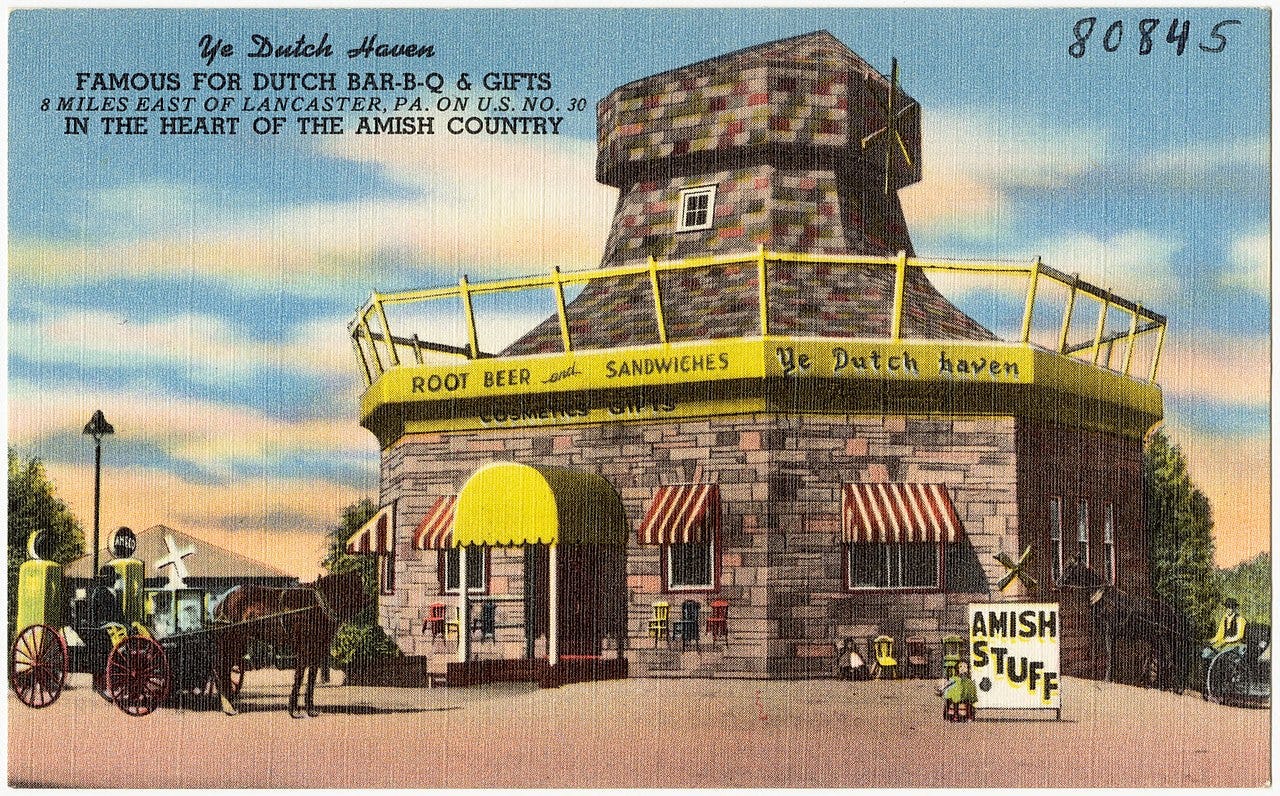
My Weekend with the Pennsylvania Dutch
How German settlers built a life in early America

I spent a lovely weekend in Lichfield. It’s a delightful little cathedral city in Staffordshire, not far from Birmingham, and the sort of place any historian would enjoy. It’s probably best known for its surprisingly elaborate cathedral, which, I’m told, is the only medieval one with three spires in Britain. Lichfield is also the birthplace of writer Samuel Johnson, creator of one of the first major English dictionaries, and an ancient religious hub that rose to prominence in Anglo-Saxon times.
There was just so much history, and much of it openly on display: stories and damage from the English Civil War, traces of Charles Darwin’s grandfather Erasmus, a statue of Saint Chad who helped spread Christianity across the Kingdom of Mercia in the 7th century… In the short time I had, it struck me as a historic, genteel sort of place. Lots of Georgian architecture, plaques everywhere and a relaxed market-town atmosphere. Well, and then I bumped into comedian and writer Robert Newman and somehow ended up in a pub drinking some local craft brew, but that’s another story.
I was actually in Lichfield to talk about Beyond the Wall at the festival there, and what a lovely experience that was, too. It was a sold-out event, and the room was full of people with personal connections to German history or to the GDR specifically. There was a young couple who told me that he recently proposed to her in the TV Tower in Berlin. A Czech lady shared her experiences of growing up during and after the Cold War with me. One man said his ex-wife was from East Germany and had fled the country in the 1970s, breaking off contact with her father, who was a high-ranking military officer. I love public events exactly for this reason. It’s a chance to connect with readers who all take something different from your work.
Between all the old English history on display in Lichfield, the modern German history we discussed at the reading and my natter with Robert in the pub, what I had not expected to be thinking about on my long drive home was the Pennsylvania Dutch.
The Pennsylvania Dutch began life as a community when German-speaking immigrants settled in Pennsylvania in the 1600s and 1700s, many seeking religious freedom. Despite the name, they weren’t from the Netherlands. “Dutch” here comes from the word “Deutsch,” meaning German, which English speakers misheard and adapted over time. There are other theories about the origins of the term, but this seemed the most likely to me. The community developed a distinct culture based on their language, farming traditions and religion, and their descendants include groups such as the Amish and Mennonites today.
All of this felt a world away in the cobbled streets of Lichfield, and yet the Pennsylvania Dutch occupied my thoughts for days after my visit (and now your inbox too – you’re welcome). This was because I had dinner on Saturday with a very nice American lady from Lichfield’s Johnson Society who grew up in Pennsylvania, immersed in this history and fascinated by it.
Over a delicious curry, we chatted about the Pennsylvania Dutch, their distinct culture and language and what’s left of that today. She must have sensed how captivated I was because the next day, she gave me a book to take home: a collection of stories and poems in Plautdietsch, the language of Mennonites in Canada and other parts of America.
It still had the original price tag stuck on the cover. She had bought the book in Pennsylvania in 1988 in a town with the wonderful name of … ahem ... Intercourse. This is right in the heart of Amish Country, also known as Pennsylvania Dutchland. So there I was, sitting in an ancient English town, thinking about Germans in America. It was too strange and good an opportunity not to share some thoughts with you.
The story of the Pennsylvania Dutch begins in the German-speaking lands of Europe during the seventeenth and eighteenth centuries. At that time, much of the continent was marked by political unrest, religious conflict and economic uncertainty. The Thirty Years’ War was particularly devastating but far from the only conflict of the era. As much of the upheaval stemmed from religious quarrels, there was also an atmosphere of intense intolerance toward differing belief systems and religious communities.
Groups such as the Mennonites, Amish and other Anabaptist communities often faced persecution for their beliefs, especially their refusal to conform to state churches or participate in military service. Because they practice a degree of separation from surrounding communities, they were often regarded with wild-eyed suspicion during a time of shifting borders and contested authorities. So, for many, the American colonies seemed to offer a chance to live peacefully and in accordance with their values.
So much for the push factors. But there were strong pull factors, too, which made the “New World” so attractive for certain religious communities. William Penn, the founder of Pennsylvania, encouraged European settlement and promoted his colony as a place of tolerance and opportunity. His policies attracted thousands of German-speaking migrants, particularly farmers and skilled tradespeople, mostly from the Palatinate region, Switzerland and Alsace.
Beginning in the late 1600s and continuing through the 1700s, these settlers arrived in large numbers and brought with them a strong sense of cultural identity. They spoke a dialect that became known as Pennsylvania Dutch, a form of German that developed independently in America. This is the bit I found most intriguing, and that had me perusing the poem collection from … ahem ... Intercourse for much of this week. I have to read the lines out loud and really concentrate to understand them, despite being a German native speaker.

It’s a fascinating variant of local German dialects originally spoken in the regions where most of the settlers were from and developed further in the Americas. Thus, language became an important link to their heritage but also a marker of the communities created in the US, some of whom still use it today. Their traditions also included distinctive styles of cooking, decorative arts and practical craftsmanship, all of which helped shape their shared way of life.
Farming played a central role in their success. The Pennsylvania Dutch adapted their European agricultural knowledge to the fertile land of southeastern Pennsylvania, creating productive farms. They became known for careful land management and efficient methods, including things that had long been practised in Europe, such as crop rotation. Their farms, barns and rural landscapes eventually became defining features of the region.

Religion remained a key influence, though not all communities followed the same path. Groups like the Amish and Mennonites maintained simple, faith-centred lifestyles and chose to remain separate from many aspects of modern society, which is why they continue to fascinate visitors and outsiders. Others gradually integrated into the wider culture, adopting English and participating more fully in American society. This created a range of experiences within the Pennsylvania Dutch identity, spanning from deeply traditional to more assimilated.
During the nineteenth century, industrial growth and urban expansion began to reshape daily life. Younger generations were sometimes drawn away from farming, and increased contact with the outside world introduced new ideas and influences. Even so, many traditions endured through strong family and community connections. Foods such as scrapple and shoofly pie became well-known regional dishes and remain part of the cultural legacy today.

Today, the influence of the Pennsylvania Dutch remains evident. The landscape reflects generations of farming, and I’m told visitors are often drawn to markets, handmade goods and a slower pace of life. Tourism now plays a significant role in the local economy, offering a window into these enduring traditions.
Amish and Mennonite groups continue to grow. In fact, they are among the fastest-growing communities in America, with new settlements being formed regularly. Some adopt limited forms of technology for business or safety, while maintaining their core values of simplicity and community. Meanwhile, many descendants who are no longer part of these religious groups continue to celebrate their heritage through festivals, food and cultural preservation.
The Pennsylvania Dutch story is a fascinating one, not least because it’s still being written. What began as a search for religious freedom became a lasting cultural presence that has influenced American life. Their legacy can be seen in agriculture, regional traditions and ideas about community. And sometimes, their presence can be felt even by curry-eating Germans in ancient English cities.


Nice one Katja, who would have thought a trip to Lichfield would lead to the Amish ,but before that Rob Newman 😀 him of Newman and Badiel and The Mary Whitehouse Experience, that's you that is ,took me right back.Interesting you say of the Amish their version of German was a bit of a struggle ,my Dutch wife says the same about Afrikaans ,it sounds like language from the time of Shakespeare ,both groups would made their move overseas around a similar time period.