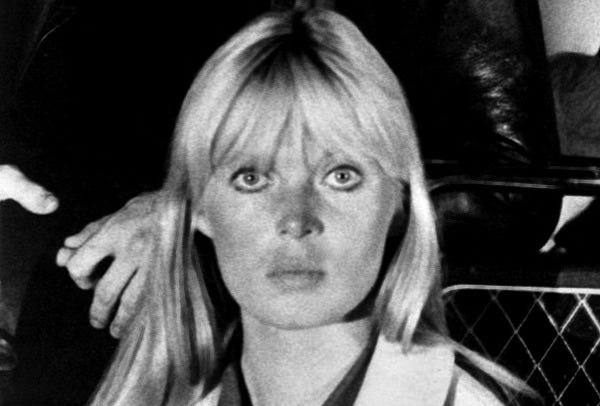
Nico: The Reluctant German Muse
How Christa Päffgen became a global icon
I was in my car the other day, happily driving along and listening to whatever my music app chose to throw at me, when a very German voice filled my head. “I’ll be your mirror, reflect what you are, in case you don’t know,” it sang in deep, heavily accented tones.
That was Nico, the singer and model who became an icon, not least because her distinctly German looks and sound made her stand out and fascinated people all over the world. The British singer Marc Almond, for instance, admitted later that he obsessed over Nico as a schoolboy because of her “wonderful, intriguing voice, icy and remote yet warm at the same time.”
On “I’ll Be Your Mirror”, which I was listening to in the car, she actually sounds a little bit softer than her usual forceful self, but even so, her accent is distinct and part of what makes this song so impactful. She recorded it with the American rock band The Velvet Underground in 1966, and when she left the group the next year, the song was still performed with the vocalist copying her accent.
Yet, while Nico was hailed as a German icon, she spent much of her life trying hard not to be German.
Even her name is part of her disguise. Nico was born as Christa Päffgen in Cologne in 1938, arriving just as her country plunged the world into a devastating war. Her father was drafted into the Wehrmacht and killed during the Second World War, leaving his wife and young daughter to fend for themselves amid the physical and moral wreckage of post-war Germany. Her mother Grete moved the family to West Berlin, where Christa grew up to become an exceptionally tall and strikingly elegant teenager with high cheekbones and the looks for a modelling career.
Yet for a young woman coming of age in the 1950s, being German was also loaded with shame and stigma. It is hardly surprising that she longed to shed it when she got the chance to move abroad. She was still a teenager, just 16 years old, when she was discovered in Berlin by photographer Herbert Tobias, who nicknamed her Nico. She left Germany and began modelling in Paris, Rome and New York, cultivating a cool, cosmopolitan mystique. Christa Päffgen lay in the past. Now there was only Nico.
She often said that she did not feel German, disliked her accent and tried to soften it, only to find it stubbornly persisted. Yet the very qualities that defined her public persona, that distinctive severity and emotional restraint, were often read by others as unmistakably Germanic.
Part of her resistance against this categorisation took the form of myth-making. Over the years, she told different stories about her origins, sometimes claiming she had been born in Budapest rather than in Germany, sometimes hinting at Spanish or other Mediterranean ancestry. At various points, she lied about her age, blurring timelines or recasting her wartime childhood in ways that made it seem less specifically German and more vaguely European. Friends and biographers have noted how fluid these accounts could be. Of course, reinvention was common currency in the bohemian worlds she inhabited, but in Nico’s case, the revisions often edged towards an attempt to unroot herself from Germany altogether.
An early brush with fame came through cinema. She appeared in La Dolce Vita, where her role was small but striking. She looked tall, unsmiling and almost statuesque. There was something austere about her that stood in stark contrast to the film’s Mediterranean feel. That starkness and seriousness was magnetic and often (and perhaps somewhat lazily) coded as German.
The decisive shift in Nico’s life came when she met Andy Warhol in New York. Warhol, who had a good feel for recognising marketable faces and cool personas, championed her as a singer. He persuaded The Velvet Underground to feature her on their debut album, The Velvet Underground & Nico. Though tensions simmered within the band, the record would become one of the most influential in modern music.
On tracks such as “Femme Fatale”, “All Tomorrow’s Parties” and the aforementioned “I’ll Be Your Mirror”, Nico’s voice sounds detached and precise. The accent she sometimes professed to hate became central to the album’s atmosphere. It lent a grave, decidedly European weight to songs about drugs and disaffection. Again, listeners heard Germany in it, whether the singer liked it or not. To American and British ears, there was a harsh rhythm and a stern clarity to her phrasing. In trying to escape her origins, Nico had made them part of her unique musical contribution.
In her personal life, too, she could never shake the perception others had of her as distinctly German. In 1962, she gave birth to a son, Ari, later known as Ari Boulogne. His father was widely believed to be French actor Alain Delon, with whom she had had a brief relationship. Delon never formally acknowledged paternity, and according to his mother, referred to Nico dismissively as “that Bosch”, invoking an old French war slur for Germans.
There are also indications that growing up during and shortly after Nazi rule may have left a legacy in the form of casual racism. Danny Fields, a friend who knew her during the 1960s, for instance, later characterised some of her attitudes as “Nazi-esque”. Fields was Jewish and found some of Nico’s antisemitic remarks and jokes rather grating. When he pointed out to her that he was Jewish, she simply said that she hadn’t meant him personally. Whether these remarks were specific to her or part of a wider atmosphere of latent antisemitism is hard to tell, but Field’s choice of words reveals that they reinforced the uncomfortable association between Nico and Germany’s darkest history.
After leaving The Velvet Underground, she released Chelsea Girl, her debut album. In the years that followed, she moved towards increasingly sombre and bleak material. Critics heard echoes of European folk and religious music, and once again her work was framed through a Germanic lens, even though the dark nature of her persona might as well have been influenced by her ongoing drug addiction and personal problems. Commercial success eluded her, but she developed a fervent cult following, particularly in Britain. Tall, dressed in black and harmonium before her, she seemed to embody a Gothic vision.
Nico died in 1988 after a cycling accident on the island of Ibiza, aged just fifty. In death, she remained a figure of fascination. Many still see in her the Warhol muse, the chanteuse with the icy voice or the exile who could never quite outrun her birthplace. Nico tried to disavow Germany to become placeless and universally cool and mythic. Yet lovers, friends and critics continually projected Germanness back onto her, sometimes admiringly, sometimes cruelly. In a way, they were her mirror, reflecting what she was, in case she didn’t know.


Fascinating piece 👏👏, a friend of mine apparently as a child when she went on holiday with her parents was told to claim Swedish nationality if asked by other children, I often wondered what would have happened if this was found out but apparently it never was ,
Very interesting ! Wondering whether her family is related to one of Cologne’s most iconic breweries ? And another irrelevant comment / correction on behalf of the neighbours across the Rhine: ‘Boche’. Merci vielmals 😉