Now, everyone can see what went on between the Kaiser and his wife
How new access to sources unlocks new glimpses inside the German Empire
I must admit that I’ve never spent a great amount of time thinking about the relationship between the first German Kaiser, Wilhelm I, and his wife Augusta. Like most scholars of Germany’s 19th century, I usually find much of my attention absorbed by the towering figure of Otto von Bismarck.
Perhaps somewhat bizarrely, I know more about Bismarck’s difficult relationship with Augusta — by all accounts, he found the Empress opinionated and interfering while she thought much the same of him — than I do about what was going on between the royal couple.
So when the German historian Jan Markert got in touch to say that a new project is now granting everyone unprecedented access to the vast correspondence between Wilhelm and Augusta, my interest was piqued.
The Kaiserly couple discussed everything from salacious court gossip to high politics in their letters to one another. And now all this is being transcribed and made available to the general public, including to a global audience via in-browser translation. I asked Jan Markert to write a guest piece for us here on ZEITGEIST about his project, and he kindly agreed.
I hope you’ll enjoy this insight into cutting-edge research as much as I have. You may just come out the other end rethinking what you thought you knew about the German Empire…
Wilhelm I, Augusta… and Bismarck
The (other) Kaiser and his Wife
by Jan Markert
When the Prussian King Friedrich Wilhelm IV suffered several strokes in 1857, his younger brother Wilhelm took over governing duties in Berlin for the childless monarch. The heir to the Hohenzollern throne was 60 years old then, and nobody could have foreseen that he would live to almost 91 before passing on the crown – and that during the three decades of his reign, Prussia would unite the German lands, with Wilhelm proclaimed the German Reich’s first Emperor in 1871.
Yet even though statues and monuments commemorating Wilhelm I can still be found all over Germany today, the first Kaiser has largely vanished from cultural memory. To most people, the words “Kaiser Wilhelm” conjure up the pointy moustache of Wilhelm II, the third and last Kaiser. By contrast, Wilhelm I stands in the shadow of the man he appointed as Prussian prime minister in 1862 and as first German chancellor in 1871: Otto von Bismarck, the “Iron Chancellor”.
Historians base their interpretations of history on the primary sources available to them. It’s all a game of finding enough puzzle pieces to fit together, while acknowledging that the picture will never be complete. In the case of 19th-century Prussian and German history, most of these pieces show aspects of “Bismarck”.
After he had been fired by Wilhelm II in 1890, the former chancellor embarked upon a literary crusade against his imperial sovereign. Journalists and historians were given exclusive access to Bismarck’s recollections and private papers. The narrative they put together under his guidance told the story of how Germany was united not by its Kaiser but by its “Iron Chancellor”, and how, instead of being grateful for the imperial crown, said Kaiser’s grandson had sacked the Empire’s architect.
This version of German history was reinforced straight from the horse’s mouth when Bismarck’s memoirs were published posthumously in 1898. In them, he characterised Wilhelm I as a weak ruler, out of touch with the ideas of his time – most importantly nationalism – and easily manipulated by his wife Augusta, born and raised at the liberal Court of Weimar. Had it not been for Bismarck, the Kaiser would never have found his way to the top of a unified German Reich. This narrative dominates historiography to this very day, not least because several multi-volume editions of Bismarck’s papers have been published over the past century and are readily available in most academic libraries.
When it comes to Wilhelm I, few historians have attempted to comb through the vast archival collection of his papers. Yet there is a lot to be discovered. Amongst the treasures found inside the former Prussian State Archive in Berlin is the Kaiser’s correspondence with his wife.
Married by royal command in 1829, Wilhelm I and Augusta were anything but a love match. The couple fulfilled their dynastic duty with the birth of their only son, Friedrich III, the ill-fated “99-Days-Kaiser”, who would come to the throne already dying of throat cancer. The first Kaiser and his wife were constantly at odds, rarely agreeing on personal or political issues. From the 1850s, Augusta would spend most of the year away from Berlin, communicating with her husband primarily through letters.
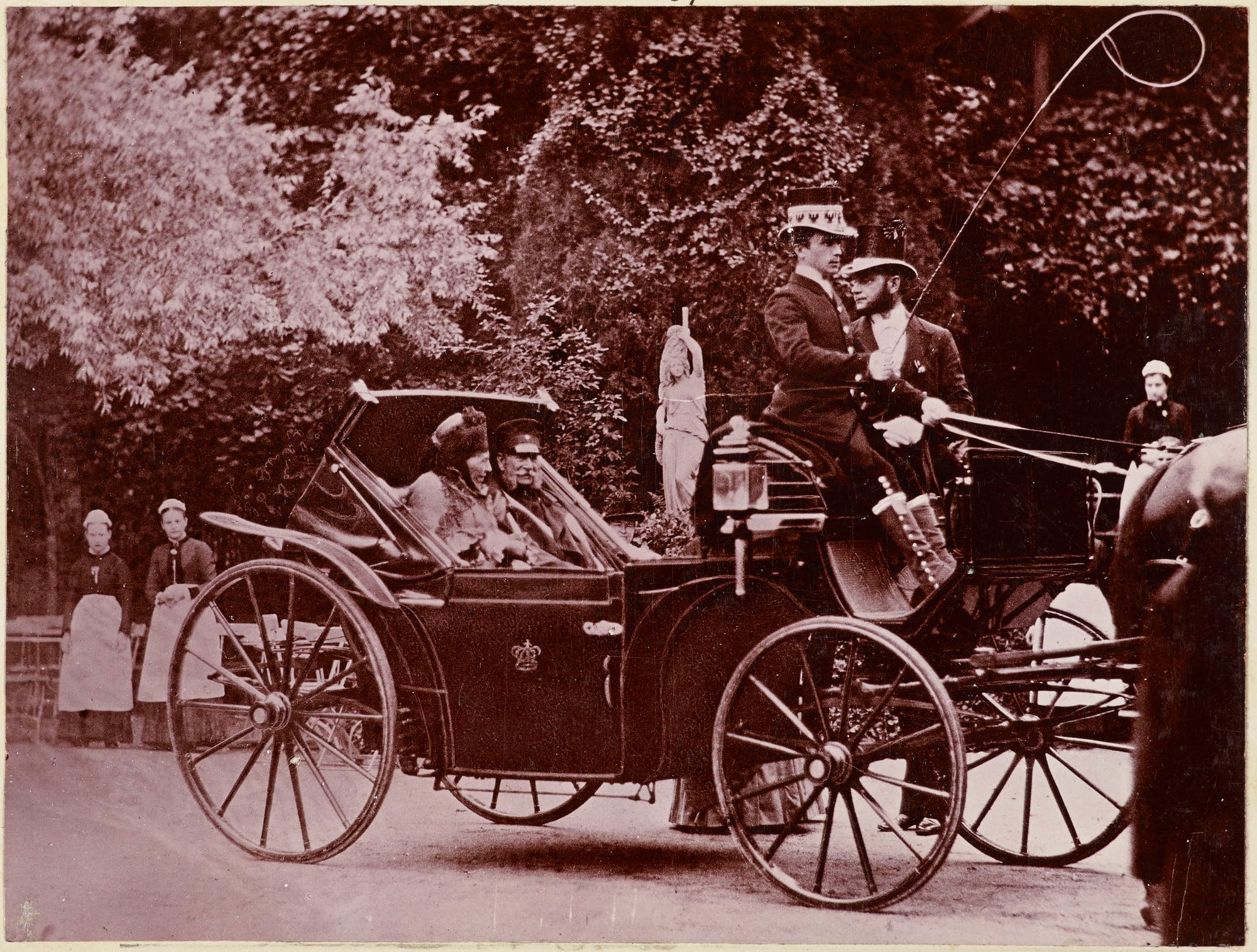
The above “snapshot” of Wilhelm I and Augusta in a carriage taken in Coblenz in 1885 or 1886 is actually the only photograph depicting both of them together that I was able to find in my many years of research. However, about 5,800 letters survived in the archives, written over the course of their almost 60-year marriage. In them, Kaiser and Kaiserin wrote about their everyday lives, meetings, conversations, the latest court gossip, and, of course, politics.
Augusta constantly criticised her husband’s political decisions, prompting Wilhelm to explain his reasons and why the alternatives suggested by his wife were discarded. Therefore, this correspondence gives an intimate perspective into the highest level of Berlin politics at a time when the future of modern Germany was decided.

I first came across these letters when working on my PhD thesis, a biography of Wilhelm I, which, ever since its publication in late 2024, has caused a bit of a stir amongst German historians. And in case you were wondering, yes, I have also come across plenty of archival evidence pointing towards Augusta having been far from the only woman in the Kaiser’s long and eventful life… and Friedrich III having had several illegitimate siblings.
Thanks to the funding of the German Research Foundation, Wilhelm I’s and Augusta’s letters, written between the years 1857 and 1871, are now being made available online, giving both historians and the public a chance to re-examine a period in German history which has only seemingly been researched to death. And thanks to browser-integrated translations, this digital treasure chest has a chance of reaching international audiences.
In sum, we are talking about 2,500 handwritten letters which are being fully transcribed – the handwriting of Wilhelm I is notoriously hard to decipher even for professional historians – and annotated. There are no text omissions, every line and every page is transcribed, even text informing us about the weather (a lot!), which member of the Hohenzollern family was suffering from indigestion (quite a few!), and which prince you should never be left alone with, particularly if you were a woman (it’s Wilhelm I’s younger brother Carl, as Augusta points out many, many, many, many times).
Every surviving original letter is being published in digitised form next to the transcribed text. Every person mentioned in the letters is identified and linked to their online data entry at the German National Library. The person index for all names mentioned in all letters from 1857 to 1871 is five digits long. Even researchers not interested in Prussian or German history should therefore take a peek.
Ever wondered what Tsar Alexander II thought of the British government under Queen Victoria? “It is pointless to look to England for guidance”, Wilhelm summarised a conversation with his Russian nephew in 1860, “as the government there is revolutionary whilst the monarch is conservative; consequently, nothing can be done about the country for the time being.”

If it is the history of the making of modern Germany through “Iron and Blood” you are interested in, these letters offer a new perspective on crucial events. To this day, historians falsely claim that we only have Bismarck’s account – written in the 1890s – about how he became prime minister following a meeting with his royal master on 22 September 1862.
Now you can read what Wilhelm I wrote about that meeting to his wife just one day later… and there is no mention of him granting Bismarck a free hand in politics (on the contrary!). In his memoirs, the “Iron Chancellor” also claimed he had to keep his monarch from marching onto Vienna after the Prussian victory over Austria at Königgrätz in July of 1866, advocating for peace negotiations instead. As Wilhelm I’s letters show, Bismarck has completely fabricated this often-cited story.
Letter by letter, a new picture emerges: The picture of a Kaiser who was anything but the weak monarch he is usually depicted as. “I decide for myself on politics, war and peace”, he wrote in 1859, after having sacked Friedrich Wilhelm IV’s ministers. Long before Bismarck arrived on the scene, Wilhelm I was advocating for national unification as a means of strengthening the Hohenzollern-Monarchy.

Our picture of Augusta also needs re-evaluation: Her letters were an important source of information for her husband, as she wrote in great detail about the various monarchs and politicians she talked with. Augusta’s network provided Wilhelm I with intimate knowledge beyond official government channels. As her own elite position in politics and society was tied to her husband’s, she did everything in her power to support him, writing him lengthy political memoranda and even giving him advice on staying healthy.
Augusta wrote to Wilhelm in 1858, “Over the course of these many years, I have proved to you that I am your most loyal friend; with this in mind, I shall always strive to fulfil my duties conscientiously.” By playing an active, albeit indirect, role in politics, Augusta drew criticism from the Kaiser’s conservative court, chief among them Bismarck. To give less weight to her many critics, she emphasised in her letters that it was her dynastic duties which compelled her “to deviate from my usual stance of non-interference in matters that do not directly affect me as a woman.”
However, the correspondence also gives an intimate perspective in how dysfunctional this royal marriage could be: In a letter from 1862, Wilhelm I writes about how he is forced to pick up a pen to communicate with his wife, even though she is sitting just next door in the same building: “Your agitation during the conversation that has just taken place is such that I must set out in writing what I said, as you were unable to listen and understand.” Then he describes in detail how when he brought up politics, Augusta started shouting at him, threw her papers at his feet and stormed out of the room.
These are only snippets from the everyday life of a 19th-century royal couple. With the launch of the website in June 2026, the complete first four correspondence years are available online: over 500 letters covering the Regency Era in Prussia, from when Friedrich Wilhelm IV was rendered unable to govern in October 1857 to his death in January 1861 and Wilhelm I’s accession to the throne.
New letters are published every month. On the website, you will also find academic essays written by me giving further insight into Wilhelm I’s and Augusta’s lives, the archival history of their letters, as well as the unsuccessful attempts at using AI to help in the time-consuming transcription process (turns out computers have an even bigger problem reading the Kaiser’s scribbling than historians).
I hope the published letters will not only allow others to verify and scrutinise my (as some would say, radical) theories on Wilhelm I’s role in German history but also to write new studies on an almost forgotten royal couple and their time, which saw the making of modern Germany. This is one scholarly debate which is long overdue.
Hopefully, you have enjoyed these insights.
You can find the letter collection discussed in this article here:
https://augusta-wilhelm-briefwechsel.uni-trier.de/home
And further work by Jan Markert, as referred to in the article here:
https://www.spkmagazin.de/2026/forschungsdebatte-kaiser-wilhelm-i.html


