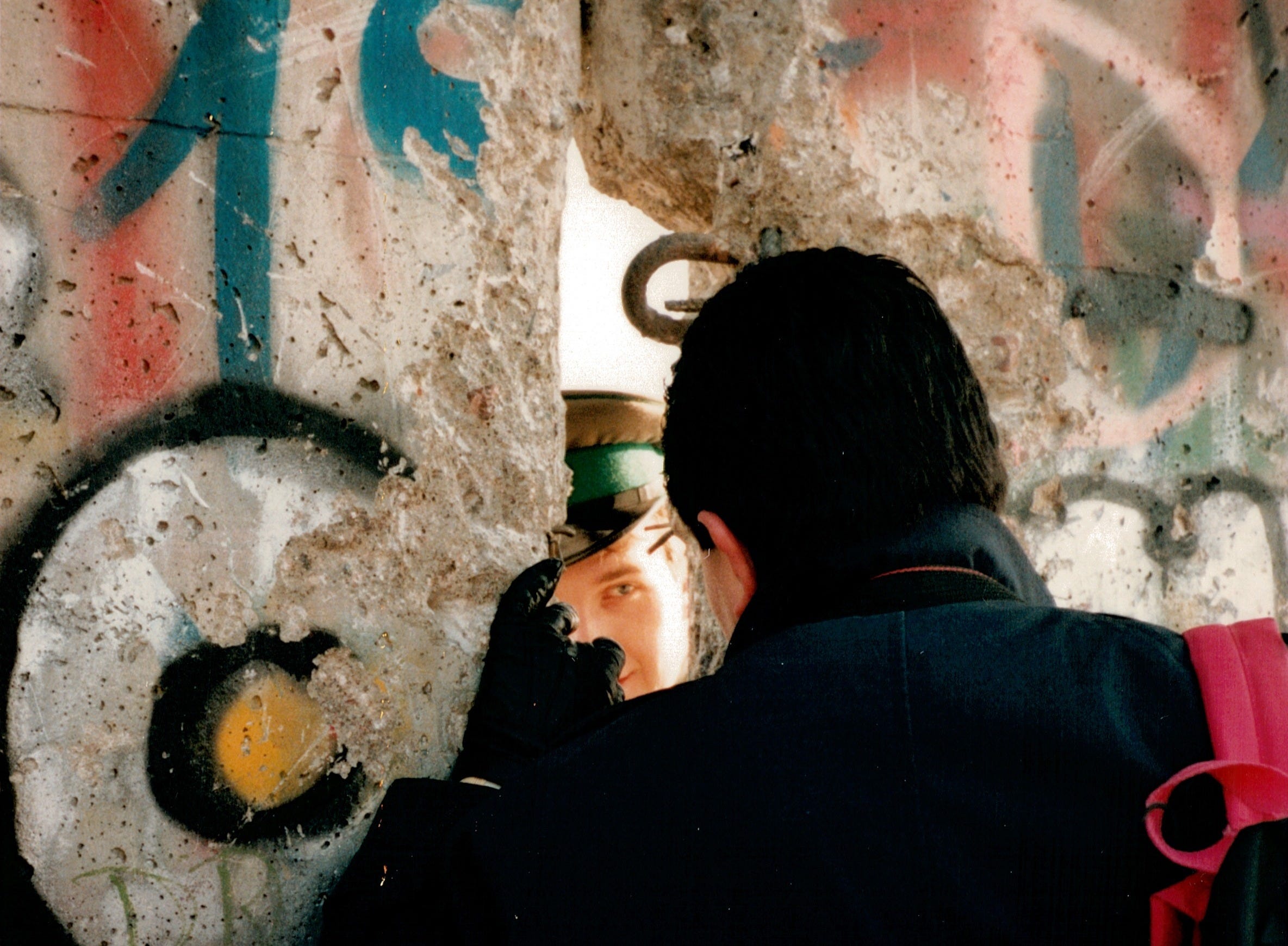
A German journalist once wrote about me that, as a “Brit-by-choice”, I must be “so far removed from the entrenched East-West debates” in Germany that I’m better able to endure their inherent contradictions. I don’t know if that’s true, but what I can say is that when I encounter them face-to-face, conflicts between East and West Germans often take me by surprise in their acerbic intensity.
Let me give you an example. In the autumn of 2024, I was invited to a lecture at Cambridge University. The speaker was Dirk Oschmann, a literature professor at the University of Leipzig and author of the 2023 bestseller The East: A West German Invention, an angry treatise about how former East Germans have been treated since 1990. There were many Germans in the audience. Everyone listened to him politely and applauded.
But at the drinks reception afterwards, a German businessman told me angrily that he couldn’t stand all the “whingeing from the East” any longer. He said he had invested a lot of money in the “new German states” (a phrase still often used for the former East German territories), yet felt the employees there were permanently ungrateful. To this day, he added, productivity in eastern Germany remained inadequate. The laziness and arrogance of the “Ossis” were unacceptable. They should work as hard as Westerners before demanding equal pay. Some in the group we were standing in nodded in agreement. Others stared at their shoes.
It is true that productivity in the East remains around 20 per cent lower than in the West. But not only has this gap been closing since 1990, but studies by the Leibniz Institute for Economic Research and others have also shown that the difference has complex causes and certainly does not mean “that East Germans are less talented or motivated.” You find similar gaps for the North of England as well, by the way.
But I didn’t get very far with such arguments that evening. It soon became clear that this outburst of anger was less about specific facts than about a vague notion that East Germans had not only failed to contribute anything positive to the “old” Federal Republic, i.e. West Germany, but had even damaged it.
It’s a sentiment, I hear and read often these days. Like the businessman in Cambridge, others too seem to project their general frustration onto East Germans. The line of thinking goes something like this: Before 1990, West Germany had strong mainstream political parties, a successful economic model and broad social consensus. Today, old certainties are crumbling. What’s changed? The East Germans joined. Instead of integrating gratefully and quietly, they wanted a say in matters and, on top of that, to be allowed to remember their own past.
Nearly 36 years after reunification, a significant number of people seem to believe that reunification is a root cause of the current German malaise, or at least a contributing factor. Or to put it another way: eastern Germany becomes a kind of scapegoat for Germany’s many problems.
Perhaps this need for a scapegoat lies behind a wave of West German frustration currently sweeping through the media. For example, a column in the newspaper FAZ recently bemoaned what it saw as an “East German sense of exceptionalism” which, unlike “the largely self-referencing regional identities of the people of Hesse, Saarland or Lower Saxony [all West German states]”, is based on “rejection, rebellion and envy of West Germany”. You really have to let that sink in: according to this view, West Germans have genuine local pride, whilst East German identity is rooted in hatred of the West.
Furthermore, according to the FAZ article, the East-West debate to date has “politely glossed over” the fact “that some of the problems facing Germany as a whole – with infrastructure, debt and shortfalls in welfare funding – are linked to the massive financial transfers to the new states [i.e. East Germany].” Blaming the East for these general challenges is a bit much. After all, bridges collapse in Dresden too, and as for high public spending, nearly half of all welfare claimants are currently non-Germans, and pensions face the enormous challenge of an ageing population. These costs are driven by nationwide developments and the East actually helps shoulder them.
Meanwhile, another magazine, Focus, has taken issue with the fact that three conservative politicians from the East – which it belittled as “the three East German musketeers” – had spoken out against the government’s planned pension reforms (always a very sensitive issue in the East). Of course one can criticise this, but portraying it as specifically East German obstinacy is wide of the mark, as a large majority of German citizens also reject the reforms according to recent surveys – including over two-thirds of conservative voters. Yet such a “blatant refusal to show loyalty to the federal party” apparently carries particular weight among politicians from the East, according to the Focus, which bemoans a “gratefulness gap” between East and West.
Here, too, East Germans are blamed for general problems – in this case, divisions within the conservative party. In truth, the conservative Chancellor’s approval ratings have plummeted to a new low this week, without any specific input from East Germans, and the disaffection within his party now extends far into the ranks of his own supporters. It may be frustrating that the mainstream parties are losing trust among voters and their own grassroots. But the East is hardly to blame.
Elsewhere, the political magazine Der Spiegel reported that “patience is running out” in “West German circles”. In the run-up to the elections in the eastern state of Saxony-Anhalt, where the AfD is aiming for an absolute majority, those circles are reportedly whispering “behind closed doors” things like: “If it comes to that: best to put a fence round it and sell it to Kazakhstan.” Nice.
But there’s more. The real question, the column argues, is: “Which is the better Germany? The new blue East or the old West?” Blue is the colour of the AfD. So the picture painted here is one of the AfD as a creature of the East. By feeding it, easterners are ruining the good old West. That “old West Germany”, the author defiantly claims, is “still alive, albeit already a bit tinted blue.” A bit? In the latest poll, the AfD is in first place nationwide, this week with a new record high of 29 per cent. Bearing in mind that the East is only a fifth of the population, there are rather a lot of West German AfD voters even if the party is significantly more popular in the East.
It’s worth remembering that right-wing populist parties are also enjoying strong momentum in neighbouring countries. In Austria, the FPÖ stands at 38 per cent. In France, the Rassemblement National leads with 35 per cent. And in Italy, the party Fratelli d’Italia, led by Prime Minister Giorgia Meloni and classified as post-fascist, continues to lead in the polls. I don’t know how many more times this needs to be explained: East Germany is not an anomaly, and certainly not one that drags West Germany along against its will.
Neither an imaginary fence nor fantasies of selling off eastern Germany to Kazakhstan can turn back the clock. Such bitter jokes say more about the helplessness of those who vent their frustration on eastern Germany than about actual problems. It achieves absolutely nothing to offload all the problems — from crumbling infrastructure and soaring welfare spending to the crisis of centrism — on former GDR citizens and their descendants. This is not only pointless and unfair, but it also unnecessarily divisive.
Fundamentally, I think most Germans, East and West, want the same thing: a safe, free and prosperous Germany, in which the state creates sensible conditions under which people can build a good life for themselves. To achieve this, we should look ahead and aim to build a better future, rather than clinging to a past that no longer exists. The “old West Germany” cannot be brought back. Not even through Ossi-bashing.
*
This is a translated and slightly shortened version of my column in the Berliner Zeitung this weekend.


I know many Wessies who blame the East for just about everything rather than look at their own mistakes such as over reliance on Russian gas, Closing nuclear reactors overnight, failure to renew basic infrastructure, etc. Many of the problems started at unification with over promising the speed of economic prosperity; and the takeover of the East rather than a real attempt to nurture local talent and work together.