Poor West Germany
Or: A Tale of Two Cities
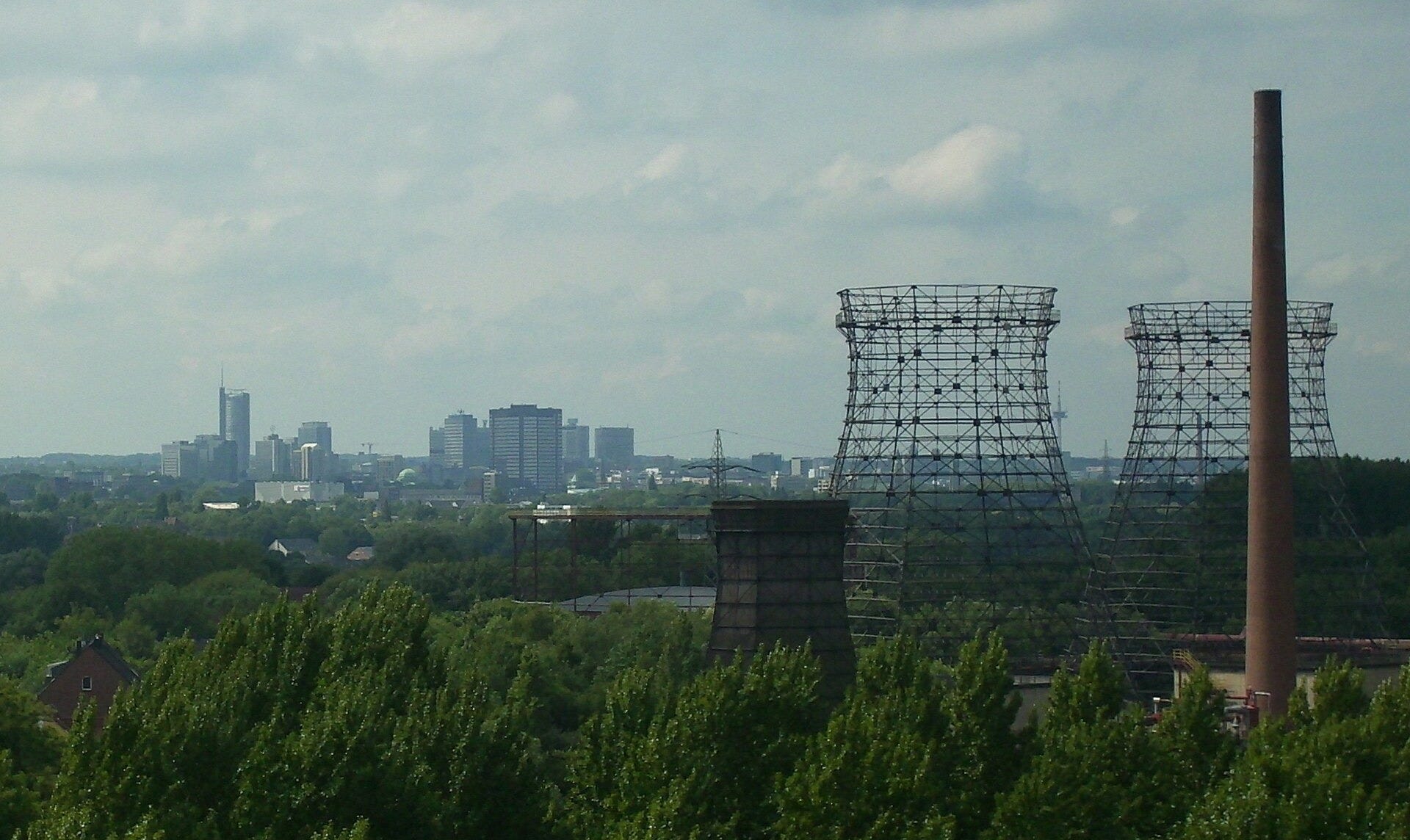
When my train pulled into Essen on Tuesday, I had no idea what to expect. As a historian, I associate this city in the Ruhr region mostly with coal, steel and Krupp. The Krupp dynasty came from Essen, and it was here that they established their (in)famous empire of steel and arms production, fuelling Germany’s steep economic rise but also its military efforts in two World Wars.
Not least due to the Krupps’ efforts, Essen rose to become one of Germany’s most important industrial hubs. Also not least due to their efforts, it was the target of one of the heaviest Allied bombing raids during the war, which destroyed around 90% of the city centre.

What would I find in Essen now? A rebuilt city, marked by post-war architecture and post-industrial transformation, that much was clear. What I – perhaps naively – hadn’t expected to find was one of the poorest cities in Germany.
I was on my way to Altessen, the most populous district of the city, but also one of those described as “problematic” by many of the locals I spoke to during my stay: many empty buildings and disused former industrial sites, high unemployment, high proportion of migrants, high crime rate, drug issues, a lot of homelessness.
Talking to social workers, youth coaches and teachers, I was told the same thing I’d heard in Dortmund again and again: the A40 motorway, which runs right through both cities, divides them like a “social equator”: North - poor, South - affluent.
This is much easier to explain than to remedy. In the decades after the Second World War, the Ruhr region recovered from bombing and ruin as West Germany underwent a so-called economic miracle, with eye-watering growth rates averaging 8% or more. For the recovery of the “Made in Germany” model, the country needed fuel, and the Ruhr region had that in spades with its vast coal reserves.
The West German government heavily subsidised coal mining, believing it couldn’t afford any gaps in the cheap energy supply this provided to the rapacious industries that underpinned the recovery necessary to stabilise German society and politics after the war. Jobs in the sector paid decent wages and seemed secure, so plenty of people moved in, from other parts of Germany as well as from Italy, Spain and Turkey.
In the 1950s, Essen built over 100,000 new flats. Workers could finally move out of makeshift and inadequate housing. At its peak in the early 1960s, the city had over 700,000 residents. It was the largest city in the Ruhr area and the 5th largest in Germany.

Much of this population growth occurred north of the A40 autobahn, where many of the mines were located. Densely populated and quickly rebuilt neighbourhoods emerged, marked by working-class culture. There were social clubs, small pubs and shops. Germany’s sharply tiered school system meant that in such working-class areas, school types dominated that did not lead all the way up to A-Level.
The speed and nature of rebuilding in the northern parts of the Ruhr district meant that city planning wasn’t done with social mobility in mind but to provide housing and amenities for workers and miners. Middle and upper class people meanwhile preferred the leafier areas south of the A40. There was less war damage there anyway, and what was rebuilt was done with their needs in mind. A sharp geographical class divide calcified, renewing itself with each generation.
Then a sharp industrial decline began. First, German industry moved away from coal and towards imported oil. The figures show how quickly this happened: in 1950, coal still made up 87% of West Germany’s energy market. By 1964, the proportion had already shrunk to 60%, set to decline further at a rapid pace. The last of Essen’s once 290 coal mines closed in 1986. An era came to an end in what had once proudly been the largest coal mining city in Europe. Steel never recovered in Essen after what was left of the Krupp assets was dismantled, given the role the company had played in the war.

So now the north of Essen was a vast landscape built for and populated by workers without work. Many moved away – today Essen has just 570,000 inhabitants – others stayed, with some falling into long-term unemployment. The south of the city prospered in the wake of deindustrialisation, benefitting from the government’s supporting measures like the founding of a university in 1972 or the fact that so many big German companies, among them energy giants RWE and E.ON, are headquartered here.
The north struggled. Densely populated, it had little room for new greenbelts. Shot through by massive infrastructure such as wide roads and of course the infamous A40, it’s pretty segregated in terms of access to educational, economic and cultural opportunities.
This self-perpetuating cycle has produced some stark results. In a recent ranking of German cities, Essen is No 4 on the list of the poorest – topped only by three other West German cities. Around a third of children in Essen depend on social welfare – bearing in mind that the city has some very wealthy parts too, you can imagine how much worse the situation is if you just consider the north.
I found it disturbing to listen to a youth worker who explained how difficult it is to break the cycle. Most of the kids he works with are from the north of Essen. If he finds a homeless teenager somewhere to live, it’s invariably in the north because prices are too high in the south. So they stay where they are. Ditto the south. There is very little interaction.
On Tuesday, I visited a former coal mine in Altessen that has now been turned into an education centre with the explicit aim of bringing kids from the north and the south together. The staff there were proud of the fact that their centre was in the poor north, which encourages children from the south to cross the “equator” if they want to attend the summer camps on offer. But they admitted that actual mingling is still tricky.
While parents from the south are perfectly happy to charter buses for their children to get to the site (note that some are clearly keen for their children to avoid using public transport and to walk to get there), uptake among northern kids is notably slower, even though participation is free for poorer families. Among adults, this disaffection is replicated in lower turnout at elections.
Most of the kids who came to speak to us for the BBC radio programme we were making spoke impeccable English. Despite being only 12 or 13 years old, some had fairly idiomatic American-accented English, indicating that they’d spent some time abroad. They told us that Essen was a “green”, “vibrant” and “cool” place to live. Their only worry was that there were still “too many cars” around causing air pollution. I rather suspect most were from south of the A40, which indicates one of the problems of dealing with the imbalance: fewer northern voices make it into public discourse.
This pattern proved a problem even for our documentary. It’s easy to find politicians, city planners, museum directors, academics and journalists who will happily tell you that Essen and Dortmund are now greener and eminently more livable places than they were fifty years ago. It’s much harder to find people who’ve lost something in that transition and who are willing to talk.
Both Dortmund and Essen have stark and visible problems with homelessness and rough sleeping — according to press reports, numbers have reached record highs. Both cities have large numbers of people living off benefits or just about getting by on low-income and insecure jobs. For them, the transformation of the economy hasn’t created so many new opportunities to participate, so they withdraw.
Eventually, I found a middle-aged man from a working-class background who was willing to talk to me. He was hanging around in Dortmund’s main shopping street with a can of beer in his hand at 10 am on a weekday morning. He said he’d “gladly” tell us what he thinks as he was “from the North of Dortmund” and “we don’t get asked too many questions.” But he apologised for not being able to do it in English as he had only gone to the Hauptschule, the lower-tier school.
Expecting him to be disgruntled about things, I was surprised by what he actually told me. The closure of heavy industry was “inevitable”, he said, and “all-in definitely for the best.” He still remembered how you couldn’t dry your washing outside when he was a kid. “The air was dirty like you couldn’t imagine. Anything you left outside for too long turned grey.” Now, he said, the air and water were clean, and there were new opportunities for “all the young people coming in”.
It’s just a shame, he added, that the northern parts of the city were sacrificed and ignored in this process. “It’s very, very bad where I live,” he said and pointed to somewhere over my shoulder, “and actually getting worse. Drugs, crime, homelessness and nobody cares. I don’t feel safe anymore. Politicians don’t care about the places where people like me live, you know, the housing estates in the north.”
Just a few metres away from him, I bumped into a man about the same age. He’d moved to Dortmund about five years ago for a new job. “A lovely city to live in,” he told me, “green, great infrastructure, vibrant culture and so much to do! I can cycle to work, and my kids love it here.” Would he recommend others to move here, too? “Sure,” he said, “the quality of life is great.”
This was a tale of two cities in more than one sense, and I found the stark social divides hard to get my head around. Coming from East Germany, I’ve grown up with an image of my home region as the “poor Germany”. Indeed, there are a couple of East German cities like Halle, Chemnitz and even trendy Leipzig that make it onto the Top 10 lists of poorest cities at times. But I’ve never seen a contrast as sharp as that in Essen in East Germany. Overall, the oft-repeated stats are clear: East Germany remains poorer than West Germany. But on the lists of poorest cities, you usually only find a couple from the east towards the back end of the Top 10.

Interestingly, when you look at entire regions, East Germany and the Ruhr are nearly on a par in terms of average poverty levels. It’s worth remembering this in debates about which regions need support and what that support can and should look like. A key issue in both regions appears to be the non-participation and/or exclusion of voices from the communities most affected by structural economic change.
When city planners, politicians, social workers and economists who, by and large, aren’t from the affected communities talk among themselves, they envision a future of people like themselves: a world in which university education, the culture sector, tourism and high-end tech jobs are the only answer to deindustrialisation and the loss of working-class jobs. Communities cut off from this brave new world, physically and culturally, are left to fend for themselves. What to do about it is a question that goes far beyond the old East-West divide.


