Return to Weimar
A Journey to the Heart of Interwar Germany
It felt strange returning to Weimar earlier this week. I spent so much time there, mentally and physically, while researching for my upcoming book on the town between 1919 and 1939, that it has taken on a strange familiarity.
While much of that cognitive familiarity is with the townscape as it was a century ago, Weimar hasn’t changed much, outwardly at least. Even what was destroyed in the Second World War has largely been rebuilt. Many streets, squares, houses and even restaurants, cafes and museums carry the same names today as they did in the 1920s and 30s. It feels very odd walking around the town today with vivid mental images of the tumultuous scenes that took place there in the interwar era.
I arrived in Weimar by train from Berlin quite late in the evening. Tired and a little disoriented from travelling between countries and cities, I walked down the steps from the platform into the train station itself… and was immediately back in my book.
Work on the neo-classical building with its high ceilings and elegant interior began in 1914 and was interrupted by war. Then, after the war, politicians and journalists arrived here in 1919 for the founding of the Weimar Republic at the theatre in the town centre.
Later on, when history took a darker turn, around 10,000 Jewish men arrived here in 1938. They had been arrested in the November Progroms, euphemistically dubbed “Kristallnacht” by the Nazis, and were to be taken up to the newly established Buchenwald concentration camp just outside of Weimar.
Having researched this history through diaries, letters and other first-hand accounts, my mind churned up random snippets of sentences spoken or written in Weimar at the time. “At the station, a Jew transport is due to arrive at 11 o’clock, come along if you want to see something,” one young couple was told in November 1938, as they were having a drink in a tavern in the nearby Röhrstraße. They did as they were told, walked to the train station and looked on as people were being beaten out of trains and onto lorries. Recalling the scene later, they said: “We just didn’t understand it, we were frightened. How could they treat people like that?”
When I exited the train station, the next evocative sight hit me. I looked left, and there was the tall white building of Brennerstraße 42. It had once been the Hotel Hohenzollern, run by Rosa and Arthur Schmidt. He was from an old Protestant Weimar family, and she was Jewish and from outside of Germany. The couple had met before the war when they had both worked on a cruise ship. Back in Arthur’s hometown, they took over the Hohenzollern after the First World War. Their hotel was where Adolf Hitler stayed during his early visits to Weimar. He had no idea that it was run by a Jewish woman.
My mind turned back to the present as I looked down the long, straight avenue that leads from the train station to the town centre. Would my hotel reception still be open? It was getting rather late, and Weimar isn’t exactly a nightlife destination.
Had I arrived here a century ago, I could have hopped on a one-car tram that would have taken me from the train station to the old town. In fact, it would have stopped directly in front of my hotel, the Russischer Hof (which had temporarily been renamed Fürstenhof due to the hostilities between Germany and Russia during the First World War). But the Nazis did away with that and replaced the trams with buses, as that seemed like progress at the time.
I could have taken a bus, too, but the thought didn’t appeal. I walked instead, down Carl-August-Allee until I reached the Museum Neues Weimar. My “protagonist”, the bookbinder Carl Weirich, walked the same route in 1914 when he came here to look at a stationery shop in the town centre that he wanted to take over if everything was in order. He would have seen the same building, thought it was still known as the Grand Ducal Museum then.
And yet, a very different scene would have opened up to Carl after that. He would have walked across a large viaduct and admired a landscaped garden in front of the museum, complete with an elaborate fountain depicting the personification of Weimar: Vimaria.
When I got to the same spot, I saw a long colonnade, arranged in a U with a sizable block-shaped building at the end and a car park underneath. This is the only “Gau Forum” or regional Nazi party complex that Hitler’s regime managed to actually build before the war scuppered such plans elsewhere. The Bauhaus Museum opposite was also not here in 1914, not least because the art movement it’s about wasn’t born yet. The history I was researching has changed the town forever.
And yet, when I walked a bit further, I was back in the old Weimar. Like me, Carl would have passed the imposing old post office (still in operation) and walked across a square he knew as Karlsplatz and which is today called Goetheplatz. That’s where the “Grand Hotel Russischer Hof” was and is. So I turned right and went through its doors. Carl would have turned left into the adjoining Geleitstraße to view the shop he wanted to take over at No 10.
I found the hotel reception was still open. A man checked me in and gave me an envelope with my name on it, which had been delivered earlier that day. It contained a number of old postcards which I’d ordered from a private archive. I couldn’t wait to see them, so I went through to the “Bar Romanov”, ordered a cocktail and began to sift through them.
I wasn’t disappointed. Among the postcards was one somebody had sent in 1936 from the Hotel Chemnitius, which was right next to the shop Carl had indeed taken over at Geleitstraße 10 in 1914. The postcard showed the hotel as it looked back then, and next to it, complete with awning and customers, was Carl’s shop!
I didn’t have much time to contemplate that I was sipping a drink in a hotel where people like Franz Liszt, Richard Wagner, Edvard Munch and Tsar Alexander I. had also had drinks. It really was bedtime. The next morning, I would need a clear head to visit many of the sites of my book with a videographer to make a short film about Weimar: Life on the Edge of Catastrophe.
It was a glorious spring day when I met the man with the camera at the Weimar town archive, where I’d spent so many hours piecing together other people’s life stories. There, we looked at Carl’s meticulous diary and the “baby book” in which he documented every step of his child’s life.
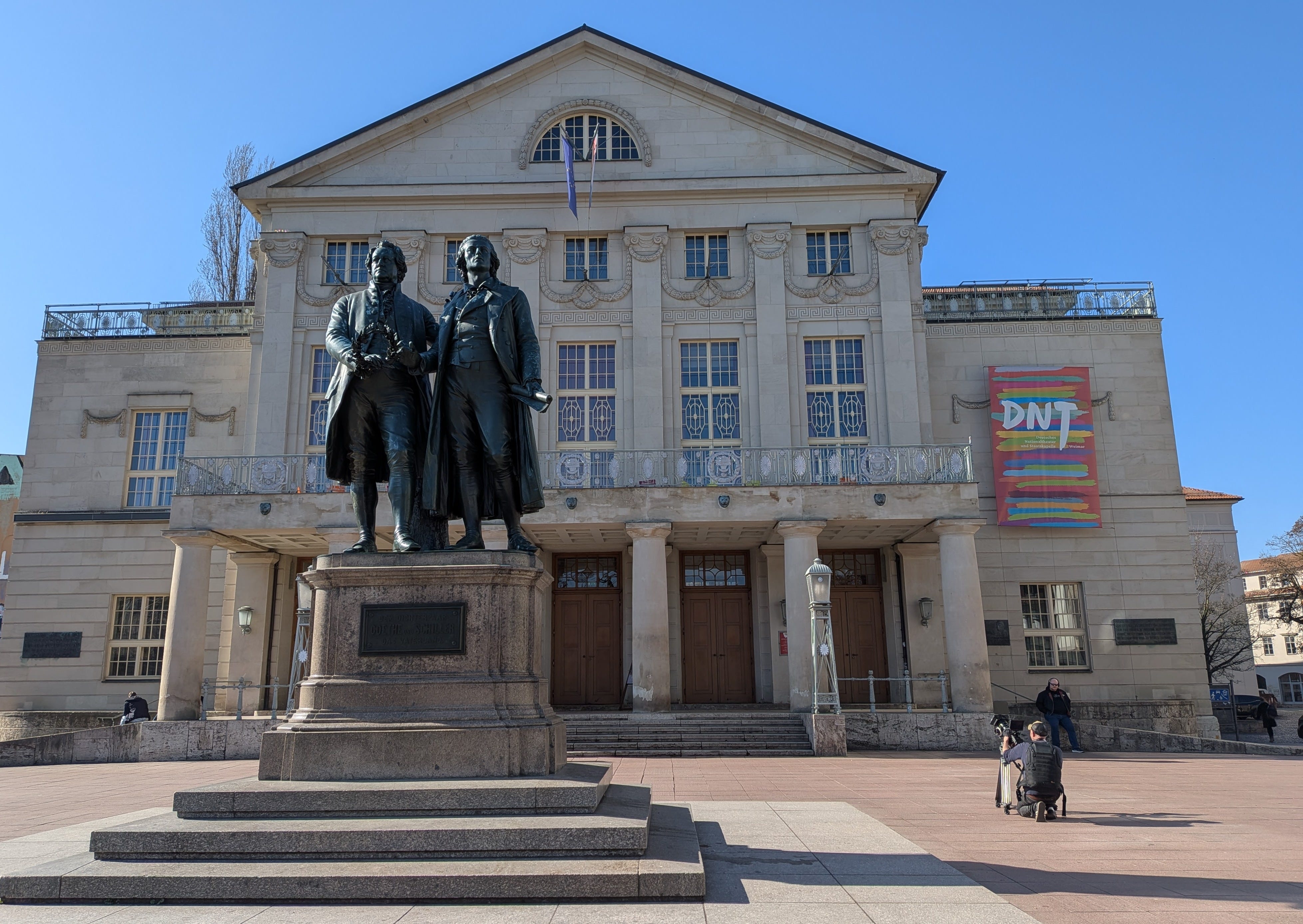
We went to the German National Theatre, where the Weimar Republic was founded and where Hitler first introduced some of the rituals of the Nazi movement. The Bauhaus-designed plaque, which documented the founding of the republic, was later removed by his troops and has now been restored.
We visited the Nietzsche Archive, where the famous philosopher died, and where his sister Elisabeth ruled over his estate in the interwar years. And we filmed at the market square, where the famous Hotel Elephant was so beloved by Hitler that it was demolished and rebuilt to his specifications, with a private suite for his exclusive use.
My return to Weimar, finished where it began: at the train station. As I stood there in front of what had been the Hotel Hohenzollern, speaking to the camera about Rosa Schmidt’s life, a truth hit me again that is easy to forget, even as a historian. What we’re researching in archives and books are the lives of real people. Their stories are complex, often even contradictory, but it’s in that nuance and complexity that we can find valuable lessons for our own times.
**
And now, for a completely shameless act of self-promotion: Weimar - Life on the Edge of Catastrophe comes out on 7 May in the UK and Germany. In the US and Canada, the release date is 9 June. If you’re elsewhere, please check as a few translations are underway. I’ve also been signing pre-order copies for independent bookshops, Blackwell’s and Dussmann in case you’d like one of my chicken scratchings in your book.
UK - US / Canada - Germany - Signed with free global shipping


