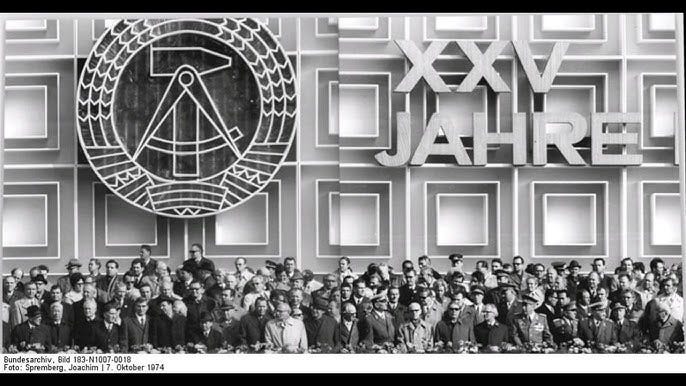
Risen from Ruins: Why the East German anthem is back in the news
And why it's always been controversial - even in the GDR

One thing I didn’t expect to hear when I got up yesterday and turned on the news was the East German national anthem. After all, it’s now nearly 36 years since Germany was reunified and the GDR became defunct, and with it its anthem. But there it was: “Auferstanden aus Ruinen…” – “Risen from Ruins…” sung by a room full of people in the town of Dessau in the German state of Saxony-Anhalt. The recording wasn’t from 1989 but from Tuesday night.
This made headlines across many media outlets because it happened at an event organised by the Alternative für Deutschland (AfD). Two of the far-right party’s most prominent figures were on the stage: Tino Chrupalla, the party’s co-chair, and Ulrich Siegmund, leader of the Saxony-Anhalt branch. In Saxony-Anhalt state-level elections are scheduled for September, and the AfD is leading in the polls with above 40% of the vote share. They are even hoping for an absolute majority. So what’s happening in Saxony-Anhalt is currently being watched by the entire country.
That’s why the news that party leaders were singing bits of the GDR anthem created such a stir despite the fact that it’s obvious from the video footage that neither of the two men had expected to find themselves in this situation. It appears to have unfolded at the end of a panel discussion, when Chrupalla told the satirist Uwe Steimle, who was on stage with them, that the AfD always sings the German national anthem at the end of their events. So could he please start them off on that.
Instead of launching into the official German anthem – the third stanza of the Deutschlandlied with its 19th-century lyrics by Hoffmann von Fallersleben – Steimle began singing “Auferstanden aus Ruinen,” the GDR’s anthem, written in 1949. The host of the event, former Green politician Antje Hermenau, can be heard trying to intervene by saying “No, no, no, no” and waving her arm about. Chrupalla and Siegmund looked at one another. Chrupalla shrugged, and when Steimle just carried on singing unperturbed, they joined in with bits of it, though Siegmund, in particular, who was born in 1990 after German reunification, appeared reluctant and unsure of the lyrics.
The incident has since developed a life of its own, with widespread reporting in Germany and internationally. Even Thorsten Frei, the head of the German chancellery, commented on it, saying that he found the whole episode “extremely disconcerting. And that’s especially the case when this is being done by political representatives who clearly do this to convey political messages with it, too.”
It’s true that the AfD taps into and fuels a sense of East German identity with its messaging and rhetoric. But quite apart from the fact that the initiative for singing the GDR anthem in Dessau didn’t come from the two AfD politicians, its origins and legacy are also more complicated than the headlines suggest.
Perhaps the most striking feature of the GDR anthem is that the East German regime itself began to dislike it. Or rather, from the 1970s onwards, it didn’t like the lyrics anymore when they seemed to convey an inconvenient message of national unity at times when politics was moving in the opposite direction.
Risen from Ruins was written and composed in 1949, the year when two separate German states were founded, but also still a time when most Germans wanted to live in one nation-state, and the leaders of both states were keen to show that this was still on the cards. Division was seen by most as a temporary political situation, perhaps even a punishment for war and genocide. The song is a product of the immediate post-war era. Set to stirring music, its lyrics reflect a desire to build a better Germany from the ruins of the Second World War (translation from Wikipedia):
I
From the ruins risen newly,
To the future turned, we stand.
Let us serve your good weal truly,
Germany, united fatherland.
Triumph over bygone sorrow,
Can in unity be won.
For we shall attain a morrow,
When over our Germany,
There’s the shining sun!
II
May both peace and joy inspire,
Germany, our fatherland.
Peace is all the world’s desire,
To the peoples lend your hand.
In fraternity united,
We shall crush the people’s foe.
Let all paths by peace be lighted,
That no mother shall again
Mourn her son in woe!
III
Let us plow and build our nation,
Learn and work as never yet,
That a free new generation,
Faith in its own strength begets!
German youth, for whom the striving
Of our people is at one,
You are Germany’s reviving,
And over our Germany,
There’s the shining sun!
Soon, the line “Deutschland, einig Vaterland” or “Germany, united fatherland” from the first stanza appeared increasingly out of sync with the GDR regime’s desire to stabilise a situation where two German states existed and both were members of the international community. This seemed to come about in the 1970s, when East Germany became a member of the United Nations and was recognised by many countries around the world.
When the East German leader Erich Honecker was received by West German Chancellor Helmut Kohl with full honours in Bonn in 1987, Honecker admitted with a view to the brutal regime at the Berlin Wall and the inner German border that “borders are not how they should be.” But he also didn’t express hope for reunification. Instead, he said that he wished that the day would come “when the border will no longer divide us but unite us, just as the border between the GDR and the People’s Republic of Poland unites us”.
But this vision of two co-existing Germanys wasn’t what the anthem said. So it simply wasn’t sung at official events anymore. Only the music was played as an instrumental version, and the notes were printed in school textbooks without the text.
The line, “Germany, united fatherland” resurfaced with a bang in 1989 when it was on many protest placards as a reminder to the regime that it had suppressed notions of German unity even when they appeared in its own national anthem. Shortly after the Fall of the Berlin Wall in November 1989, it became part of the clamour for German reunification in the East, most famously during Helmut Kohl’s visit to Dresden in December 1989.

When reunification happened, there was a brief debate about whether the reunified Germany needed a new anthem or whether the Deutschlandlied would remain. This had been adopted by West Germany after the war but, as mentioned above, is much older than that. Originally a 19th-century rallying cry for all Germans to forget their regional and other differences and unite as a liberal nation state, it had also been the anthem of the Weimar Republic. Then the first stanza was also sung by Nazi Germany together with the Nazy Party song, the “Horst-Wessel-Lied”.
There was a vocal minority in 1990 that demanded a fresh start, and the most popular suggestion for a new German anthem was Berthold Brecht’s Kinderhymne, or Children’s Anthem, written in 1950 and, like the GDR’s anthem, set to music by Hanns Eisler. All three anthems partially follow the same meter and could therefore be sung to the same melody. So some suggestions proposed a combination. None were adopted, and the shelving of the GDR anthem became part of the pattern of East Germany being voluntarily annexed by West Germany rather than the two countries merging. Some people continue to see this critically. I wrote here about current-day attempts to revive a discussion around anthems before.
I would urge the (West German-dominated) media landscape in Germany to take this complex legacy into account when reporting on this incident. Headlines like “AfD celebrates brutal injustice regime” aren’t exactly helpful in describing the complicated relationship between East Germans and the GDR anthem — even if that’s a quote from the Christian Conservative Party in Bavaria. Such words are more likely to compound the rise of a new eastern identity that we’ve been seeing in recent years, and that is indeed connected to AfD voting in the former East – albeit not in a direct and linear way.
The anthem headlines have also overshadowed some of the unpleasant remarks made in Dessau on Tuesday. For me, the most disturbing incident was that the comedian Steimle, who initiated the singing, made a rather crude joke about the German Chancellor: “By now, I have to say that when I see Friedrich Merz, I sometimes wonder: Where is Stauffenberg when you really need him?” This refers to Claus von Stauffenberg, who famously tried to assassinate Hitler. Of course, comedians have a licence to be crude, but implicitly comparing Merz to Hitler and expressing a wish for him to be assassinated is a disturbing and dangerous thing to say in times when politicians are increasingly targeted, as we’ve just seen in the UK with the murder of former Conservative Minister Ann Widdecombe.
There’s already a widespread loss of trust in traditional media and a particular sensitivity towards opinionated reporting in the former East. I think it would help if a calmer, more explanatory tone were struck in news reporting and opinion were kept to opinion columns.
If you’d like to know more about this particular incident, I can recommend the report by the journalist Martin Debes, who actually appears to have been in the room. You can also watch the video recordings that caused the stir here and here. You can listen to the East German anthem with English subtitles here.
As ever, I’d be interested in your views on this. Leave your notes below the article on Substack if you have any thoughts. I apologise for not responding to comments as much as I usually do in recent weeks due to all the travelling I’ve been doing, but I always read your remarks and questions and will do my very best to reply more regularly.