
Should you keep a diary?
Or: Why Samuel Pepys's bowel movements matter

“Have you heard of Samuel Pepys?” I was asked on a podcast recently. As it turned out, I had. In case you haven’t: Samuel Pepys was a 17th-century English government official. He remains one of the most famous diarists of all time because he kept detailed written notes between 1660 and 1669, leaving us one of the most vivid firsthand accounts of the Great Fire of London and of everyday life at the time.
In case you’re wondering why someone might ask a German historian of Germany this question, it’s because we were talking in the abstract about different types of historical sources scholars can draw on to reconstruct what happened in the past.
When you’re looking at “big history”, it’s usually not so bad. Laws get written down and preserved in records. Wars are chronicled. Major events appear in newspapers or other contemporary accounts. Where historians run into difficulty is with “history from below”, when we’re trying to capture the experiences and voices of ordinary people who have been dead for years, decades or even centuries.
This is why Samuel Pepys is so famous. He is a rare direct voice that speaks to us from the 17th century, and he’s so wonderfully irreverent, too. Take this entry from his diary:
Thursday 28 September 1665
[...] in the night was mightily troubled with a looseness (I suppose from some fresh damp linen that I put on this night), and feeling for a chamber-pott, there was none, I having called the mayde up out of her bed, she had forgot I suppose to put one there; so I was forced in this strange house to rise and shit in the chimney twice.
Thanks for sharing, Samuel. No, seriously. Records like this are a powerful reminder that people’s lives in the past consisted of far more than politics, wars and big things happening. People got bored, they visited relatives, they made bad business deals, they got sick, they travelled, they loved, lived and died. Pepys is a rare example of someone who thought it was worth writing this sort of stuff down, and historians have been grateful for that for generations.
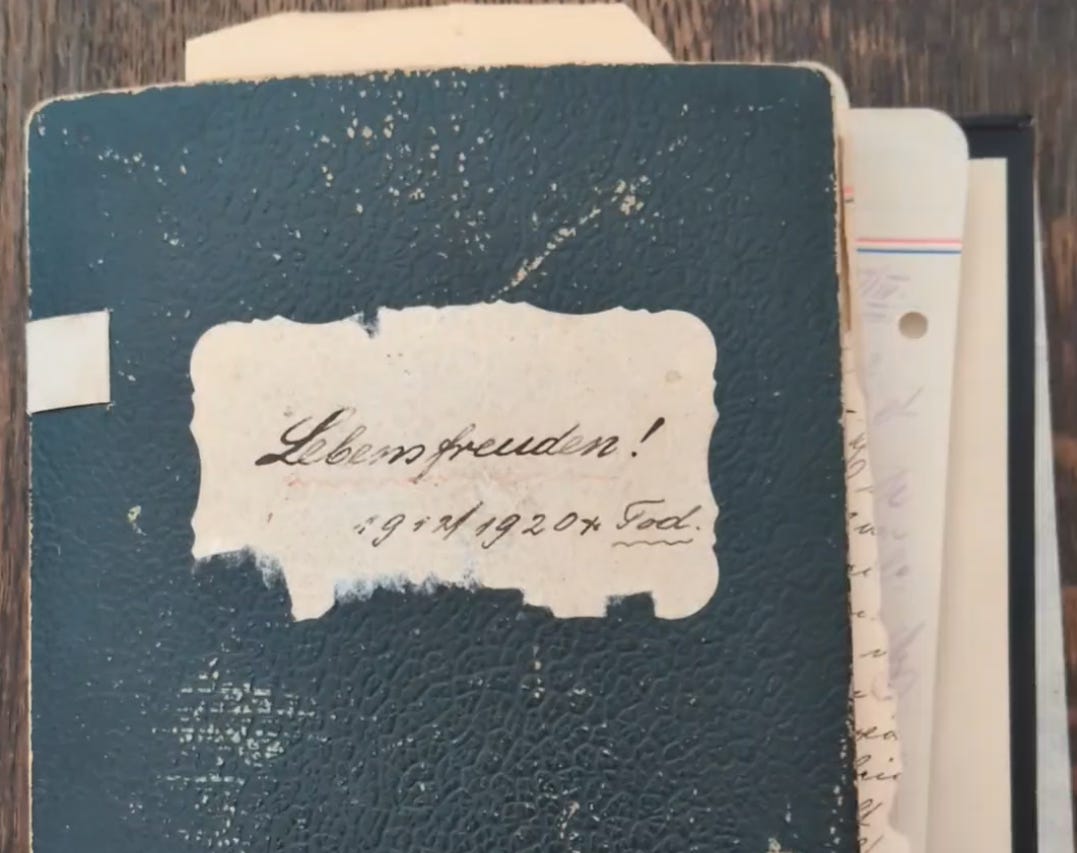
In that respect, the comparison to my “protagonist” in Weimar, Carl Weirich, which is where the podcast host was going with his question, is actually not as far-fetched as it may seem. Carl also left a detailed diary, only that he happened to live in 20th-century Germany rather than 17th-century England. Like Pepys, he often recorded seemingly unimportant things like room layouts for his refurbished flat or poems he liked.
Take his entry for August 1924, when thousands of people poured into the town of Weimar for a so-called “German Day” that sought to unite nationalist, conservative, right-wing, and far-right forces under the leadership of Erich Ludendorff, a leading military figure from the First World War.
It was an absolute spectacle full of debate, alcohol-fuelled violence and ubiquitous shouts of “Heil” everywhere. It was where Joseph Goebbels found his calling. Curious to find out more about what this felt like to the inhabitants of Weimar, I turned to this time in Carl’s diary, holding my breath as my finger traced the lines down to the right date on the page…
I learnt that Carl’s brother- and sister-in-law, Karl and Hedwig, came over that week, and the two couples went hiking. The visitors were impressed by Bratwurst, grilled Thuringian sausages, but there is no talk of Ludendorff in Carl’s notes. A different sausage barred my view into Carl’s thoughts on the 1924 elections. He didn’t even mention polling day in his diary, instead recording theatre visits, work trips and yet another Bratwurst that he was particularly impressed with.
As much as I sighed and huffed at the time, there is value even in these seemingly mundane observations. That Carl didn’t feel the 1924 elections or the “German Day” were worth recording for posterity suggests they just weren’t important events in his life at the time.
Both are interesting to us today because we have the benefit of hindsight. We know these things would become political milestones on the dark path Germany was on. But in 1924, Carl had no way of knowing that one of those right-wing splinter groups gathered in his town would one day cause it to be bombed. He also had no idea who Joseph Goebbels was. Why would he? The future Nazi propaganda minister was just a frustrated writer then.
Just like the Great Fire of London in 1666 was so big that Samuel Pepys wrote about it rather than his bowel movements, certain political, economic and social events in interwar Germany became so all-encompassing that Carl Weirich mentions them in his diary. In 1933, politics were clearly more important than in 1924. Now, Carl wrote that he was pinning all his hopes on one “young man, the Führer of the National Socialist Party A. Hitler”.
The fact that I have his own words from a century ago is nothing short of amazing to me. People often use the phrase “bringing history to life” lightly, but this reall is what diaries and letters do. I can trace my finger over lines and paper that Carl had once held in his hands. I can read his words as he had written them, and so can you now.
This is a very rare and personal type of source, only really found in diaries and letters. Of course, they come with all sorts of issues, such as questions of reliability, intention and authenticity. Historians can never take their eyes off the ball when it comes to keeping a critical distance from their sources. But diaries are still brilliant material for the kind of history I attempted in Weimar: direct, human, street-level.
Which begs the question where that leaves us today. Diary and letter writing in their classic, pen-to-paper form have declined significantly. But on the other hand, digital forms of personal records have soared. People keep blogs online, and they document everything from holidays and major life achievements to what they had for lunch on social media. We send text messages, emails, voicemails and digital birthday cards. We also take far more photographs than we used to. But most of those traces of human communication and lives are stored on our phones, computers, and external servers.
I’m often asked how historians in 200 or 500 years will research the lives we live today. The honest answer is that I have no idea. My instinct is that those future researchers will either have a lot of information or very little – depending on whether all the digital traces we leave are safely stored and accessible or not.
I must admit that – despite knowing better – I’m very bad at recording my own life. I throw out most cards and letters I receive. I travel lightly and rarely bring anything back from trips that isn’t edible or drinkable. So my plea to the wider public would be: don't be like me. Write letters. Keep diaries. Preserve clippings of newspaper items that feel important to you.
You never know when a curious future historian might come along and pore through the remnants of your earthly existence, excited to be able to restore a fraction of the life you once lived.
It's true that receiving a handwritten letter nowadays is in itself a historic event.
The best diaries are those whose authors who were writing solely to their inner self, rather than with one eye turned to posterity or publication. That's why Tony Benn and Alan Clarke's diaries are so compelling, whilst those of most other politicians are considerably less readable. Of course Pepys was the OG (as the kids say) "warts and all" narrator, although I've only ever read collections of extracts from them. I pity future historians having to wade through "The collected emails of Kier Starmer".