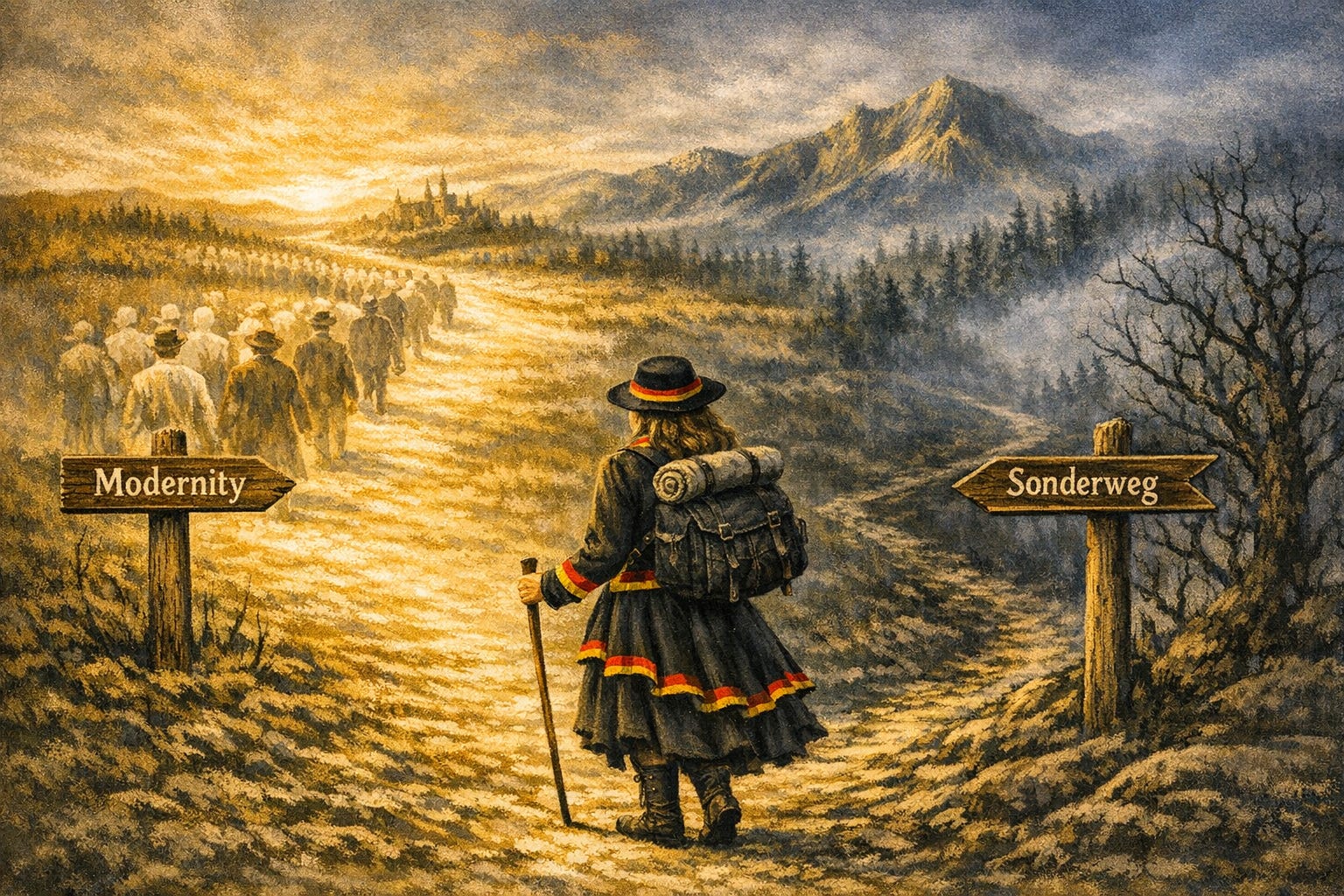
Sonderweg: How Strange is German History Really?
Or: What is "normal" history anyway?
When I was growing up in Germany, history was all around me, but it never felt particularly special. As children, we were taught that the woods were still full of World War II ordnance and what to do if we found any. That seemed perfectly normal. Indeed, two of my dad’s friends worked as bomb-removal specialists at building sites in the 1990s.
It was also normal that there were warnings about wild mushrooms being radioactively contaminated in eastern Germany since the Chernobyl disaster of 1986. It was normal to have hazy childhood memories of a big wall near my uncle’s flat in Berlin that prevented us from walking down certain streets.
It was normal to be chucked out of the classroom for asking your teacher whether she had taught things differently in the socialist GDR, or to have three out of four grandparents who came from places that were German when they were born there but weren’t now.
These things didn’t even seem to be history as such. They felt recent and immediate. After all, there were still plenty of people around who talked about the Second World War as though it had only ended yesterday. And German division and reunification...well, that had only been yesterday.
“Real” history, I thought as a kid, was on display when we visited Frederick the Great’s palaces in Potsdam or the Wartburg castle where Martin Luther translated the New Testament into German or the Teutoburg Forest where the Germanic chieftain Arminius is supposed to have beaten the Romans. But that history, too, never felt strange. I knew other countries had their own stories of kings and castles. What they did have, I realised later, was Nazis and Hitler and Auschwitz.
My first serious debate about whether German history was special took place at university. The inevitable question every student of this field must ask themselves sooner or later is what they make of the Sonderweg theory.
This posits that Germany followed a unique historical path when compared to other European nations. Usually, France and Britain are used for comparison to argue that other countries in the West had walked a less violent and destructive path from all-powerful monarchy to democracy, while Germany went from fractured patchwork to ultra-nationalist dictatorship before ending up with a liberal republic.
As many others have pointed out, there are plenty of problems with this theory. For one thing, it presupposes the existence of a “normal” path to modernity that Germany deviated from. Yet the French Revolution (which I learnt about in school as often as about the Nazis) was no more “normal” than the execution of England’s Charles I or the American Civil War. Of course, German history is like no other national story on earth, but British, French, American or Russian history is just as unique. There is no set path from the prehistoric age to the present that Germany could have deviated from.
And yet, there is no getting away from how fractured German history is — and how extreme. Germany is one of the youngest European nation-states, only formed in 1871, a little over a century and a half ago. Yet since then, it’s been a monarchy and several republics. It’s seen fascism and socialism, democracy and dictatorship. It played a major role in causing two World Wars. It was divided and reunited. It’s seen millions of its people killed and uprooted, its borders expand and contract. It planned and executed a Europe-wide genocide.
Out of this came a nation wary of itself and of the very concept of continuity. By contrast, most British, French and American people seem perfectly happy using the collective “we” when referring to events that lie centuries in the past. There are books with titles like “1000 Years of Annoying the French” by Stephen Clarke, who tries to get to the bottom of the “love-hate relationship between the French and the Brits”, banking on the fact that everyone agrees that those two groups have existed continuously for a millennium. Clarke insists that “we can’t ignore our pasts”.
The German collective “we” tends to only start in 1949 with the foundation of West Germany, a narrative that is causing its own problems today because it tacitly excludes East Germans, only allowing them into the story from 1989 onwards when the Berlin Wall fell.
But the widespread unease regarding a continuous German identity is broader than that. I remember our history teacher getting agitated when one of my classmates used “we” to describe something Germans had done in the past, as in “when we lost the war”. If you did that in an essay, you’d get a red squiggly line underneath and a sarcastic comment like “you weren’t there” written in the margins. German history itself may not have followed a Sonderweg, but perhaps its memory culture has?
In any event, I think we can all agree here that German history is both strange and fascinating. I presume you wouldn’t be reading ZEITGEIST if you didn’t feel the same way.
I certainly think there is a lot to talk about. So much so, that I decided to launch a brand new podcast dedicated to German history, and this is my way of letting you know that it exists. I have teamed up with Christopher Dillon, who is a Senior Lecturer in Modern German History at King’s College London, and will bring all his academic research and teaching expertise to the mix to add to my musings.
Uniquely, all incarnations of Germany as a political entity have been either a reich or a republic and so that’s what our podcast is called: Reichs and Republics. The pilot episode is out now on all platforms, including Spotify, Apple, and YouTube. Future instalments will be released every Tuesday, so hit the subscribe button to receive them weekly. It’s completely free, and you can choose whether to watch or just listen.
I shall leave you with a short teaser (sound on!) and hope you’ll forgive me another shameless act of self-promotion 🙂
Links for Reichs and Republics


First of all I very much enjoyed the pod and I am looking forward to further episodes. I knew about the expression sonderweg but didn’t really understand it, so thank you for clarifying that. As a Brit my understanding of German history was fairly superficial and almost entirely understood in relation to conflict with the United Kingdom. Clearly that is no longer the case. I think German history’s biggest problem is whataboutery and the giant black hole of the SWW and its attendant horrors. For example as you have said the instant you try to discuss the quotidian life of ordinary East Germans someone will always mention the Stasi. Lately I have been reading about the displacement of millions of Germans from their homes and ancestral lands. Try discussing that in a rational manner. Good read on a Sunday morning Katja.
I listened to the pilot episode this week, it took my mind of the monotony of pizza leaflets and brown envelopes, so bravo that's my Tuesday sorted .