

I know many people find cooking relaxing. I don’t. I experience it as a sequence of boring tasks interrupted by intensely stressful intervals where timing is everything. So I distract myself, often by listening to programmes about German current affairs. That may not be everyone’s go-to option for relaxation, but I find it intellectually engaging enough to take my mind off chopping root vegetables. The only problem is that I have begun to associate the smell of frying onions with bad economic news.
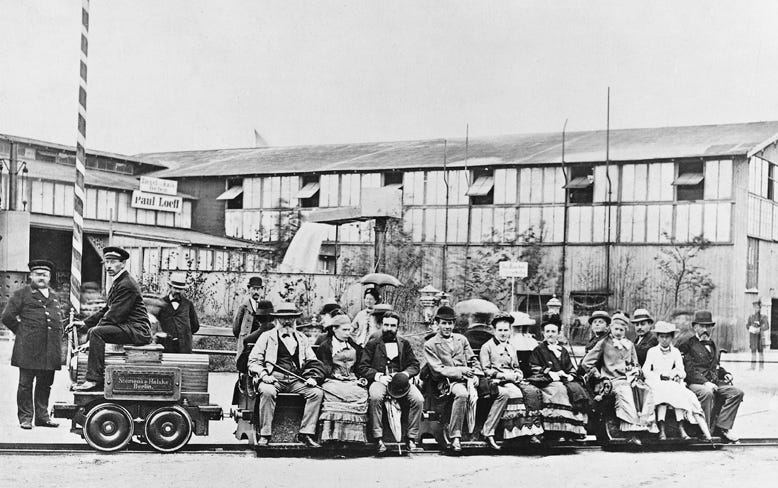
Anyway… This week, the onions were accompanied by a curious statistic: around half of the companies in the Dax, Germany’s leading stock market index, go back to the 19th century. We’re talking German giants like Siemens, Bayer and BASF, whose names evoke Germany’s economic success story. They speak of industry, engineering, machinery and chemicals. I’d heard the statistic before, but now it’s no longer used to point to things Germany is good at, but to argue that the country’s economic model is outdated.
Indeed, when commentators debate the weaknesses of the modern German economy, they often turn to the 1870s and 1880s. The argument usually runs that today’s model was forged in the age of coal and steel, under Otto von Bismarck and the early German Empire. It therefore belongs to another era. Heavy industry, big factories, protective tariffs and social insurance seem like relics of a world of steam, mines and spiked helmets. How could an economy forged in the 19th century still be relevant in the 21st? What could an economy designed for blast furnaces possibly teach a digital society? Quite a lot, I would say… and not just because I spend a lot of mental time in the 19th century.