The AfD on the Threshold of Power
Explainer: Why all eyes are on Saxony-Anhalt
In the middle of Germany lies a state that many people outside the country have never heard of: Saxony-Anhalt. Picture a conservative and underappreciated region marked by industrial decline and rural traditionalism. There is rich regional history here. Notable figures such as Martin Luther, Otto von Bismarck and Friedrich Nietzsche were born within its territory.
In its present form, the state has existed since German reunification in 1990. It may not evoke strong associations like Bavaria, and it doesn’t often make international headlines. Yet at the moment journalists from all over the world are descending on Saxony-Anhalt. They feel history could be made here, in this sparsely populated place of just 2.2 million souls. When people go to the polls on 6 September to elect a new state parliament, the outcome could reverberate far beyond Germany’s borders.
If polling holds, the Alternative für Deutschland (AfD) will comfortably win the Saxony-Anhalt election with around 40% of the vote. Domestic intelligence has classified the state branch of the party as “right-wing extremist”, yet this hasn’t put off voters. In fact, the current polling trajectory puts it within reach of winning an absolute majority of seats in the state parliament, which would allow the AfD to govern Saxony-Anhalt alone without coalition partners and elect the Minister President, Germany’s equivalent of a governor.
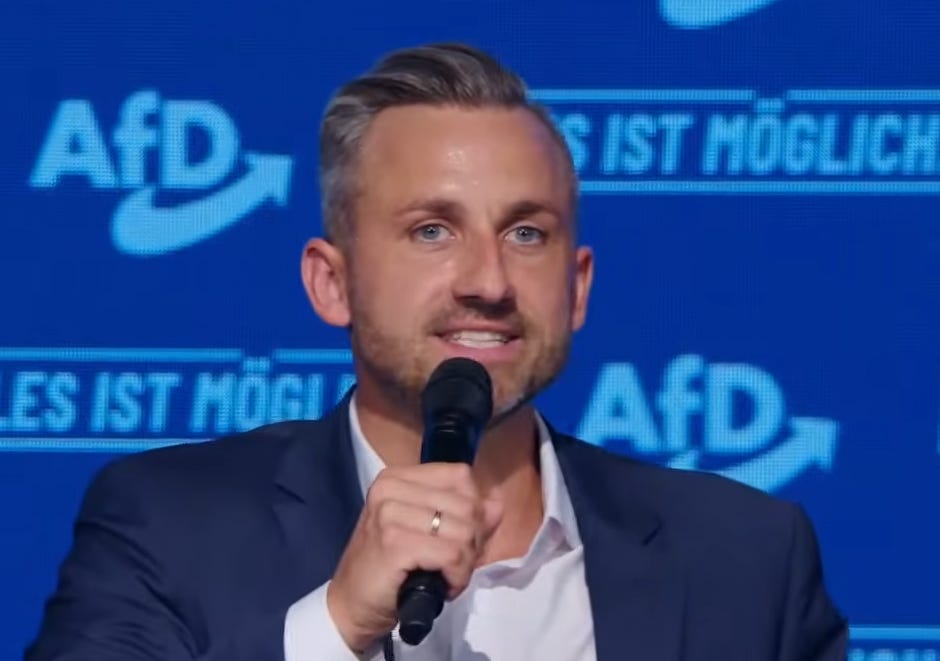
Saxony-Anhalt could thus become the first place in Germany run by a far-right party since the end of the Second World War. The AfD itself is very conscious of this as a historical moment. Its leader in Saxony-Anhalt, Ulrich Siegmund, a charismatic and well-groomed young man who appears to be smiling non-stop on the campaign trail, says he intends to “write history”. He emphasises at every opportunity that his manifesto for Saxony-Anhalt, confidently entitled “Governing Programme” in anticipation of victory, is intended for the “first”, rather than the only AfD-led government in Germany.
So what would an AfD-led government in Saxony-Anhalt actually do? Much like the US, Germany has a federal system. Power is divided between the national government and sixteen state governments. While Berlin handles matters such as foreign policy and defence, the German states have substantial responsibility for areas such as education, policing and culture. And that’s where the AfD manifesto in Saxony-Anhalt is notably different in tone and content from the other parties.

In the section on schooling, for instance, the programme bemoans that for students “having the correct opinion is now valued above real knowledge.” It argues for a return to “traditional education” in the form of “homework, teacher-led instruction, regular in-class exercises, systematic review and assessment, extensive reading.” The AfD further argues that disabled children and children who came to Germany as asylum seekers should be taught in separate classes or schools, away from German children with no disabilities.
The programme also wants to ban the rainbow flag of the LGBTQ movement from schools and “children be taught as a role model the normal family consisting of a man and a woman, from which children are born.” This is something it also picks up in its explicitly pro-natal family policy, which names as one of the reasons for declining birth rates the claim that “sexual deviations and non-reproductive lifestyles now enjoy greater acceptance and are promoted more aggressively than the normal family”.
On culture what the AfD is proposing in Saxony-Anhalt is a radical break with Germany’s memory politics or Erinnerungskultur. The post-war approach in both East and West Germany had put education about the Nazi era front and centre under the slogan “never again”. When I grew up in Germany in the 1990s, we learnt three times about Hitler’s rise and reign in school, which meant we ran out of time to deal with anything post-1945.
The AfD says it wants to change this, shifting the emphasis to the 19th century, when Germany first became a nation-state, as an era that “can still be a source of inspiration and a role model for us today.” This would involve “rewriting the history curriculum”, “honouring the sacrifice of soldiers” in historical conflicts such as both World Wars, defunding “anti-German art and culture” and changing the state motto of Saxony-Anhalt from its current slogan “Think Modern” to “Think German.”
On immigration, the AfD’s core issue, the party has limited room to manoeuvre at the state level, since this area is largely the federal government’s prerogative. But it says it would use Saxony-Anhalt’s four of 69 votes in Germany’s upper house, the Bundesrat, to lobby for radical change at the national level as well as enacting state-level measures like refusing to take an allocated share of asylum seekers if they have entered Germany through a safe state, which they almost always do.
There is also a notable and frequent use of the term “remigration” to describe the party’s aim to reverse the mass migration Germany has seen over the last decade or so. Because the term in its current political sense was coined by far-right circles, the federal AfD leadership tried to distance itself from it for a while before readopting it last year. There’s no sense of hesitation about it in the Saxony-Anhalt manifesto, which demands a “180-degree turn on migration”.
Everything in the AfD plans for Saxony-Anhalt reads like an ambition for all of Germany, and we should take that ambition very seriously. For years, this wasn’t done because the idea of an AfD government seemed unlikely. Not least due to its Nazi past, Germany has a cross-party consensus to uphold a firewall or Brandmauer against any parties to the right of the conservative Christian Democrats (CDU/CSU). This means no party would form a coalition with the AfD, which is almost always necessary to rule in Germany’s electoral system. Even when the AfD came first in the 2024 elections in Thuringia, a state neighbouring Saxony-Anhalt, the centre-right CDU, which came second, chose to form an unpopular minority government with parties to its left, sending the AfD into opposition despite being the largest party.
So what’s different in Saxony-Anhalt? For one thing, the AfD is very close to an absolute majority here. Where in Thuringia it won with 33% in 2024, the latest polls for Saxony-Anhalt give it 42% – a result that would double the party’s vote share compared to the last election in 2021. Of course, this is nowhere near 50%, but the party might still get more than half the seats. Germany has a 5% hurdle for all parties to enter parliament – once introduced as a measure to keep extremists out. Currently, three parties, among them the Greens, hover around the 5% mark. If they don’t make it over the line, they lose their allocation altogether, and the seats get distributed among the parties that make it in. This could give the AfD more than its proportional share in parliament.
According to one recent poll, the AfD could end up just two seats short of a majority. Those could be supplied by rogue conservatives from the CDU. Officially, this isn’t on the cards because of the firewall, but ultimately there would be little to stop individual parliamentarians from voting with the AfD or even changing parties once elected. The nervousness in the CDU about this is palpable. One of its most senior figures, Thorsten Frei, the head of the Federal Chancellery, threatened last week that he would “intervene” should the Saxony-Anhalt chapter of his party begin talks with the AfD. He seems to feel that he has cause to make this point. Another possibility is that the left-wing-conservative BSW, a relatively new party, currently polling at 4-5% in Saxony-Anhalt, makes it over the hurdle. They indicated that they’d be willing to work with the AfD.
Despite there being many viable routes for the AfD to come into power for the first time in a German state government, parts of the German media still treat the erosion of the old political landscape as a regional – and therefore containable – development. In this line of thinking, Saxony-Anhalt is an anomaly rather than worth watching as an indicator of things to come beyond the state’s borders. One aspect that underpins this argument is that Saxony-Anhalt, like Thuringia, is in the former East Germany. The AfD have long polled more strongly here than in the former West Germany. So some commentators have put this down to the idea that East Germans feel uniquely “estranged from democracy” due to having lived in a socialist dictatorship for four decades after the Second World War.
Such explanations of the Saxony-Anhalt election as a regional issue are not only dismissive of swaths of voters but also misleading. For one, the AfD now also leads in the national polls. At around 28%, it may be much further away from an outright majority in future federal elections at the moment, but it’s worth remembering that those are figures that would have been unthinkable just a few years ago. In 2021, when the AfD reached just 10 per cent in the federal German elections, commentators looked aghast at Saxony-Anhalt, where it was polling at 26 per cent. Senior CDU politicians then declared it a scandal but a localised one, arguing East Germans “have never arrived in our democracy”.
It’s time to stop explaining away the rise of the AfD and take the party and its ambitions to dramatically change Germany seriously. In Ulrich Siegmund, they have found not just a popular local leader but also a credible and likeable figure for their national campaign. The party has not just been working on radical programmes but also on their professionalisation and delivery by opening training programmes for civil servants and administrators. The ambition is not to create regional strongholds in the East or anywhere else but to change Germany itself. Wherever he goes, Siegmund tells his audiences “we’ll claim our state back” – an ambiguous phrase that applies to both Saxony-Anhalt and Germany.
The Saxony-Anhalt election is one to watch – not as a regional anomaly, but as a landmark indicator of a trend affecting all of Germany and much of the West.
*
An edited version of this article first appeared in Persuasion.


