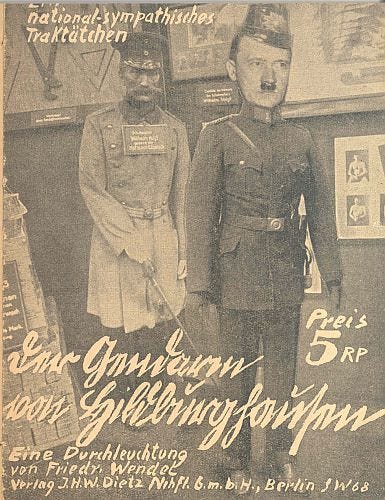
The Gendarme of Hildburghausen
Or: How Hitler became German

There is an old and terrible joke that Austria’s greatest achievement was convincing the world that Adolf Hitler was German and Ludwig van Beethoven was Austrian. It sprang to mind earlier this week when I was on the train to London, contemplating Austrian angles of my new book. I’d been invited to the Austrian Embassy for coffee, cake and a chat about Weimar, and wanted to offer at least a few overlapping touch points.
There are actually quite a few, which shouldn’t be surprising. It seems obvious today that Germany and Austria are two separate countries. But the question of whether the German-speaking lands should be unified into a Großdeutschland (Greater Germany), including Austria, or into a Kleindeutschland (Lesser Germany) without Austria, was wide open in the 19th century and was raised again after the First World War. Later, Adolf Hitler decided to annex Austria in the Anschluss of 1938, before the countries went their separate ways again after the Second World War.
Given all this overlap, there are Austrian stories in Weimar, too. Most are harrowing and tragic. Take that of the popular Austrian librettist and writer Fritz Löhner-Beda. He was arrested shortly after the Anschluss, and by September 1938, he was incarcerated at the Buchenwald concentration camp on the slopes of the Ettersberg hill above Weimar. Whether out of sheer cynical malice or by coincidence, the famous theatre in the town centre – the one where the Weimar Republic had been founded – played the romantic operetta The Land of Smiles while Löhner-Beda, the librettist of the piece, was a prisoner just a few miles away.
Together with fellow prisoner and Jewish-Austrian Hermann Leopoldi, Löhner-Beda penned the “Buchenwald Song”. Commissioned by SS officer Arthur Rödl, it was sung at roll calls and when marching to and from work. Its moving lyrics are still sung at commemoration ceremonies today, but Löhner-Beda himself never knew how long this legacy would last. He was beaten to death at Auschwitz III Monowitz in 1942 for being too ill to work.

Another Austrian story in Weimar is that of Hitler. Hitler saw himself as a German, but he had been born in Austria. Living there as a young man, he bitterly complained to friends how all Austria ever knew was to “suppress talent out of competition, envy and bureaucracy”. He planned to emigrate to Munich, that “most German of German cities”. Hitler served in the Bavarian army and was wounded in the First World War, which he felt made him deserving of German citizenship.

Instead, he managed to make himself stateless. The Bavarian authorities tried to deport him to Austria after his failed coup in 1923. His home country refused to take him back on the grounds that Hitler clearly considered himself German. He retorted in a public statement that “The loss of my Austrian citizenship is not painful to me, as I never felt as an Austrian citizen but always as a German only.” In 1925, he applied to be released from Austrian citizenship, which was duly granted. Hitler was now officially stateless.
In and of itself, that didn’t bother him so much, but he’d decided while in prison that he would try to get elected into power rather than attempt another violent revolution and in order to get elected, he might need to be a citizen. The easiest route appeared to be through becoming a civil servant, who were all citizens by legal default. Hitler’s men were falling over themselves to try to achieve this for their Führer, but few were in a position to get a convicted traitor a job in the public sector. This is where Weimar comes into the picture.
The first Nazi minister in Germany, Wilhelm Frick, had his seat of office in Weimar. From January 1930 – three years before Hitler became Chancellor of Germany – Frick was a minister in the state of Thuringia, of which Weimar was the capital. He had the power to appoint civil servants, being in charge of Thuringian culture and education. In this capacity, he tried to give Hitler a position at the local art academy, the successor of the famous Bauhaus in Weimar.

Unsurprisingly, there was resistance against appointing to an academic post someone who’d dropped out of school without any form of higher qualification, and the attempt failed. The Thuringian cabinet declared that it had no intention of “enabling Adolf Hitler to acquire Thuringian citizenship by employing him as a Thuringian civil servant in name only”. Hermann Brill, a prominent local Social Democrat and a vocal opponent of Frick’s regime, later mused, full of bitter irony: “The world might have been spared a lot if Hitler had been able to follow his artistic inclinations at the Weimar School of Art to design wallpaper patterns or porcelain vases.”
Undeterred, Frick tried again. In July 1930, he appointed Hitler as gendarmerie commissioner in the southern Thuringian town of Hildburghausen. Hitler reluctantly accepted the commission but later tore the document to shreds when he realised this wouldn’t work – it was an ignominious way to become a German citizen through the back door. It would only make him vulnerable to press scrutiny and ridicule later.
That’s exactly what happened in 1932, when Hitler wanted to become the German President but was still stateless and therefore ineligible to be elected. The press had dug around in his background and found out about the Hildburghausen shambles. It became a public scandal. Hitler’s propaganda man, Joseph Goebbels, wrote in his diary: “hacks have found out that Frick suggested in the year of 1930 to appoint the Führer to a minor post in Hildburghausen in order to get him citizenship. A feast for those distorters... This question is yet to be solved and quickly. After all, the Führer must be a citizen to be a candidate.”
In the end, the problem was solved not in Thuringia but in the Free State of Brunswick, where Nazis were part of the government. They appointed Hitler as a Brunswick legate to the Upper House in Berlin. This made him a citizen of Brunswick and Germany as of 1 March 1932 – just in time to stand for and lose the presidential election against the incumbent Paul von Hindenburg.
But the story wasn’t over yet. The Communist Party launched a public inquiry into the Hildburghausen Affair in the Thuringian Parliament, and both Hitler and Frick were summoned to Weimar to appear before a parliamentary committee headed by the aforementioned Hermann Brill. Hitler duly appeared, and Brill gave him a thorough grilling, one so humiliating for the future Reich Chancellor that he lost his cool.
Goebbels, who watched the whole session noted that the “‘Führer is excessively provoked by the red deputies and throws his retort back in their faces in a fit of rage.” Others saw it too. “Herr Hitler was exceptionally nervous,” one liberal journalist reported. “Soon the great tribune of the people fell into rolling pathos and bloated phrases and always in moments when it was the most embarrassing to him.” Frick and Hitler “appeared as they were, small and ugly”.
The whole episode didn’t have the impact the communists and social democrats hoped for. They’d hoped that by exposing the shenanigans it had taken to make Hitler German, they might sway the public’s view of him, but it didn’t work. The moment Hitler stepped out of the inquiry room, he knew that himself. Jubilant crowds awaited him. “In Weimar itself the mood is brilliant,” wrote Goebbels. “The party has already partially overcome its first momentary depression. Fight! Attack! Fanfare!”
Many Weimarers didn’t seem to care that Hitler had just been exposed and humiliated like a “prima donna without make-up”, as one social democratic newspaper put it. His voters simply weren’t interested in the skeletons in Hitler’s closet.
Hitler himself, however, still harboured deep resentments over the humiliation he felt he had been subjected to. His relationship to Austria remained darkly complex. It was, after all, where the unsuccessful, unhappy and confused years of his early life had taken place. Many historians of Germany, including grandees of the field like Ian Kershaw, have argued that the annexation of his birthland in 1938 was more than a political project for Hitler. It was an emotional moment of vindication and triumph, celebrated in a very different way compared to other territorial gains.
After the war, Austria would use this and other arguments to claim that it had been the “first victim” of Nazi Germany’s aggressive expansion. A political path opened for an independent and neutral post-war Austria, putting clear blue water between its own national identity and that of its German neighbour(s).
Don’t worry, I didn’t bring much of this up at the Austrian Embassy this week. Rather, we discussed the book, history and politics in more general terms. I always enjoy talking to Austrians about Germany. I usually find them very well-informed, but bringing a completely different perspective to the table. As a rule of thumb, they know Germany’s past and present better than the other way around, but look at it from the outside. The result is usually refreshing and insightful.
I was therefore pleased to see that the Austrian interest in Weimar went beyond the Embassy in London. It has been well reviewed in Austria itself so far, and I will return there in September to speak about Weimar in Vienna. I have no doubt that this will prove to be another stimulating exchange between German speakers from two separate countries that share a great deal of history.