

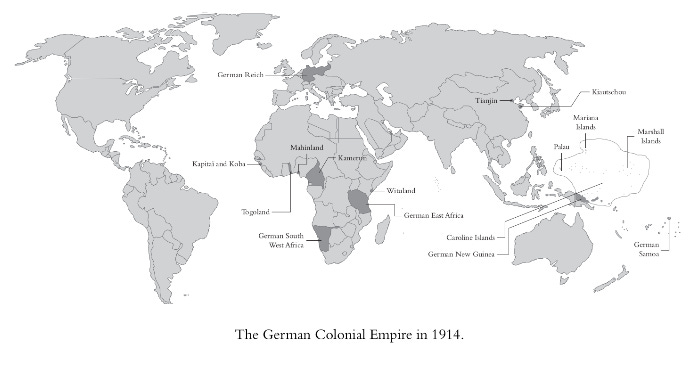
When people think of German history, the German colonial empire is not typically the first thing that springs to mind. I think that applies to most Germans, too. When I think back to my own school days, I can’t remember having been taught much about it. We learnt about the British, Spanish, French, Portuguese and Dutch empires in passing. I also remember reading Joseph Conrad’s Heart of Darkness and finding it an intense and harrowing introduction to the idea of Belgian colonialism. But I very rarely came across mentions of German colonialism, fictionalised or otherwise. That’s despite the fact that, at its largest extent, Germany had built the third-largest colonial empire in the world after Britain's and France's.
Awareness of this history has changed massively in recent years and decades – or at least it has in academia. There’s been a flurry of research activity, especially looking into the structures and experiences of the German colonisers and the people they colonised. This is a very sensitive field charged with present-day debates over what we should remember and how.
To name but one example: fierce arguments have broken out over how to describe the genocidal policies enacted against the Herero and Nama people in German South West Africa between 1904 and 1908, in which around 80% and 50% respectively of their pre-war populations died. Germany recognised this as genocide in 2015 and agreed to pay reparations. Some historians have compared the racialised violence and genocidal intentions to the Holocaust, while others have pushed back hard against drawing a direct line between the two historical events.
I found myself deeply immersed in this history and the attendant debates while discussing with my podcasting partner, Chris Dillon, how to approach this subject in a future episode of Reichs and Republics. The complexity of the matter, the vast amount of fresh research and the sensitive nature of this field of scholarship make this an incredibly challenging topic to address in a compact and accessible format. There are just so many angles to it as well, and all are morally and historically complex.
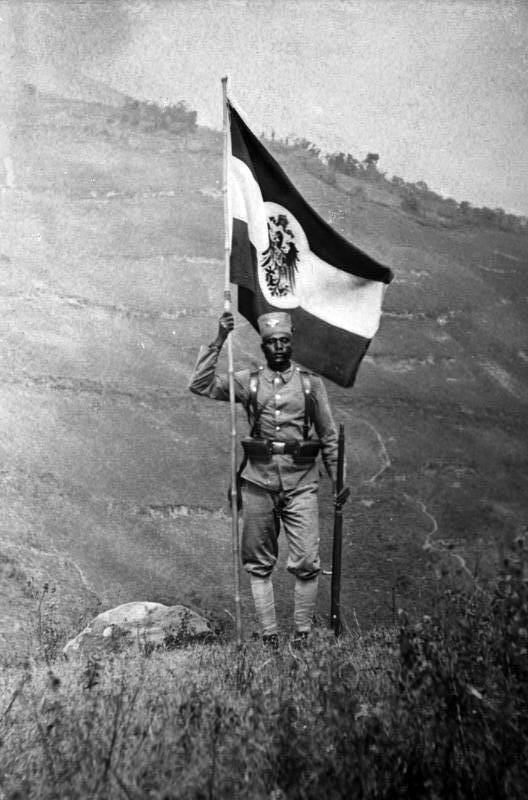
Take the Askaris. These were African soldiers who served in Germany’s colonial army, mainly in German East Africa, before and during the First World War. Their story exemplifies the sheer length of the German colonial empire's afterlife. So let’s look at it back to front.
In 1964, half a century after the start of the First World War, a small group of elderly men, all former Askaris, gathered in Dar es Salaam, Tanzania. They wore simple clothes. Some were leaning on sticks. They wanted due recognition and their pensions. They had come to prove they had once been soldiers of the German Empire.
This proved tricky. There were few uniforms left, even less official documentation of any kind. That was lost a long time ago, nearly five decades earlier, when Germany lost its colonies. There was only one way for the men to prove that they had once been Askaris, and that was to act in a way that only they could. So the men were asked to perform drill commands. This involved marching, presenting arms and responding to orders barked in German. They could all still do it. And that was enough to prove they had once fought for Germany.
The story of the Askaris is intricately interwoven with Germany’s colonial ambitions.