

Germany’s long history of a fractured political landscape is still very visible in current affairs. One day, you’ll have the Bavarian Minister President Markus Söder complaining about how Berlin is wasting Bavarian money. On another occasion, you see a Hamburg politician frowning at election results in the southern state of Baden-Württemberg because they seemed to him to be “from another planet.”
Yet in the face of external threats, like the war in Iran, which is having a huge impact on the cost of living in Germany, you hear politicians appeal to some sort of national solidarity, condemning companies exploiting the situation as “unpatriotic”. The German pendulum continues to swing between regional diversity and national unity.
I think today, most Germans are okay with that tension. Being a decentralised nation-state has become part of the post-war identity. That’s also how Otto von Bismarck had set up the first incarnation of the modern German state in 1871. But in his day, people were much more nervous about the fragility of German unity than they are today. So the German Empire busied itself in building monuments to ancient legends that were supposed to give meaning and collective memory to the newly formed Germany.
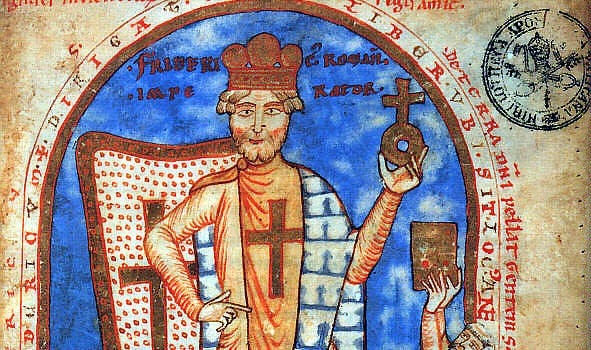
Nowhere is this more visible than in the Kyffhäuser Monument in the mountains of Thuringia in central Germany. Erected between 1890 and 1896, shortly after the death of the first German Kaiser Wilhelm I, it aimed to declare him the reincarnation of the medieval king Frederick Barbarossa, whose powerful legend had long been a feature in central European political myth-making.
A kind of German King Arthur, Barbarossa was said to be asleep under the Kyffhäuser mountains in Thuringia. His red beard was said to be growing longer and longer as it wrapped its way around a stone table while he sat there dormant, destined to wake up one day and restore Germany to its greatness.
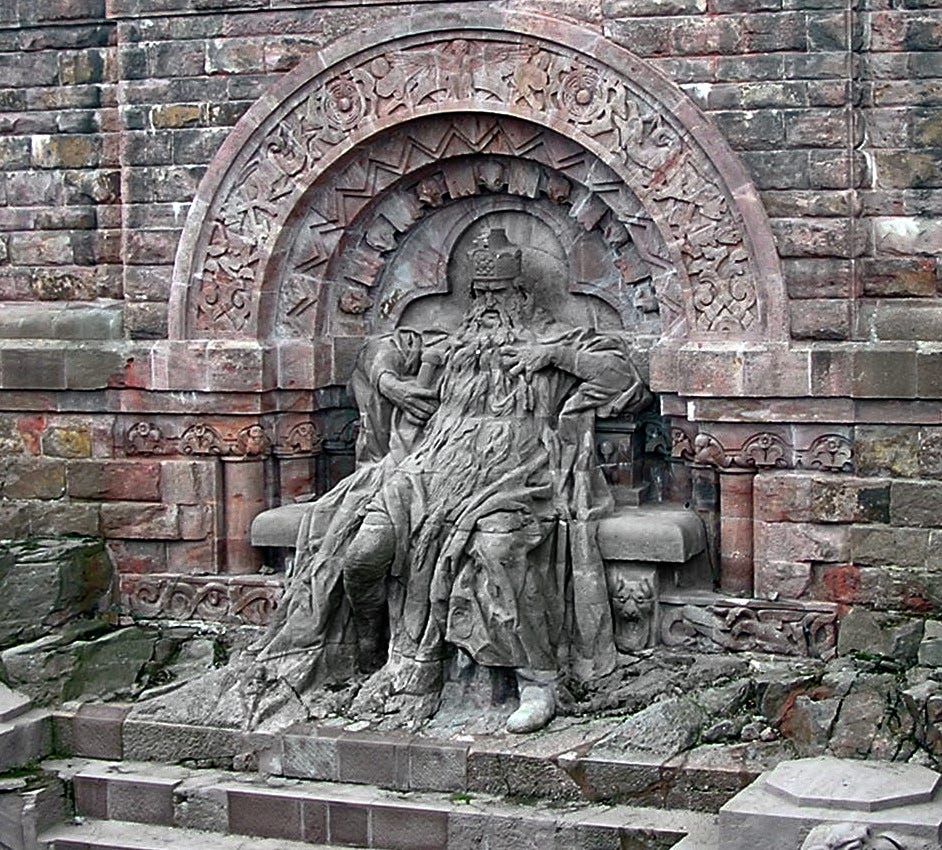
The vast monument there depicts this story, showing the medieval emperor in an enchanted sleep while an equestrian statue of Wilhelm I towers above him, adorned with a Pickelhaube and an Iron Cross. Both sit among the ruins of Kyffhausen Castle, which is associated with Frederick Barbarossa, as it reached its most impressive phase during his reign.
The divergence between the real Barbarossa and his legend reveals a lot about German history, so I think it’s worth going into this a bit: Who was Barbarossa, and why were 19th and 20th-century Germans so taken with him?