The Second Life of Nazi Buildings
A Visit to Berlin's Olympic Stadium
I’m sitting at the airport as I type this, bright red in the face with an actual, real-life sunburn. Yes, in early March. No, unfortunately not from a spontaneous holiday somewhere hot and lovely. I was out and about in Berlin all day, filming for a Channel 4 documentary on the 1936 Summer Olympics held in Nazi Germany.
With my last ZEITGEIST piece about East Germany’s vanished Palace of the Republic still fresh on my mind, I was struck by how many of the structures the Nazis built for the Olympics not only survived the Second World War but also demolition afterwards.
German memory politics are complex anyway, but they walk a particular tightrope when confronted with buildings that are intrinsically and irrevocably loaded with Nazi symbolism and propagandistic purpose. Nowhere is this tension more visible than in the Olympic Stadium, where we filmed in the morning.
I had a clear blue Berlin sky above me as I left the S-Bahn station and approached the vast sweep of the Olympiastadion. In my head, a sense of awe at the monumental nature of the site began to push its way through the mess of thoughts crowding around the questions I’d have to answer on camera in a minute.
There’s something very captivating about the symmetry of the structure. The bright spring sun sharpened every line of the stone façade. Historian or not, it’s impossible to arrive here without sensing that this arena was built to impress.
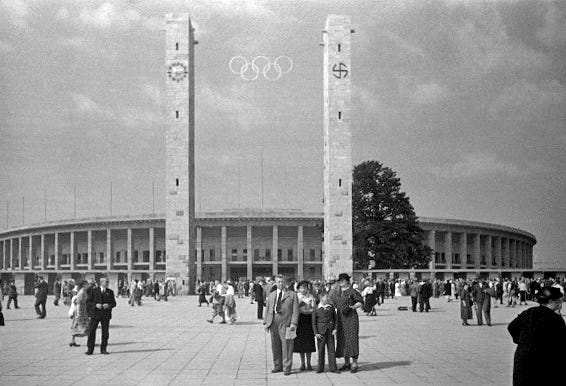
The stadium was conceived specifically for the 1936 Summer Olympics, the Games that the Nazi regime used as a showcase for its vision of power and order. The architect Werner March designed a structure that feels both stripped-down and monumental: colonnades, symmetrical axes and muscular forms that project endurance and discipline. Today, the swastikas and other overt insignia of the regime have gone, but the aesthetic language of the 1930s remains
I stopped in front of the entrance, taking a moment to let the sight sink in. High above me, the Olympic Rings hung suspended between two towers, just like they are in black-and-white pictures from 1936. But there was one difference. Where there had once been symmetry, with a clock on the left-hand tower and a swastika on the right-hand one, there was now only the clock.
I was soon torn out of my musings when a voice told me in a broad Berlin accent: “You can’t just walk in here.” I looked down and found it had come from a woman in a small guardhouse. “You need special permission or book a tour,” she elaborated. I told her that I was here to take part in a documentary and pointed to the cameraman, whom I could see flying a drone inside to capture aerial footage. “You can’t just enter,” insisted the woman. “I’m responsible for who goes in and out.” Before I could say anything more, another member of the film crew spotted me and confirmed that I was who I said I was. Permission duly granted, we walked out of the sunshine and into the vast, empty stadium.
Inside, the first thing that struck me was how carefully the modern has been threaded into the old. The sweeping roof, added in the early 2000s renovation ahead of the 2006 FIFA World Cup, hovers lightly over the seating bowl, its translucent panels forming a contemporary halo above the heavy masonry. I folded down a plastic chair with the number 3 on it and sat down to be briefed for my interview.
The seating is itself new, individual blue chairs replacing the old terraces, offering comfort and clear sightlines. There are updated VIP lounges, media facilities and hospitality areas. The press boxes gleam with glass and technology. There is under-soil heating beneath the pitch, modern floodlighting, high-definition video screens, improved accessibility with ramps and elevators and upgraded, discreetly hidden security systems.
In other ways, too, the stadium feels thoroughly modern. The filming for my documentary segment was interrupted several times when groups of tourists shuffled in, clustering around guides who told stories of fascism and football. School classes trailed behind teachers with clipboards, their chatter echoing off the wide esplanade. And yet, the stadium does not feel new or even remade but preserved.
The original Marathon Gate, with its Olympic cauldron still framing one end, opens toward the vast Mayfield and the distant, reconstructed bell tower. The proportions remain monumental and austere, even though the capacity today is 75,000 rather than the original 100,000. The stone blocks bear the faint weathering of 90 years, yet have also been so well preserved, cleaned and restored that they look pristine and new in most places.
The statues that flank the approaches, depicting powerful athletes in heroic poses, still stand as embodiments of a classical ideal that the Nazi regime appropriated for its own purposes. They stand there as they always have done, contextualised by plaques and tours that explain rather than erase their origins.
In the stands, I was telling the camera how the stadium was once a theatre of masterful propaganda. The opening ceremony was especially impressive. When Adolf Hitler entered the stadium, he was greeted by jubilant crowds. The Hindenburg airship floated above. The Olympic torch was carried to its final destination, igniting the flame in the stadium (itself a ritual invented for these games and continued afterwards). The best sportsmen and women from all over the world marched in with their flags, and thousands of doves were released into the sky. It was a spectacle that nobody in the audience that day was likely to forget.
When the batteries of my microphone needed changing, I looked out over an immaculate pitch, home today to the Hertha BSC football club and host to international matches and concerts. This was very visibly an active arena, not a museum piece or memorial site. The same bowl that staged Nazi spectacle now hosts Bundesliga fixtures, athletics championships and jubilant fans draped in the colours of their teams.
That layering of past and present is most palpable near the Olympic Bell. This was and is a stark symbol of what the Nazis were trying to achieve with the Games. It was engraved with a swastika, an eagle holding the Olympic Rings, a depiction of the Brandenburg Gate and the slogan “I call the youth of the world”. Held in Berlin, the capital of Nazi Germany, the Games were supposed to convince the world that this was a resurgent but peaceful nation. Nobody knew a Second World War was looming on the horizon. Since then, the bell was engulfed by flames, fell 77 metres from its position in the Bell Tower and was used for target practice after the war. It now sits, severely battered and cracked and with its swastika slightly altered, on the grounds of the stadium – fallen but present.
The removal or distortion of overt Nazi insignia is significant, of course. There are no swastikas glaring from the stone, and Hitler’s name has been removed from a memorial plaque that carries the names of the victorious athletes and key Olympic officials. But the regime’s architectural ambition cannot be so easily excised. The very scale of the place, its axial planning, its severe symmetry, was conceived to communicate permanence and power. Preserving the building means preserving that language, even as its meaning has shifted.
Germany’s approach here is to contextualise, repurpose and rewrite rather than demolish. Information boards explain the stadium’s origins and its role in 1936. Guided tours inform about the propaganda of the Games, about the systematic exclusion and persecution that the Nazis were trying to hide from visitors. The site acknowledges its birth in a dictatorship while asserting its present in a democracy.
Waiting for silence to return for our interview, we watched a cluster of primary school children running between the seats excitedly. They were more interested in the famous footballers having stood on this turf than the history their teacher was trying to convey. Their relationship to the place is mediated by sport rather than ideology. Yet the architecture works quietly on them all the same. I heard audible gasps and “wows” as they walked in. It shapes their sense of spectacle and of what a national stadium looks like.
The decision to keep the stadium and to modernise it means to allow for continuity, a historical concept Germany is often deeply uncomfortable with. The alternative, to tear it down and rebuild something new, would have erased a physical reminder of how architecture can serve tyranny. On the other hand, preserving it without commentary or alteration would risk aestheticising that tyranny. Berlin has chosen a middle path, one that trusts education, transparency and repurposing to do the heavy lifting of distancing the dark past from the present and future of Germany.
As we left, tourists were posing for photos and a groundskeeper was tidying the Away Fans section from the remnants of the last match. The place felt calm and ordinary. It made me think ahead to another building we visited later that day: Hermann Goering’s Air Ministry, another Nazi megastructure that has been stripped of its political insignia and repurposed.
Opened to coincide with the beginning of the Olympic Games in the summer of 1936, it ironically became one of the few large structures in central Berlin to survive aerial bombardment. What was then the largest administrative building in Germany, with 2,000 offices, now serves as the German Finance Ministry, still radiating monumental ambition and ruthless discipline while housing a thoroughly mundane government department.
There are other examples, too, such as the Waldbühne arena, which was also built by the Nazi regime and remains a popular open-air concert venue today. Such structures are neither shrines nor scars of the past. They are working buildings whose current-day meaning and use are wrapped around a difficult inheritance.