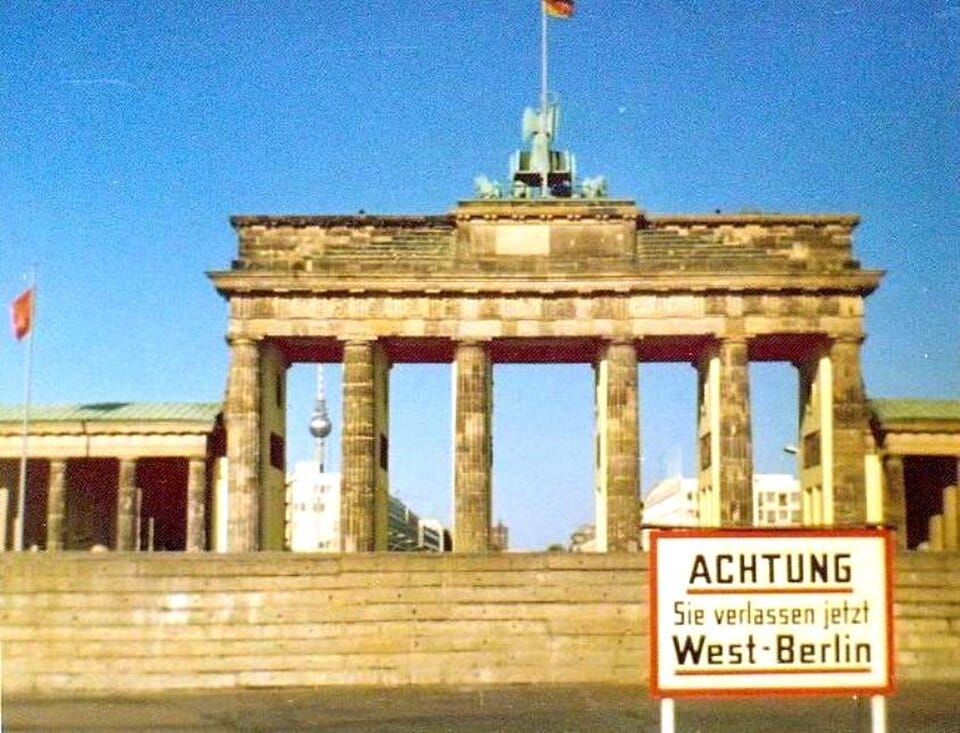
A strange article made the rounds on social media this week. Published under the title “65 years since the construction of the Berlin Wall – The GDR and the Cold War” in an online magazine called Monthly Review, it turned out to be an angry rant against the “Bourgeois media and all manner of ‘experts’” waging an “anti-communist propaganda campaign”. While it doesn’t quite go as far as saying it outright, it seems to justify the East German regime’s decision to build the Berlin Wall.
Perhaps this shouldn’t have taken me aback as much as it did. The author is named as “In Defense of Communism”, which is a self-proclaimed “Marxist-Leninist blog”. So there was no attempt to obscure the writer’s ideological outlook nor that of the assumed audience.
Nonetheless, it’s still stark to see in black-and-white sentences like: “The GDR’s border regime and the so-called ‘victims of the Wall’ remain among the most frequently used instruments of anti-communist historical falsification.” To me, such words seem to exude the same contempt for the people trying to leave East Germany that was held by the regime that built the Berlin Wall.
But let’s look at this properly. Last week, on 13 August, was the 65th anniversary of the day the Berlin Wall went up in 1961. As a result, numerous articles were published outlining what happened and covering the events marking this anniversary in Berlin. I touched on this myself in an article for UnHerd, which was about declining birth rates but opened with a reference to the Berlin Wall:
“Early on 13 August 1961, Berliners woke up to find their city divided. The East German regime was building the Berlin Wall in a desperate attempt to stop its people from leaving. Around 2.5 million had already done just that, since the foundation of the two German states in 1949. When the Wall fell peacefully in 1989, the exodus wasn’t supposed to resume. But it did, and on a devastating scale.”
I loop back to this again towards the end, saying “the East German regime kept its existing population in the country at gunpoint”. So presumably, I’m part of the crowd of “Bourgeois” commentators and sarcastically quotation-marked “experts” that the author of the article accuses of “using the anniversary as an opportunity to wage their anti-communist propaganda campaign”.
Interestingly, the year my history of the GDR, Beyond the Wall, came out, one of the few outright critical reviews in Britain came from a similar direction. The socialist “Morning Star” magazine bemoaned, among other things, that my “two overlong early sections detail years of brutal violence” and came to the conclusion that my “blindness to the more positive aspects is a serious omission.”
The thing is: there was brutal violence in the history of the GDR, and the Berlin Wall was an oppressive – and outright murderous – instrument to sustain the state’s population and economy. No amount of context and no amount of free medical care, subsidised rent, affordable theatre tickets or female labour is ever going to undo that. It’s not a zero-sum game. That’s just the messy reality of history. Two things can be true at the same time.
I certainly found that confirmed when I was interviewing people for Beyond the Wall. I asked everyone old enough to have been there in 1961 what they made of the Berlin Wall going up, and I got completely contrasting answers.
Some people told me that they were on holiday when they heard on the radio that the government was erecting an “anti-fascist protection wall”. They said it didn’t really affect them, so they went back home and got on with their lives. One lady told me she was relieved that the local doctor now had to stay as he’d previously planned to move to West Germany. For others, especially Berliners, the division of their city was devastating. They suddenly found themselves cut off from friends, family, university or workplaces.

The article in Monthly Review reduces all that to a calculation of numbers: “Between 1961 and 1989, 140 people died at the Berlin Wall. Of these, only 101 were people attempting to flee who were shot, suffered fatal accidents while trying to cross the border installations, or took their own lives.” The author concludes that “this corresponds to an average of around 3.6 deaths per year associated with border enforcement” compared to “recent crossings at Ceuta, where as many as 140 people can die in a single day” and “yet the European Union is not described as an ‘unjust regime’”.
The assumption underlying this line of argument is chillingly devoid of empathy. It implies the numbers of victims and therefore the significance of the Berlin Wall itself is overblown. The article bemoans the supposed existance of a “myth of the Wall’s victims” and demands more emphasis on the GDR’s “achievements, or the historical context in which the Wall was built.” I have tried to take a nuanced and multi-faceted approach in my book — to a point of that being seen as controversial by some critics — but nothing takes away from the terrible human tragedy of the Berlin Wall.
At the end of the day, the Wall was built to stop people from leaving the country — if necessary under pain of death. Even the GDR regime itself was aware of how cruel this measure was, especially Erich Honecker, who grew up in the Saarland in West Germany and still had family there while being leader of the GDR and having to tell other people in the same situation that they couldn’t see their family members.

In 1987, Honecker used the opportinity afforded by an official visit to West Germany to see his younger sister Gertrud Hoppstädter, who still lived in the Saarland by the French border. Visibly touched by this reunion, he admitted that the inner-German “borders are not how they should be” and expressed hope that the day would come “when the border will no longer divide us but unite us, just as the border between the GDR and the People’s Republic of Poland unites us” — in other words, he knew the Berlin Wall was no ordinary border.
Unlike Honecker, many other East Germans never got to see their sisters in West Germany again. One of the best-known victims of the Berlin Wall was Peter Fechter, an 18-year-old bricklayer from East Berlin who was frustrated with the East German regime’s refusal to let him see his older sister in West Berlin and spent his lunchtime breaks fantasising with his colleague Helmut Kulbeik about escaping to the West. When he finally tried in 1962, it cost him his life.
Peter was shot and fatally wounded at the Berlin Wall, bleeding to death for over 50 minutes, whimpering and pleading for help. This terrible story summed up the entire tragedy of the Wall. The GDR needed it to survive, but the regime knew full well the human cost. That’s seems to me to be the same calculation the article tried to make this week.
Of course, the Berlin Wall was built within a specific “historical context”, and of course the GDR itself is worth studying in full detail with all its social, political, cultural and economic dimensions. But that doesn’t make the impact that the Berlin Wall had on people’s lives any less worthy of consideration and remembrance.
This remembrance doesn’t stop with the number of fatalities either. What about all those people who would have liked to move, visit people or travel but were prevented from doing so? What about those who didn’t dare try to cross after so many people died in the first few years of the Berlin Wall and after its system became more sohpisticated? What about those who tried and didn’t die but were caught and imprisoned or punished in other ways?
The Berlin Wall divided a city and a country. It divided families, curtailed opportunities and restricted the freedom to travel and live the way people chose. This aspect of the GDR is just as real as its diplomatic isolation, economic pressures or social achievements.
65th years after the Berlin Wall first went up, it’s clearly worth saying something again that should be perfectly obvious: The victims of the GDR’s border regime were no “myth”. And they weren’t numbers or statistics either. They were real people whose lives, hopes and dreams were brutally upended. That is why the “Bourgeois media and all manner of ‘experts’” still highlight their stories. They were people, not propaganda — and they deserve to be remembered as such.


