

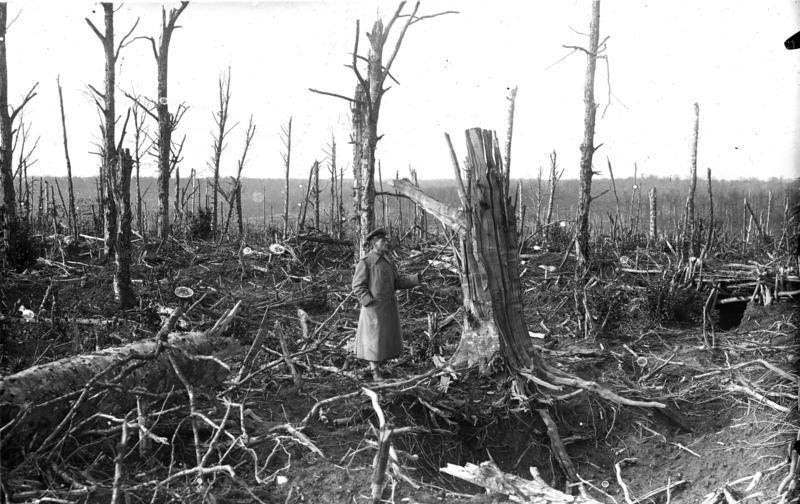
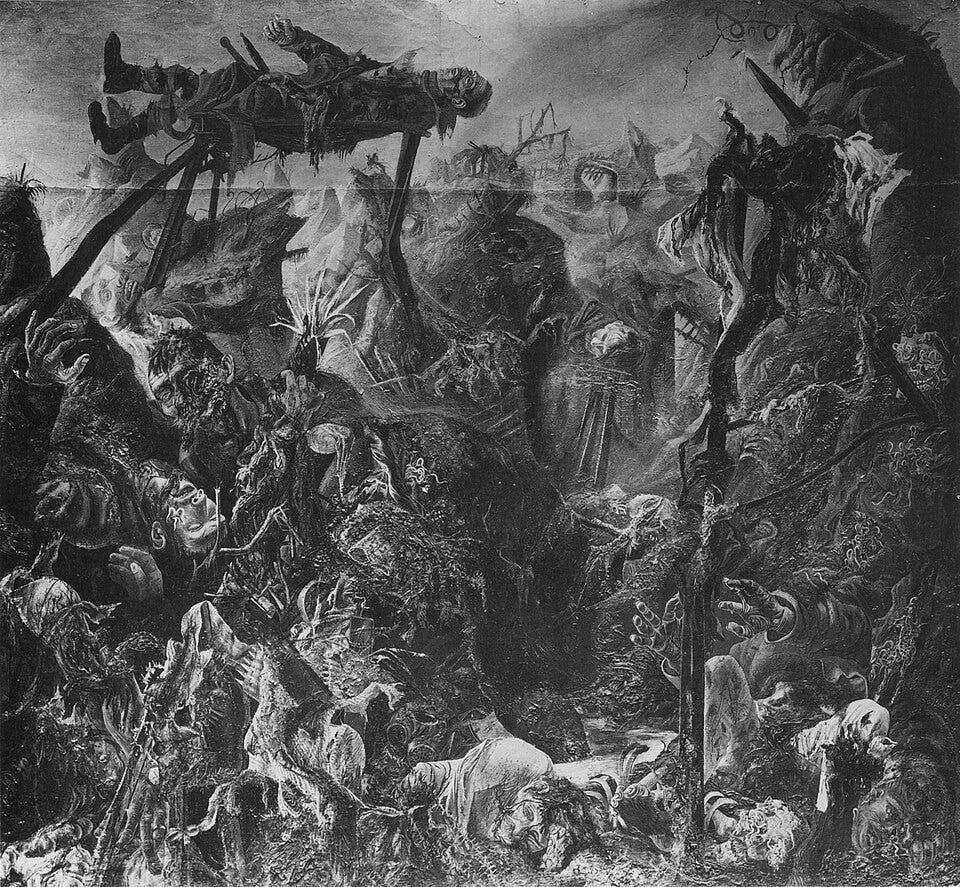
I was on the BBC’s Start the Week on Monday, and while it was early in the morning and I was desperately focusing my mind on what I was going to say about my own book, I found myself transfixed by another participant’s contribution. Art historian John-Paul Stonard was describing a painting called The Trench by the German artist Otto Dix. Sadly, the painting was lost, and we only have black and white photographs of it, but John-Paul described the horrors of war that it depicts in vivid colour:
“It’s a gun emplacement in Flanders which has been blown apart by a shell…Otto Dox puts you right in there…you’re surrounded by bodies which had been blown apart by bombs…Some are rotting, and maggots are spilling out of them…It looks like a Dance of Death…the colours were described as being putrid. It was a painting of pure horror.”
His words and the image they created in my mind were a powerful reminder that war is an ugly thing. We talk about it often in abstract terms. We recount casualty statistics, shifting borders, political outcomes. But for people at the time, the main consequence was that war destroys lives both directly in combat and indirectly on the home front.
The First World War did this on a scale that had simply been unimaginable before 1914. It is worth recalling how that came about and what it did to individuals and societies, even if Germany doesn’t always find it easy to do so today.
Few foresaw it at the time, but the economic developments preceding the First World War caused its immense deadliness. Over the 19th century, the Industrial Revolution brought forth the means of mass production. Now bullets, shells and machinery could be made at speed. Vast amounts of raw materials, such as coal and iron, were unearthed to feed the rapacious war machine.
Farming, too, had been catapulted into a modern age of mass production. Between 1873 and 1913, German wheat production grew by over 50 per cent, and the number of pigs reared for slaughter increased from 7 million to 25 million, chiefly due to the introduction of sodium nitrate as fertiliser and steam-driven machinery.
Stable food supplies contributed to a population boom. In 1871, Germany had 41 million citizens. By 1910, it had 65 million. So in 1914, we find a huge generation of young people who had never seen what industrial warfare does marching into what was to become the deadliest conflict in human history up to that point.
While poignantly remembered as national traumas in Britain and France, the horrors that unfolded between 1914 and 1918 are overshadowed in German memory by the even more horrific Second World War. There is also a degree of unease about the idea of commemorating the German victims of a war that has no ready-made place in a national narrative.
From a memory perspective, the First World War is complicated for Germany. The country played a significant role in causing the conflict in the first place, and after 1945, German historians, most notably Fritz Fischer, emphasised this and drew lines of continuity between the First and the Second World War. It was also a lost war the enormous sacrifices for which seemed almost unbearingly futile to many contemporaries. The upshot of this complex memory conundrum is that the First World War is now often regarded as a kind of prelude to the Second.
Of course, Germans who lived through the 1920s and 1930s had no idea that another war, even more horrendous, destructive and deadly than what they called the Great War, awaited them. And there was nothing inevitable about that either.
I felt I needed to capture the atmosphere of that post-WWI world somehow in my book Weimar. I wanted it to convey the sense of trauma, shock and loss that laced German society from 1918, but also the earnest and genuine hope that something like this would never happen again, that the catastrophe had created a positive tabula rasa moment, too.
I strongly felt that this could only work if I took readers to the battlefields of the Eastern and Western fronts, following soldiers from Weimar. Perhaps unsurprisingly, I got a bit carried away in this endeavour. How could I not? Engaging with the human experience of the First World War is one of the most harrowing things you can do as a historian of modern history.
Sitting in the Weimar branch of the Thuringian State Archive, I looked through box after box of letters and postcards young men had sent back to their wives and mothers from the front lines. I’d like to share some of the findings from that here.