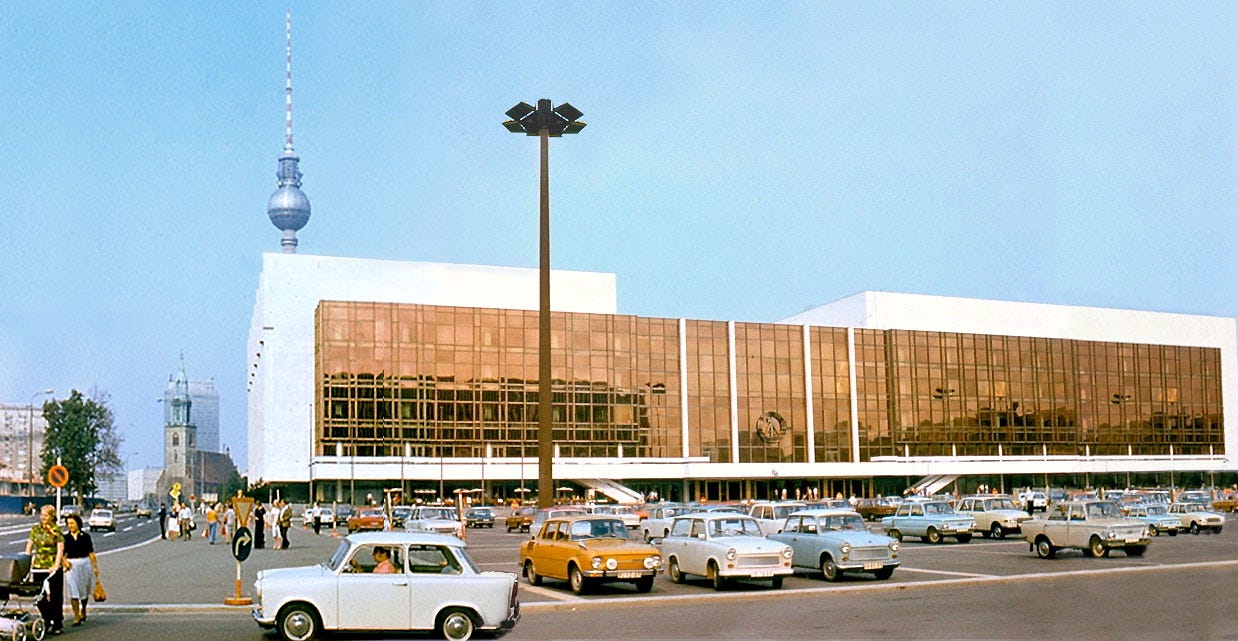
The Vanished Palace
...and the Battle for the Heart of Berlin
Is it ever right to erase history? That was the question we returned to time and again last Tuesday. I was sitting in a TV studio in what had once been East Berlin and was asked for my thoughts on a long-vanished building I had never set foot in: the Palace of the Republic.
The Palace of the Republic was purpose-built by the GDR government as the seat of the parliament of East Germany. It was opened in April 1976, an event that will have its 50th anniversary soon, and on that occasion, German public broadcaster ARD will show a documentary about it. This is what I had come to contribute some comments to.
The “People’s Palace” has a very special place in Germany’s complex memory politics. In part, that’s because it has now been erased completely. With the exception of the odd set of crockery and a few bits and bobs from the interior, there’s not a trace of it left. In 2003, the Bundestag voted to demolish it.
It was subsequently dismantled in its entirety and replaced by a partial reconstruction of the old Berlin Palace, which had been the main residence of the Kings of Prussia and the German Kaisers until 1918. This replacement was and is hugely controversial. The argument over which palace, if any, belongs in the heart of Berlin is a proxy-war over the soul of the German capital.
The story of the Palace of the Republic is about so much more than a vanished bit of steel, glass and asbestos. It’s about what a nation wants to preserve, what its people are supposed to remember and what a city wants visitors to see. The arguments about the Palace encapsulate the story of reunification, its chances, conflicts and missed opportunities.
But let’s start from the beginning. The origins of the Berlin Palace lie in the 15th century, when Frederick II, the Margrave and Prince Elector of Brandenburg, built a fort on the swampy banks of the River Spree, which divided the towns of Cölln and Berlin (the palace is marked with the letter A on the map below).
Frederick was a member of the House of Hohenzollern, which later provided the Kings of Prussia and the Kaisers of Germany. By moving in, he made Cölln and Berlin (which merged later, in 1710) the seat of power of that dynasty. Grocely oversimplifying, this is why Berlin is today the capital of Germany and why the fate of the Palace is right at the centre of the national story.
The Berlin Palace was expanded in the years that followed, reflecting the growing power of the Hohenzollerns. Its Prussian baroque pomp, enormous size and significant height made it a statement of intent. It dominated Berlin.
When Hohenzollern rule came to an abrupt end with the abdication of Kaiser Wilhelm II in November 1918, the Palace became defunct as a seat of royal power. But of course, the building itself didn’t vanish. It was used as a museum, cultural venue and headquarters for various institutions that rented office space. The Berlin Palace was largely destroyed in an Allied air raid in 1945 and burnt out. Now in East Berlin, what was left of it was demolished by the GDR government in 1950.
On the plot where the old City Palace had stood for centuries, East Germany decided to build a new kind of palace. The baseline concept was that of a Volkshaus, a People’s House. This was a 19th-century tradition, steeped in the European workers’ movements. A Volkshaus served as a political and cultural hub for local workers and their organisations. They were often built in grand, representative styles and contained libraries, event spaces and amenities such as bowling alleys. The Palace of the Republic was to be a giant, national version of that.
On the political side, it contained space for the Volkskammer, the People’s Chamber or parliament to meet. On the cultural side, it had a large event space with a movable stage and flexible walls that could be repositioned to create different room sizes and layouts. At its largest set-up, it fit 4,500 seats. TV shows like the entertainment programme Ein Kessel Buntes (A Kettle full of Colour) were recorded there. Concerts took place, featuring international stars such as Carlos Santana, Tangerine Dream, and Harry Belafonte.

There were different restaurants, pubs, cafes and a milk bar in the Palace, as well as art galleries, a bowling alley and an in-house disco for young people. Families came for exhibitions and children's events. Couples met for dates or for a fancy meal, not always available elsewhere.
It’s those sorts of private memories of the Palace of the Republic I often heard about from friends and family as I grew up. People would talk about taking their date out to a meal or to dance. Others said the prices were quite high by GDR standards, so they had to save up for a while and then go there as a special treat.
A woman once told me she and her female friends were always a little wary going to the Palace because “old men from West Germany” would hang around at the bar, trying to entice East German women with their West German money. Whatever their specific memories, many East Germans didn’t see the Palace of the Republic so much as a symbol of the power of a dictatorial regime. It was first and foremost a leisure destination and a landmark in East Berlin.
When the West German political establishment moved back to Berlin in the 1990s, it saw something very different: an ugly, asbestos-contaminated, modernist piece of communist architecture. Like the GDR itself, it was labelled an “interruption” in the proper history of Berlin and Germany, something to sweep away, a failed project that was best consigned to the dustbin of history.
In 1990, the Palace was closed straight away, even before the GDR itself was defunct. It was found to be contaminated by asbestos, and to this day, this is used as the main argument for demolition. That this is clearly not the only reason is obvious in the timeline of subsequent events.
By 2003, all the asbestos had been removed, and the building stripped back to its bare bones. Visitors were even allowed inside. Yet the Bundestag, Germany’s parliament, decided a few months later to demolish what was left of it completely and reconstruct the old Berlin Palace, even though the dynasty that had once built this wasn’t coming back to the throne.
Neither had the money been raised yet. Yet, it seemed preferable to have an empty space in the heart of Berlin rather than the remnants of the Palace of the Republic. Not even the raw steel would be reused for anything anywhere in Germany. It was sold off to the United Arab Emirates, which used it to build the Burj Khalifa skyscraper in Dubai. The German political establishment that had moved back to Berlin wanted nothing to do with any part of the Palace of the Republic, literally.
Protests against the demolition took many different forms: demonstrations, sit-ins on the roof and graffiti on the ruins that read: “Die DDR hat’s nie gegeben” - “The GDR never existed”. To this day, many East Germans, including many I have spoken to, feel they had little agency in the erasure of this part of East Berlin. This includes people who were critical of the GDR regime, but are nonetheless uncomfortable about the complete evaporation of an architectural piece of their past.
The documentary I was contributing to in Berlin on Tuesday tries to capture different voices. When I pointed out to the director that I was only four years old when the Berlin Wall fell and had never set foot in the Palace of the Republic, he shrugged and said he thought it was important to document the thoughts of the so-called “Third Generation East”, that’s those of us born in East Germany’s last decade or so. “I hope I’m not wrong in assuming that you carry some form of an East German identity in you,” he said, “so you’ll have thoughts on this.”

I do. Having lived abroad for so many years, I now also feel British as well as German (rather than specifically East German). But I also realise that I share many experiences and attitudes with others from the former East. The way I grew up was distinctly Eastern in many ways, and I guess that’s what makes me uncomfortable about the vanished Palace.
I remember visiting Berlin on a class trip as a teenager – it must have been around 2000 – and seeing the shell of the Palace standing there. We were actually visiting the German History Museum, which is nearby, and it felt very odd that this carefully preserved German history behind class, while another part of German history was being erased across the road.
I think the historian in me is even more doubtful about the process than the East German. Just to be clear, this isn’t about the aesthetics of the Palace of the Republic vs the Berlin Palace. As a ZEITGEIST reader, you’ll know that I’m partial to a bit of Prussian history, too. This is about the, in my view, arbitrary decision that the Hohenzollern Palace is “true” Berlin history while the GDR Palace was an artificial “interruption”.
What would I have done, I wondered as my nose was being powdered before the next round of filming.
I think there was a way to remove the asbestos and then integrate what was left of the Palace of the Republic into something new, even if it was just the steel frame. The current reconstruction even makes an effort to lay bare the foundations of the old Berlin Palace in the basement. It could have done something very similar with the GDR palace.
It’s not too late either. Pieces of art that were once in there still exist in storage, as do things like signage (some of which has now actually been installed in the new building). There should also be a permanent exhibition about the GDR palace in there.
Whatever one thinks of the Palace of the Republic, it did exist. Erasing it and its memory entirely feels wrong, especially in a country that prides itself on confronting its past.


That is an absolute travesty that such a gorgeous looking building was destroyed ( essentially) on a lie , as you say the asbestos was removed and the building was an empty shell , so short sighted of the authorities back then , this is what happens when you look through the prism of ( Stasi , die Mauer , etc etc ) , in my opinion that building could ( in the correct circumstances) pulled in thousands of visitors each year , very sad 😔. Great article Katja 😀👍👍
Thank you for this clear explanation of what happened to the Palast der Republik. Though I'm not particularly a fan of mid-century modern architecture and I understand the asbestos issue, I think it was a crime to entirely demolish the old building and erect a strange hybrid of a mock Prussian palace and a bland office building in its place. And the fact that steel from the "People's Palace" was used to build the Burj Khalifa of all things - the ultimate symbol of elitism and capitalism, constructed under terrible human rights conditions - just adds massive insult to injury. What a strange, sad tale in Berlin's archictectural and social history.