The Wisdom of Schnitzel
A German classic served with a side of deconstructed history
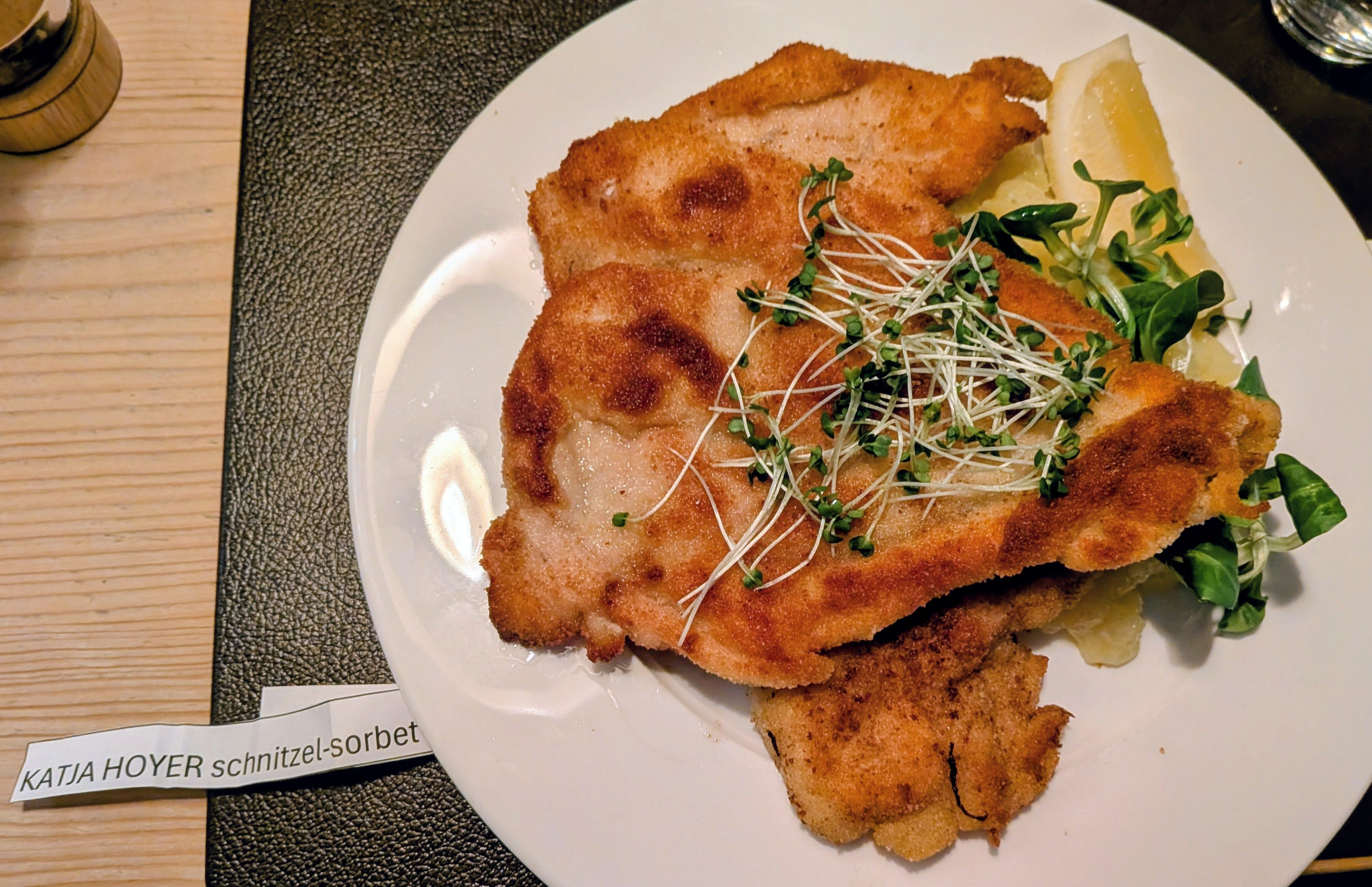
I do like a good schnitzel. So I was pleased to be served one in West London this week. Okay, this wasn’t exactly an unexpected treat. I may have been in the heart of the British capital, but I was also at a very German event at the Goethe Institute in Kensington, which has a German restaurant on site. I’d pre-ordered my dinner a few days in advance, and when it came out, it literally had my name on it. But still, when this classic German comfort food was set before me, it made me think, not least because it went perfectly with the evening’s theme: German unity.
I appreciate that many people think of Schnitzel as an Austrian rather than a German dish, and they aren’t wrong. The most famous Schnitzel of them all is the Wiener (Viennese) Schnitzel. Legend has it that the Austrian Field Marshal Joseph Radetzky von Radetz brought the idea for this back from Italy in the mid-19th century. The court chef in Vienna then tried it and added the now-famous coating of golden breadcrumbs. From there, the dish spread through the German-speaking realms as the “Wiener Schnitzel”. Historians argue about the details of this story, which seems fitting since arguing over it is the best way to honour a recipe. But the basics sound about right.
While the Wiener Schnitzel is indeed regarded as a national dish of Austria, it isn’t the only game in town. It’s actually a very specific thing, made from veal. Call a pork or a chicken Schnitzel a Wiener Schnitzel in the presence of Austrians, and you may well get corrected, judged or quietly pitied.
The word “Schnitzel” on its own, however, is more generic. “Schnitt” means “cut”, so a “Schnitzel” is something that was cut, in this case, meat. The word simply refers to a thin cutlet. In Germany, pork is the most common variant. I have childhood memories of my dad standing in the kitchen on a Sunday, pounding pork cutlets with a mallet before coating them in pepper, flour, egg, and breadcrumbs. This is the German standard Schnitzel, usually served with potato salad, fried potatoes or fries.
However, the Schnitzel multiverse is vast. Once breaded meat had left Vienna, it diversified through culinary evolution, adapting to local tastes and ingredient availability. There is a Munich Schnitzel, which gets coated in the sweet mustard that’s often used in Bavarian cuisine before it’s breaded. There is a Hamburg Schnitzel, a regular Schnitzel topped with one or two fried eggs. There is a Gypsy Schnitzel (although the name is now somewhat contested), which is covered in a rich sauce made with red peppers. Pork is the most popular base in Germany, but there are also chicken and vegetarian versions.
Much like sausages, the schnitzel is a nice metaphor for the interplay of unity and diversity in Germany. While there are regional and personal differences in preferred versions, most Germans are united in their love for Schnitzel. According to a poll published last year, nearly 70% of them eat a version of the dish at least once a month. It also always ranks among the top dishes served in the workplace canteen. There are restaurants solely dedicated to Schnitzel.
There is also an East-West dimension in all of this, and that’s what I was contemplating while munching on my schnitzel in London this week.
On Thursday, I was at the 49th Annual Conference of the International Association for the Study of German Politics. A large room full of people who have chosen to dedicate their professional lives to the minutiae of German politics — what could be finer? Some delegates had come all the way from Japan and the US. I was the last event of the day, speaking on stage to Matthias Dilling, Assistant Professor of Political Science at Trinity College Dublin, about “German democracy 35 years after reunification”.
Afterwards, as we made our way to the German restaurant, someone asked me whether I thought there would always be an East-West divide in Germany. After all, the Berlin Wall has now been down for longer than it was ever up, and the division seems to be more visible than ever in many ways. My answer was the same as in my book: When the first German Chancellor Otto von Bismarck created the first German state in 1871, he didn’t expect regional variation to vanish. He opted for a federal system so that Bavarians could stay Bavarian and Saxons Saxon. Both would become Germans without losing their local traditions, food, dialects and cultural traits. He understood that political changes don’t eradicate history. In the same vein, it was always unreasonable to expect East Germans to be exactly like West Germans just because they live in the same country again. Certain traces of the diverging post-war stories will remain and form another layer of identity.
Which leads me back to the Schnitzel. If you order a Jägerschnitzel (Hunter’s Schnitzel) in Germany, what you get served still depends on which side of the former Cold War divide you order it in. In the West, you’ll get a classic Schnitzel, as described above, topped with a creamy mushroom sauce. Order the same thing in the former East Germany, and you’ll get a different dish: beneath the breadcrumbs will be “Jagdwurst” (hunter’s sausage), a cooked sausage made from ground pork, usually seasoned with salt and mustard seeds. It can also be served with fries or potato salad, like its Western cousin, but the most common variety is with tomato pasta on the side. It tastes better than it sounds, but then I’m probably not a neutral judge. It was still very common in my school and university canteens in the 1990s and 2000s, and is served in restaurants in former GDR territory to this day.
So there are two very different Jägerschnitzels, and few people would call for abolishing one for the sake of culinary unification — it’s a beautiful analogy for the patchwork nature of German identity and nationhood.
If, like me, you feel a little peckish after all of this Schnitzel talk, here is a recipe to Germanify your lunchtime this Sunday:
Ingredients
4 pork cutlets
Salt and pepper
½ cup flour
2 eggs
1 cup breadcrumbs (traditional German Semmelbrösel if available)
Oil for frying
2–3 tbsp butter (optional but traditional)
Lemon wedges, for serving
Instructions
Prepare the pork
Place the pork cutlets between plastic wrap.
Pound gently with a meat mallet until evenly thin.
Season both sides with salt and pepper.
Set up breading station
Place flour in one shallow dish.
Beat eggs lightly in a second dish.
Put breadcrumbs in a third dish.
Bread the schnitzels
Dredge each cutlet in flour.
Dip into the egg.
Lightly coat with breadcrumbs without pressing (helps create an airy crust).
Fry
Heat oil over medium-high heat. Add butter for flavour.
Fry schnitzels one or two at a time for about 2–3 minutes per side.
They should be golden brown and crisp.
Drain
Remove and drain briefly on paper towels.


The last schnitzel I had was on your trip in Berlin, I was with James, he may have mentioned this elsewhere.The venue was a Hofbrau so that would been a Bavarian variation came with a slice of tomato and lemon plus a potato salad ,all washed down with a dunkel .Lekker
Hungry now