

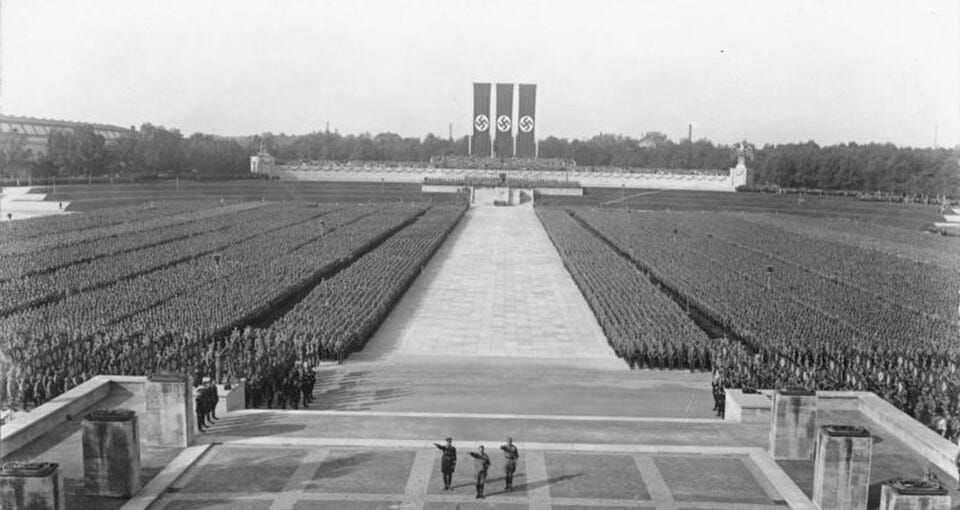
When I was a German teenager interested in history, one way to learn more than there was time for in school lessons was to watch history documentaries. In an age before streaming and YouTube, the modern German history TV market at the time was dominated by Guido Knopp, a journalist and author who produced a great number of documentaries on the rise and reign of Hitler.
From "Hitler’s Women” to “Hitler’s Warriors", they usually consisted of several parts per season and followed a pretty formulaic pattern: slow, dramatic narration over endless black-and-white images, most of which came straight from the Nazis' own propaganda material.
The result was that many of us grew up with an image of the Nazi era not a million miles away from the one the regime itself had wanted to project. Long columns of soldiers marching in rigid formation. Perfect young boys and girls in uniforms, ecstatically following their Führer into his future. Order. Discipline. Design.
The reality of the Nazi regime was of course very different. So by looking at the Nazi regime through its own lens, are we perpetuating its propaganda?
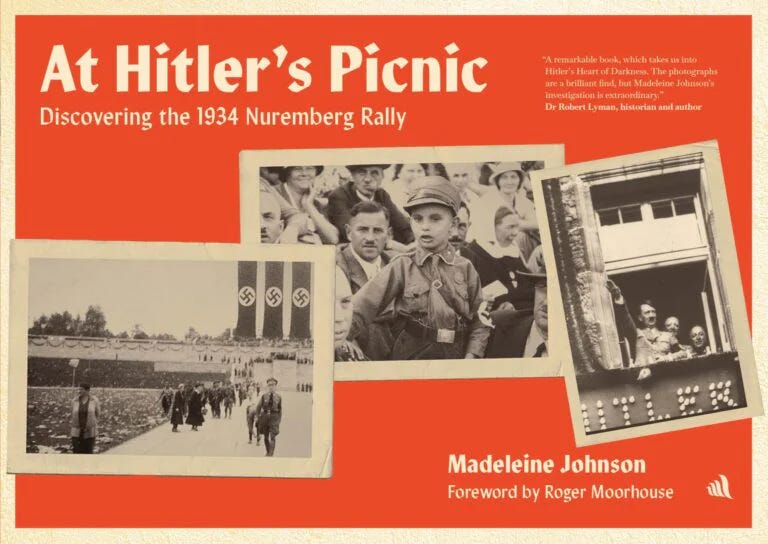
That’s the question the American art historian Madeleine Johnson asks in her book At Hitler’s Picnic: Discovering the 1934 Nuremberg Rally. She has kindly agreed to give us here at ZEITGEIST a taster of her work and some of the very different images she has found.
The Third Reich Lives On
By Madeleine Johnson
Have you ever noticed how you can almost bet which photos will accompany any book or video about Nazi Germany? You can almost guarantee there will be sepia images of armed SA men on trucks, footage from Leni Riefenstahl’s Triumph of the Will, clips from Eva Braun’s home movies or newsreels of the Wehrmacht in combat.
I had never really thought about this until 112 old glass slides turned up when we cleared out my childhood home. As I eventually learned, my uncle, a U.S. G.I., had found them scattered on the floor of a local Nazi headquarters in March 1945 and sent them home as a souvenir.
When I first saw them, it took a moment to recognise that these slides of portly men and their families snacking in the stands, children in mini Nazi uniforms and litter in the famous Luitpold Arena were taken at the 1934 Nuremberg rally. They were completely unlike the perfectly aligned ranks of the SS and SA and glowing Hitler youth familiar from Heinrich Hoffmann’s photos and Riefenstahl’s film.
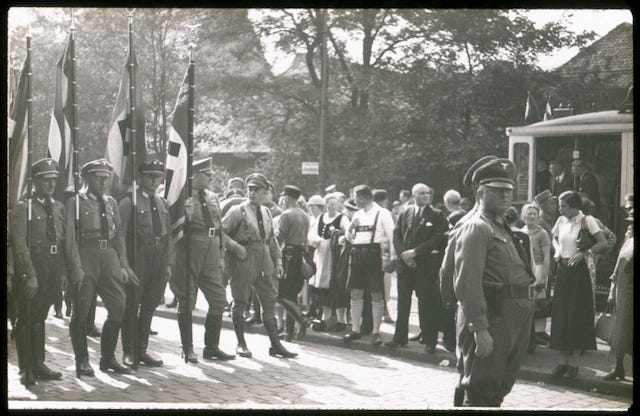
The contrast between these amateur snapshots and the images we “know” got me thinking about how and why such a predictable, and limited, group of images still dominate the narrative of Nazi Germany today.
Some of the reasons we keep seeing the same photographs are structural. It may have been the country of Leitz and Zeiss, but cameras were expensive and not widely owned in 1930s Germany. The regime limited photography too. Only three official photographers were permitted to take photos at rally venues. Those combat films would have required propaganda ministry permission. Heinrich Hoffmann had the exclusive on Hitler photos, and he and Eva Braun were the only ones with access to Hitler’s private life.
There is the survival factor. Personal photos that weren’t destroyed by war may not have survived de-Nazification or family shame. Another reason for the constant employment of the same images is that they are familiar. They are a kind of shorthand that does not need explaining. They offend no one, and their authenticity is not in doubt (except for that famous one of Hitler in the 1914 crowd, probably made by Hoffmann’s studio).
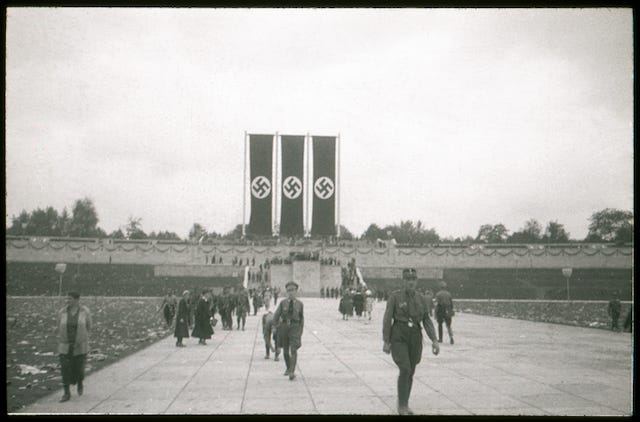
There are ethical issues too. Should we show only photos of the SA doing bad things and not Hoffmann’s pictures of SA men enjoying skiing or drinking cocoa with their buddies?
However valid these reasons, the limited number and repetition of these familiar pictures matter. In a world of Holocaust deniers and neo-Nazis, it matters when images of Nazi Germany are used with a carelessness that historians would not accept for textual documents.
Serious historians’ precious credibility is undermined when the same newsreels of the Wehrmacht are used indiscriminately, whether discussing 1940 or 1945, or a photo of the “Cathedral of Light” at the Nuremberg rally from 1937 is regularly attributed to 1934. (To be fair, the light show’s creator, Albert Speer himself, got mixed up in 1970s interviews).
It matters that sticking to the same old images stifles the search for different ones that open new areas of research or bring fresh perspectives.
The July 1944 bomb plot is typically illustrated with a photo of Hitler viewing bomb damage. There are two never-before-published photos from the same time among the 400,000 images in the Heinrich Hoffmann Collection in the U.S. National Archives and Records Administration. One is of bodies under tarpaulins on the Wolf’s Lair’s lawn, with Hermann Göring smiling in the background. The other is of Hermann Fegelein—now a meme from Downfall—shirtless and in blast-shredded trousers. Either one evokes so much more than the propaganda-ministry-approved photo of Hitler, which could depict bomb damage anywhere.
It matters when overused images reinforce mistakes and myths, such as legends of the Wehrmacht’s technological superiority that those newsreels promote. It matters when historians’ interpretations are based on the common error of forgetting the difference between a picture and the actual experience of something.
In his famous 1935 essay “Art in the Age of Mechanical Reproduction”, philosopher Walter Benjamin theorised that people turned to fascism and consoled themselves with illusory spectacle after the hoped-for proletarian revolution never came. Benjamin’s idea about the “aesthetisation of politics” is clearly based on images—perhaps Triumph of the Will—rather than experience.
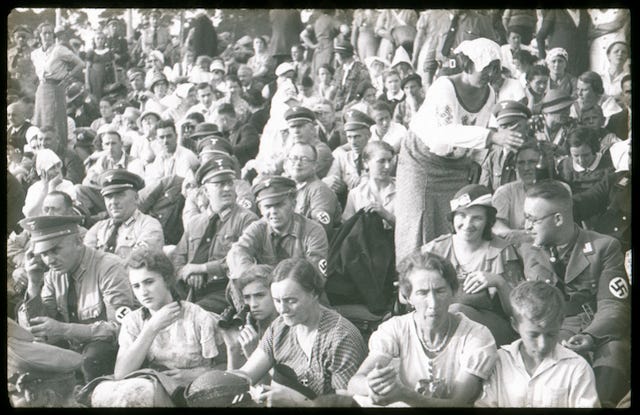
The reality of Nuremberg in 1934 is more like the slides I found. The photographer and his subjects show more interest in their comrades and enjoying a trip away than in the failure of a revolution. The consoling spectacle is little more than a speck on a far-away, temporary stage (Hitler). The aesthetic experience is probably a view of the back of the guy marching exactly 118 cm ahead.
But what matters more than anything is the fact that most of the images we see over and over were produced by the regime itself. The Thousand Year Reich may have died, but we haven’t stopped consuming its propaganda.
At Hitler’s Picnic by Madeleine Johnson was published on 14 September 2026.
Don't be stupid - be a smarty!
Come and join the Nazi Party!
-- "Springtime for Hitler"
The best visual commentary about the "technological superiority" of the Wehrmacht is in the final episode of "Band of Brothers" where the young paratrooper riding in a convoy of US Army GMC trucks shouts at the defeated Wehrmacht members riding in their horse carts bout what fools they were to think they could defeat the United States with a horse-drawn army.
The image still important today and equally mastered by Putin, Xi, Kim, not to mention the current resident of the White House!