Walls, Krautrock and Fascist Flirtations: Bowie in Berlin
Ten years after David Bowie's death, what's left of his German phase?
My first encounter with David Bowie was terrifying. Those odd eyes, the sharp cheekbones, the elegant menace he exuded! As far as I can remember, my first impression of Bowie was not as a charismatic singer, but as a deliciously evil Goblin King. It was in a school classroom in Germany sometime in the 1990s. The teacher had rolled the TV set in, and excitement had been mounting when she produced a VHS cassette entitled Die Reise ins Labyrinth.
Soon, Bowie appeared as Jareth the Goblin King, all eighties white-blond hair, eyes lined dark, body wrapped in tights that made us all giggle a little. I remember feeling both frightened and fascinated. He was captivating and unsettling, both playful and cruel. I didn’t know then that this same figure had once lived just a short train ride away from where I was growing up, nor that he was then looking at the Berlin Wall from the other side, deeply impacted by that experience.
Ten years have now passed since David Bowie’s death. In hindsight, his bond with Germany and Berlin feels less like a footnote and more like a central chapter of his artistic life. And it’s a mutual one. For many Germans, Bowie is more than an international pop icon. He arrived at a moment when the city was fractured, and West Berlin was a hotbed of creativity, forever renegotiating its identity. In the late 1970s, it was still an island of the West surrounded by the Wall, simultaneously isolated and intensely alive.

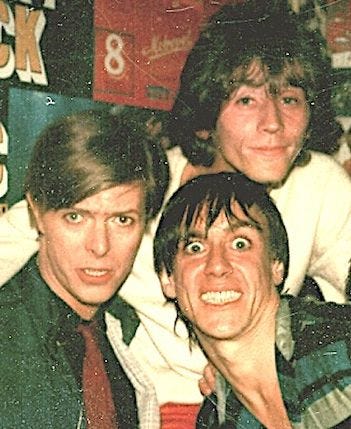
By the time he moved to Berlin in 1976, Bowie was exhausted by Los Angeles excess and the weight of fame. It still makes me laugh a little that, at a time when he was looking to find a way out of his crippling drug addiction, he chose to move to the place many regarded as the capital of hedonism. But Germany did seem to promise him relative anonymity and discipline. He settled in Schöneberg, at Hauptstraße 155, sharing an apartment with Iggy Pop (again, great choice for a flatmate when you’re trying to convert to a clean life).
Today, a modest plaque marks the building, allowing people to pause and reflect on his presence there. In his new home of West Berlin, Bowie rode his bicycle through the streets, shopped at local markets and immersed himself in a city that valued cultural experimentation over glamour.
The music that emerged from this period is often grouped as the “Berlin Trilogy” and consists of three studio albums: Low (1977), “Heroes” (also 1977) and Lodger (1979). Their output is heavily influenced by what Bowie saw and felt while in Germany, even when it wasn’t entirely recorded there.

You can hear the influence of German electronic and experimental acts like Kraftwerk in the synthesisers, rhythms and general feel of the music. For German listeners, this was a rare moment of reverse cultural impact. They had idolised British and American music for decades. Now here was an English rock star not only acknowledging but internalising German musical innovation.
“Heroes” is the emotional core of Bowie’s German period. Inspired by his sight of producer Tony Visconti kissing his lover by the Berlin Wall, the song transformed a symbol of division into a fleeting moment of defiance and intimacy. When the Wall fell in 1989, Bowie’s voice seemed to echo through history, prophetic without having intended to be.
Living with Iggy Pop in Berlin further deepened Bowie’s German connection. Together, they formed a strange, mutually supportive and highly creative exile community. Bowie helped resurrect Iggy’s career, producing The Idiot and Lust for Life, albums steeped in Berlin’s starkness. Tracks like “Nightclubbing” and “The Passenger” carry the feeling of nocturnal movement through the city. For Germany, these works captured something true about Berlin at the time: a cold, wired and restless place, alive with possibility.
Any account of what Germany meant to Bowie must also confront the shadow of “The Thin White Duke”, the persona he adopted for public appearances in the mid-1970s. The Duke was austere, aristocratic, emotionally frozen…. and flirted uncomfortably with fascist imagery.
During this period, Bowie was criticised for remarks that appeared to show sympathy for Nazi ideology. He later addressed this directly, conceding that he had become briefly obsessed with Nazism, but insisting that this had emerged from a profoundly disturbed psychological state brought on by extreme physical exhaustion and “astronomical” drug consumption.
In retrospect, Berlin can be seen as an act of self-exorcism. He went there not to indulge the Duke, but to retire him. Therefore, what Bowie meant to Germany is perhaps best understood by the way he mirrored the country back to itself at a moment when it was still uncomfortable doing so.
Bowie engaged with German culture without irony, took its artists seriously and allowed their ideas to reshape his own work. In return, Germany embraced him not as a novelty but as a participant. That relationship continues to be negotiated. In Berlin, there has been debate about naming a street after Bowie. While this may seem a small thing, it reveals that there is not so much an argument about whether he mattered as about how to commemorate someone who was always in motion. The existing plaque on Hauptstraße feels appropriate in its restraint, although I’d not be opposed at all to a David-Bowie-Straße in the German capital.
For those of us who grew up in Germany, Bowie often arrived indirectly, through films shown at school, songs on the radio or later, the realisation that global culture had once paused in our own streets. Looking back now, the Goblin King no longer seems so terrifying. Instead, he feels like a guide: someone who lures you off into a world of wonder, creativity and self-expression. Bowie showed that Germany, and Berlin in particular, could be a place not just weighed down by history, but also one of reinvention. Ten years on, his German years still resonate.


David Jones had just turned 69 when he died……far too young these days.
He made a truly unique contribution to (British) music, one that he could hardly have imagined doing when he started out - around the same time as the Beatles made it.
Unlike them, it took him almost 10yrs to make a mark, which he did with Hunky Dory - to this day, an utterly superb album that has not dated. His work in the 1970s was astonishing.
I first listened to Hunk Dory in 1982, which was after he had reprised ‘Major Tom’ in Scary Monsters - Ashes to Ashes was a brilliant song with a brilliant video (so ‘avant garde’).
After that - he reinvented himself again as a slick-suited singer - I didn’t really like much of what he did. Though unlike some, I didn’t resent him for not conforming to (unreasonable and unrealistic) expectation.
Without question, a little bit of him belongs to Berlin.
On the recent Katja trip to Berlin in which we learned about people places and Prussia i came into the German capital a few days early to see some non Kaiserreich stuff.One of which was the David Bowie commemorative installation at 155 Hauptstraße ,it's not large so of course I did manage to walk passed it, but once found it is neat and in keeping with a nice sense of slightly more recent history,right at the bottom are Bowie lyrics written by fans with sharpie pens .
At home I have a mug listing the playlist of the Bowie concert I went to in 1990 and yes Heroes is on there.