Was Weimar an Unloved Democracy?
Or: When people get fed up with voting

“Sweden is an unbelievably beautiful country,” I thought on Thursday when I was undertaking a two-hour coach journey from Stockholm to the Engelsberg Ironworks nestled in the countryside northeast of the capital.
I was surrounded by fascinating people, all preeminent scholars in their field. Next to me sat Rana Mitter, historian of modern China at Harvard, and Ali Ansari, Professor of Iranian history at St Andrews. Having access to those two for a couple of hours and all their knowledge on two of the most important countries in the world right now proved endlessly fascinating.
But every now and then, my gaze wandered to the Swedish landscape on the other side of the window where vast lakes lay glittering in the summer sunshine. Deep green forests sped past, punctuated here and there by Sweden’s iconic red cottages. I was pretty sure Pippi Longstocking must live somewhere nearby…
The Engelsberg Ironworks estate itself is no less idyllic. Built in the 17th century as a then state-of-the-art ironworks, complete with traditional cabins for the community and an elegant manor house, it’s very well preserved today. We were shown the old furnaces, tools and even some raw iron ore.
I was astonished to learn that the place is named after a German miner called Englika who moved here in the 14th century, built a cabin for himself and began to unearth and process iron. Despite this German connection, I found myself wandering through the estate, along its tinkling streams and waterfalls, thinking that this was an incongruous place to discuss the prelude to the darkest period in German history. But that’s exactly what I had come to do.
I had been invited to the Engelsberg Seminar, an annual event where an impressive array of scholars from any number of fields come together for a few days to exchange ideas about the past, present and future. I’d been to this event twice before and always came away with my head spinning with new thoughts, impressions and knowledge from far outside my own area of expertise.
This year, the theme was “Political Order and the Future of Democracy”. As a historian who’s just written about Weimar, arguably the most terrifying example we have of a collapsed democracy, I certainly felt I could offer some useful observations from the past.
The thing about Weimar is that it’s almost always referred to in a negative way. The very name conjures notions of instability, crises and fallen ideals. So when the Bavarian politician Markus Söder recently said that the German government might be on a “Weimar path” or when the British political magazine The Spectator features the notion of “Weimar Britain” on its cover, the implication is usually not that our democracies are stable today. Weimar is almost always a warning from history.
But Weimar holds constructive lessons, too, I argued at Engelsberg. The German interwar period has much more to offer the present than a vague sense of fear that we might be witnessing a repeat of the catastrophic fall of Western democracies.
In fact, one of the core impressions I took away from studying the town of Weimar itself during this time is that most people fundamentally liked democracy, the idea of citizen participation in politics. The trouble began when the reality of that process turned sour. It was the gulf between the theory of democracy and its often disappointing practice that soon disenchanted Germans after the First World War. And that’s an observation well worth heeding today.
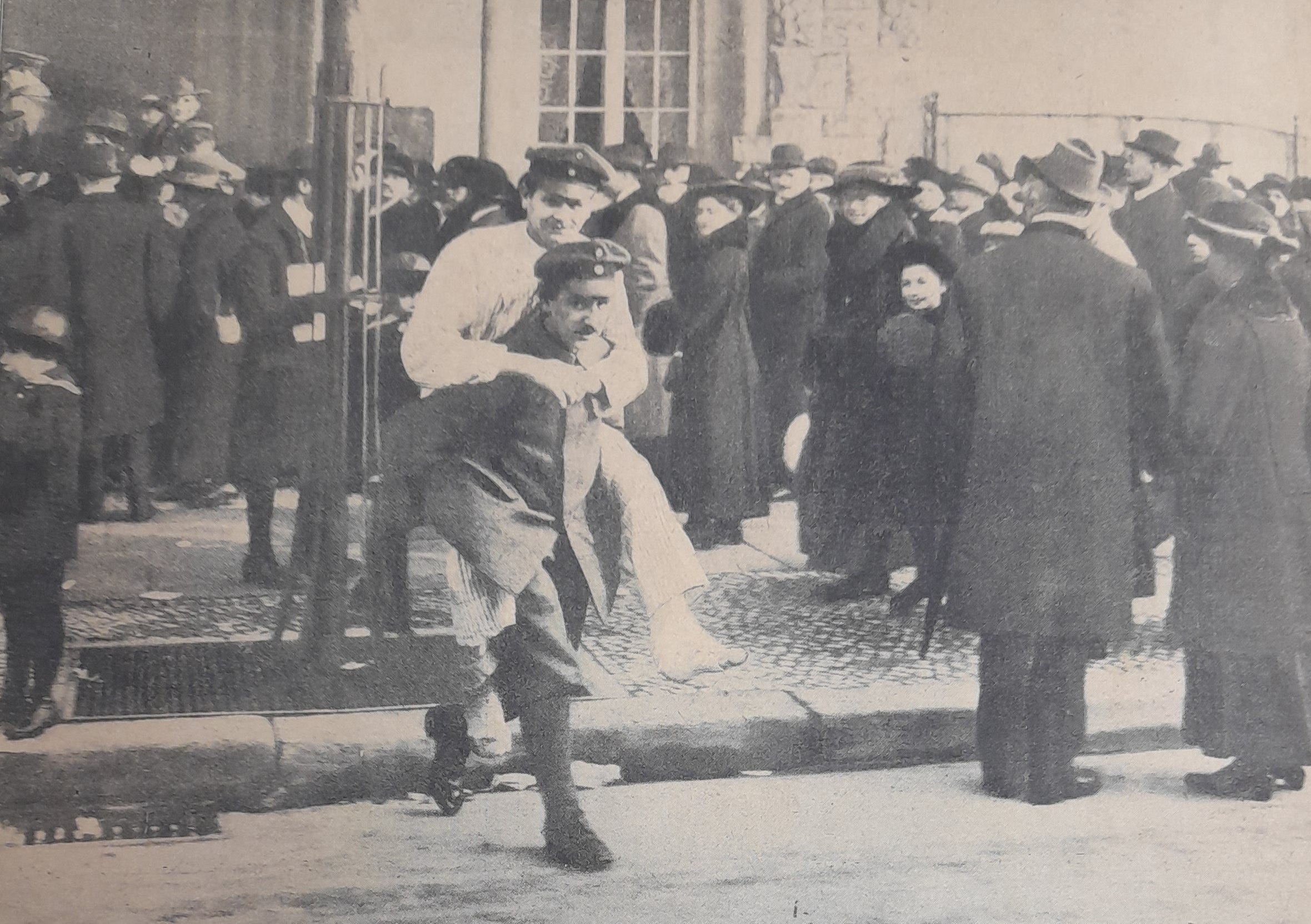
Take 1919, when the first fully democratic German elections took place. The Kaiser had abdicated, women had been given the vote, and the voting age had been lowered from 25 to 20. More Germans than ever before were asked to decide who should run their country, with the electorate increasing by 167 per cent. In my book, I used the diary of a Weimar woman called Käte Lehmann to capture some of the excitement of that moment.
Käte took her time to take in what was on offer, went to political education evenings and party rallies to see what each option on the ballot paper actually meant. “For weeks the public mood has been very excitable, the clash of the parties pulls this way and that, and it has transfixed us too,” she wrote in her diary. When the much-anticipated election day arrived on 19 January 1919, she was overcome by a “celebratory mood” as she dropped her ballot paper into the box.
Käte was by no means alone. At 83 per cent, turnout in 1919 was very good and at exactly the same rate as the latest German election in 2025. In the first vote after the First World War, the vast majority of people opted for moderate centrist parties who wanted to build and uphold a democratic republic rather than overthrow or undermine it.
Turnout declined in the middle years of the 1920s as elections returned dysfunctional parliaments that seemed increasingly incapable of addressing the economic, social and political challenges of the day.
Once the Great Depression set in, causing misery and despair, extreme parties benefited by being able to mobilise disaffected voters — first and foremost the Nazi Party, which made no secret of the fact that it wanted to use democracy to destroy democracy. Yet I don’t think it was the rejection of democracy itself that caused so many ordinary Germans to vote for its abolition. I think it was the absence of credible and convincing leadership within the moderate spectrum and the lived reality of a government paralysed by internal strife.
This pattern still applies today. A study by the Bertelsmann Stiftung last year showed that the vast majority of Germans today approve of the features and institutions of democracy: elections (91 per cent approval), parliament (83 per cent) and political parties (77 per cent). But asked how they rated the performance, in other words, the reality of these things, the results were starkly different. Here, elections only got 65 per cent approval, parliament 31 per cent and political parties a shockingly low 17 per cent.
Those figures suggest to me that past and present people don’t turn away from democracy itself, as is often claimed, but rather they become disenchanted with the version of it that they see in front of them.
It’s hard to feel as enthusiastic as Käte Lehmann did in 1919 when you don’t feel that there is a good option for you on the ballot paper or when you know from experience that the values and policies you think you have voted for don’t materialise in the years following the election.
Take the 2016 American presidential election, when voters were asked to choose between Donald Trump and Hillary Clinton. A study by the Pew Research Centre found that “satisfaction with the choice of candidates is at its lowest point in two decades” and that “the presidential campaign is widely viewed as excessively negative and not focused on important issues.” This didn’t mean people weren’t interested. On the contrary, “fully 80% of registered voters say they have given ‘quite a lot’ of thought to the election, the highest share at this point in any campaign since 1992.”
So rather than conjuring the spectre of Weimar to express anxiety over the supposed collapse of democracy, I suggest that a more positive and constructive way to learn from this history is to take on board that, in principle, most modern-day citizens in the West value democracy and are happy to participate actively in the process under the condition that it offers them clear and agreeable choices and that it delivers tangible results post-election.
I fully appreciate that this is easier said than done in times of crisis. But we can’t go around offering voters nothing but fear in order to convince them to stick with an unsatisfactory status quo for a little longer. Democracies need to offer optimism, a desirable future and the option of real change on the ballot paper.
When people feel those conditions are in place, when they feel they actually get a say in how their country is run, then they will happily participate in the process. That, I suggested to the delegates gathered in the incongruously tranquil Swedish countryside, is a hopeful lesson from Weimar for the present.


Regrettably politicians know little about history and when they do bring history into debate it is usually error stricken (Trump) or an attempt to smear opponents (Suez - appeasement). A famous case in point was Thatcher calling in some historians in 1990 hoping they would support her view that a united German was a serious danger. They did not agree so she gave up consulting outsiders unless they agreed with her! Blair knew little or nothing about the history of British involvement in Afghanistan and Iraq before committing troops there. In the current Trump administration there is no one at senior level with any understanding of Iran or Persian history. If there were, we might not be in the situation we are in today. Sigh.
Fascinating as ever. I always think of that wonderful photograph of Joseph Beuys being ejected from the Düsseldorf Kunstakademie for free-thinking, which he printed as a poster with the words 'Demokratie ist lustig' — the swings and roundabouts of it all.