Watched by the Stasi and Appalled by Communism: Reagan in Cold War Berlin
A new book traces the US President's trips to the divided city

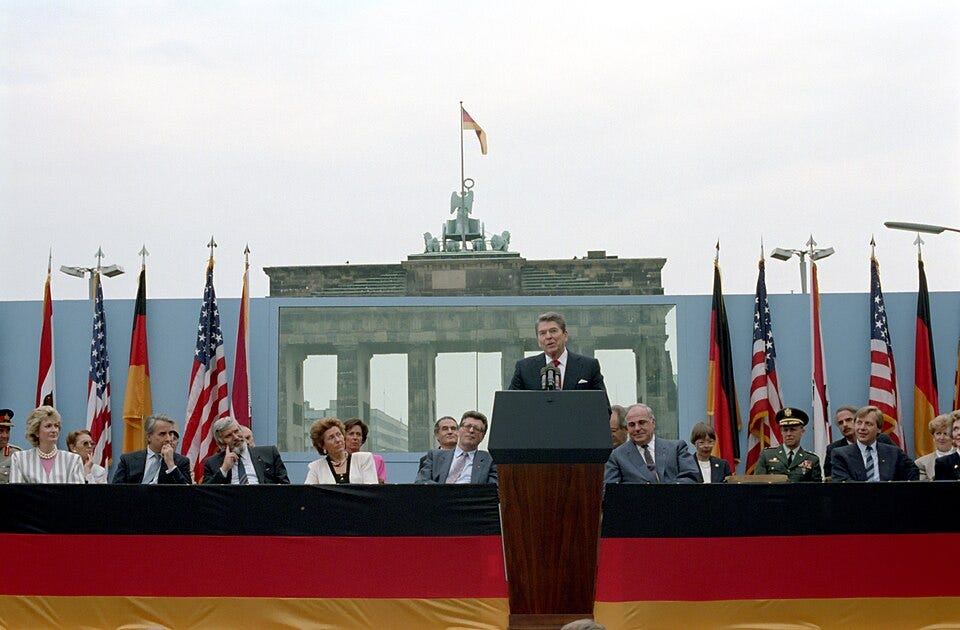
“Mr Gorbachev, open this gate! Mr Gorbachev, tear down this Wall!” – those words are among the most iconic in Cold War history. They were uttered by the then US President Ronald Reagan as he stood at the Brandenburg Gate in West Berlin on 12 June 1987 — almost to the day 39 years ago. Reagan had made his mark on history and on Berlin.

Much less known is the fact that this hadn’t been Reagan’s first visit to the divided city. His first trip as US President took place exactly 44 years ago today, on 11 June 1982, and four years earlier still, he had come as a private citizen. After his bid for the presidency in 1976 was defeated by Gerald Ford, he prepared intensively for the 1980 election – which took him to Berlin for the first time in 1978.
Now, for the first time, a publication by German historian Jens Schöne takes English-speaking readers along on Reagan’s Berlin travels, right up to his final visit in September 1990. It delivers fascinating insights into how Reagan’s movements were monitored by the Stasi, how he felt when he briefly visited East Berlin and how his view of communism was impacted by his trips.
And the best thing? This concise and engaging book available in full and entirely free online for anyone to read.
Naturally, I got very excited about this when I saw it on Jens Schöne’s social media feed (do follow him for more fascinating history on X if you can). So I have asked him to provide a teaser, exclusively for us here on ZEITGEIST.
The following excerpt from Ronald Reagan in Berlin. The President and the Divided City describes how it all began….
Excerpt from:
Ronald Reagan in Berlin.
The President and the Divided City.
By Jens Schöne
[…]
Reagan and his advisors had recognized that he had a major shortcoming as a candidate, and that this would need to be addressed before pursuing another presidential nomination: his lack of foreign policy experience. On the domestic front, Reagan’s governorship had earned him sufficient credentials, but in terms of foreign policy he was virtually unknown. Although he had not yet announced whether he would run again, he needed to be prepared. For this reason, two visits (each lasting several days) were planned for 1978: one to East Asia (Japan, Taiwan, and Hong Kong) during the spring, and one to Europe at the end of the year. The primary aim of the trips was not to gather detailed knowledge about the countries and places visited, but rather to send a signal to potential voters. Carter had demonstrated his aptitude for foreign policy in Berlin to great public effect, and now Reagan was to follow suit.
“It struck me that he knew practically nothing of Europe but that he possessed a skill that is rare among politicians – the ability to listen.”
After Great Britain and France, the Federal Republic of Germany was the final stop on Reagan’s European tour. On November 30, he spoke with Chancellor Helmut Schmidt. He then met with the Leader of the Opposition, Helmut Kohl, who later made a pointed remark about the meeting: “our discussions lasted longer than originally planned. It struck me that he knew practically nothing of Europe but that he possessed a skill that is rare among politicians – the ability to listen. He was very interested in the question of German division.” Further talks followed, including one with West Berlin’s Governing Mayor, Dietrich Stobbe, who was in the capital of Bonn as acting President of the Bundesrat. The same evening, Reagan, his wife Nancy, and their companions flew to Berlin’s Tempelhof airport, settled in to Hotel Kempinski on Kurfürstendamm, and prepared for the eventful day ahead.
Reagan’s trip did not go unnoticed in East Berlin. More than a week before it began, it was the subject of top-secret documents within the Ministry for State Security. There, alongside his visit to Bonn (and subsequent flight to Munich), Reagan’s other travel plans were also noted: “[f]urthermore, this US citizen will be visiting WB on 12.01.78 [December 1, 1978].” The secret service regarded itself as prepared and intended to leave nothing to chance – which makes what happened next even more surprising.
Reagan’s trip did not go unnoticed in East Berlin.
December 1, 1978, a Friday, started out rainy. Dietrich Stobbe, who had in the meantime returned from Bonn to the divided city, invited Ronald and Nancy Reagan as well as several of their companions (including Reagan’s close advisors, Richard Allen and Peter Hannaford) on a private bus tour of the city. Around 10:30 in the morning, the group reached Checkpoint Charlie, the inner-city border crossing, just as John F. Kennedy had done 15 years previously. Wary eyes observed their movements from the eastern section of the city: “[a]t the same time, approx. 10 civilians arrived in another bus […]. One female and one male individual were filmed by the aforementioned camera team beneath the sector sign and right in front of the checkpoint building.” While the identities of the individuals are not explicitly stated here, the security services knew perfectly well who they were dealing with.
Another stop was made at the western side of the Brandenburg Gate. Kennedy had come here too, and hardly a decade after his first visit, Reagan would give his most famous speech on precisely the same spot. As his companions recalled, Reagan was deeply affected by the sight of the Wall, and expressed his hope that there must be a way to bring it down. Around midday, the group arrived at the US headquarters in Dahlem and dined with military personnel. In his brief address, Reagan made his position clear once more: “I hope you will never think of it [the Wall] as something permanent.”
As his companions recalled, Reagan was deeply affected by the sight of the Wall
The spectacular itinerary of the afternoon can only be reconstructed with the help of surviving eyewitness accounts, namely those of Allen and Hannaford. While the MfS kept its eye on Reagan, it certainly had not reckoned with one possibility: that he might enter East Berlin. It is likely that Reagan expressed this desire spontaneously at the US headquarters, before putting his money where his mouth was. Accompanied by his two advisors and their wives, he set off for the eastern part of the city in two cars with uniformed drivers, but the security agencies there paid them no further notice. The archival documents that have so far been found only record the border crossing. At 14:22 Reagan passed through Checkpoint Charlie, and by 15:18 he had returned to West Berlin, “without incident”.
If one believes Reagan’s companions, the trip had a lasting impact on him. The surviving reports may be contradictory and in some places unconvincing, but the basic details are clear: the entourage made its way through a bleak cityscape full of undeveloped plots of land and ruins from the Second World War to Alexanderplatz. Here, the group visited the department store, where the Americans were struck by the sparse range of goods on offer. While the women remained in the store, the men made their way into the Platz and observed a man being checked and harassed by heavily armed police, apparently without reason. According to the two advisors, this scene etched itself deep onto Reagan’s memory and strengthened his anti-communist engagement. He later referred to it several times.
After returning to West Berlin, Reagan had one last appointment that day, at the Axel Springer publishing house. Here, too, there was a vivid reminder of the division of the city and its sometimes barbaric consequences: the company’s headquarters, which stood almost directly on the Wall, overlooked the spot where 18-year-old Peter Fechter had been shot by East German border guards in August 1962. Peter had been attempting to cross the death strip between the two halves of the city when he was wounded by several shots. He subsequently bled to death, slowly and publicly, while making desperate pleas for help. The incident was described to Reagan late in the afternoon of December 1, 1978, and left a deep impression. […] Reagan could be satisfied; his visit to Berlin had been a profitable one. When he returned many years later, he did so under very different circumstances, with far-reaching consequences.
Jens Schöne, Ronald Reagan in Berlin. The President and the Divided City, Berlin 2026. A joint publication by the Ernst Reuter Archives Foundation and the Berlin Commissioner for the Reappraisal of the SED Dictatorship.
Free download:
https://bebra-wissenschaft.de/vzgesamt/titel/ronald-reagan-in-berlin-2.html


Thanks Katja 👍that was an eye opener 👏👏
"... the men made their way into the Platz and observed a man being checked and harassed by
heavily armed police, apparently without reason."
Wouldn't be an unusual sight for an American at home these days.