What could a German Portrait Gallery look like?
Heads and Headaches of a Nation
Good news! I think… Germany wants to create its own National Portrait Gallery. The government’s Culture Commissioner, Wolfram Weimer, said the idea came to him on a visit to the famous gallery in London. Now he’s initiated a new exhibition in Berlin that’s to open in 2028. “This will, through significant personalities, showcase how diverse German history is. In the long run, a National Portrait Gallery could emerge from this after the British model.”
Since the word “diverse” is now often used in a specific political context, I should add that Weimer is a rather controversial figure in Germany. Not for being “woke” but the opposite, for being very conservative, and some people have accused him of trying to bend the German culture sector in that direction. He says he envisions the German Portrait Gallery as a way of “narrating the broad lines of German traditions more strongly again” but without ending up with a “narrow, ethnic view of history”.
All will hinge on which faces and figures the Berlin gallery will feature. I doubt that a one-to-one adaptation of the British National Portrait Gallery is feasible. After all, that began life in 1856 in Victorian Britain as a means of celebrating a confident nation at the head of the Industrial Revolution and running a vast global empire. Berlin 2026 is a very different proposition. With dictatorships, World Wars, the Holocaust and German postwar division in the rearview mirror, Germany has developed a very distinct memory culture that has to be taken into account.
London’s National Portrait Gallery – despite an expansive revamp that has seen a degree of activism creep into its halls – essentially remains “the same old cocktail party” and “a peculiarly British institution that reflects our national cult of celebrity,” as The Guardian groaned after the reopening in 2023.
Berlin’s National Portrait Gallery can’t and won’t be that. The organisers have used the very first press statement to deliberate more about “questions of analysis, contextualisation and presentation” than the British original ever did. “How do we deal with heroicising portraits of men and women in power?” the German Historical Museum, which will house the exhibition, asks itself. “How do we find a balance so that we definitely won’t tell top-down history only? How do we deal with the Nazi era?”
The Australian-British historian Christopher Clark will curate the thing, which I find reassuring. As a Germany expert with excellent command of the language and a deep understanding of the cultural sensitivities in situ, he is well positioned to navigate the choppy waters of German memory politics. I can’t wait to see the outcome. Because that’s still a couple of years away, I thought I’d offer you some thoughts on the complexities involved in putting the gallery together.
By the sounds of it, the Germans want to be a bit more arty than the Brits. In London, the aspiration is “to look at the celebrity of the person represented rather than the merit of the artist” while Berlin explicitly wants “mainly artworks that have high merit in themselves.” I personally wish they’d stick with the British idea. Of course, art purists have always complained about the supposed low quality of some of the portraits on display in London, but artistic merit isn’t why so many tourists and locals are drawn to the National Portrait Gallery year on year. They come for the personalities depicted, not for the artists.
But there are also many specifically German considerations. The gallery may wish to honour Jewish contributions to German culture, science or public life, for instance. But Germany once stripped Jews of their citizenship, drove many into exile or murdered them. Would putting their portraits in a German National Gallery be seen as an attempt to reclaim their achievements for the nation? If so, what exactly does that mean?
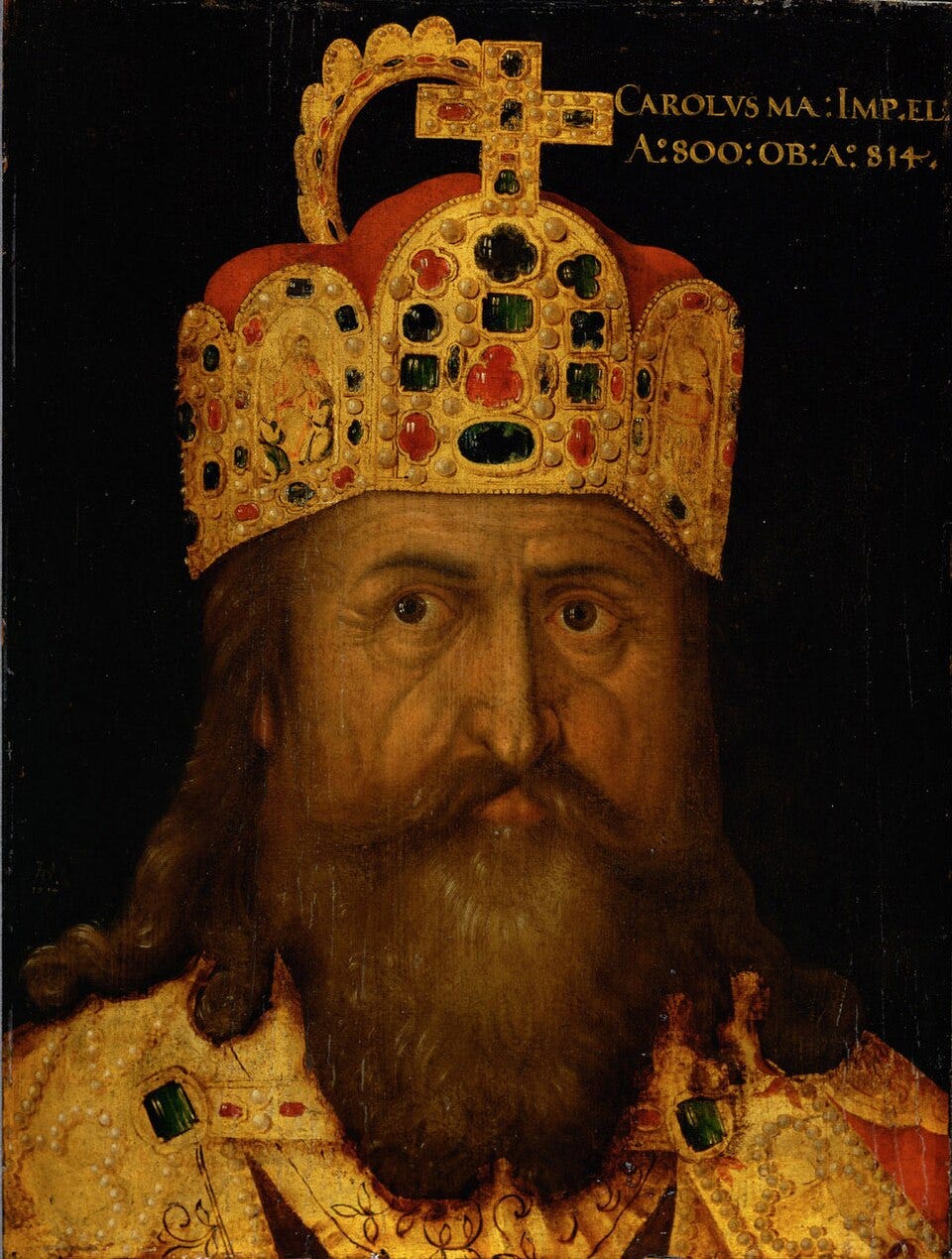
There is also the issue that “German” is very difficult to define for periods before the nation-state was founded in 1871. The press announcement of the exhibition, for instance, uses a likeness of Charlemagne, King of the Franks. Well, I grew up thinking of him as German, but the French think he’s theirs, and many others are undecided. Putting his portrait up would be a good way to discuss notions of German nationhood in the first place, but the gallery would have to do so without weighing visitors down with tons of “contextualisation”. After all, the whole point is for viewers to study faces rather than read text. Will the curators trust audiences to make up their own minds, as the London gallery still largely does?
Crafting a German National Portrait Gallery is a daunting task indeed, but also a rather exciting one, I think. I’ve deliberately refrained from making specific suggestions here as to who or what I’d put on its walls. I’d be very interested to hear your thoughts. After all, we’re a unique community of people interested in German history here at ZEITGEIST (now getting on for 10,000 subscribers in total). So having told you a bit about the project, I throw the question back at you:
What could a German Portrait Gallery look like?


The very first portrait acquired by the NPG was the ‘Chandos Portrait’……supposedly, and in my view highly likely to be of William Shakespeare.
Given Germans’ feelings about ‘Unser Shakespeare’, perhaps a GPG’s first acquisition should also be of the Bard.
It is a good idea. And Christopher Clark is a good choice to head it up, agreed (although it is a bit odd a German hasnt been chosen, surely). But it could lose its way if it succumbs too enthusiastically to the liberalism of our epoch. Pantheons and portrait galleries are not at their heart liberal institutions.